2025: Clubroot Survey: Monitoring the Clubroot Spread in the Major Canola Growing Counties
(Research Report, Langdon REC, December 2025)Objective: Survey and quantification of resting spores of Plasmodiophora brassicae from soil samples collected in North Dakota fields.
Survey Procedure:
The objective of the survey involved three components: 1. visual survey, 2. soil sampling, and 3. molecular quantification of resting spores of the clubroot pathogen.
Components 1&2. Visual Survey and Soil Sampling: A comprehensive clubroot disease survey was carried out in eighteen counties of North Dakota, leaving no stone unturned in our quest to determine the prevalence of Plasmodiophora brassicae. The survey involved a visual inspection of canola crop roots, with one field in every 5,000 acres targeted for scouting in each county. Soil samples were meticulously collected from the visited fields to determine the pH of the soil and the number of resting spores per gram of soil. A minimum of three to ten fields per county were the focus of our scouting efforts.
The survey was done in two phases.
1st Phase: At flowering (10% of flowering onwards)
Plants were sampled from distinct stunted patches or prematurely senescing plants in the field during the growing season. Patches visible from the edge of the field were checked by digging and observing the roots for clubroot symptoms, and then soil samples were collected from those specific areas.
2nd Phase: After swathing
Scouting at swathing was based on the methodology followed in Canada by the Alberta Agricultural and Rural Development (AARD) for their annual clubroot disease survey. Reports from AARD indicated that the probability of finding clubroot was higher if scouted at the field entrances. Hence, the survey was initiated starting from the main entrances/approaches in each field. The survey group walked in a “W” pattern, stopping at five spots and uprooting ten consecutive stems from the ground at each spot. Each sampling point was separated by 100 meters (328 feet). Roots of fifty stems were evaluated for the presence of clubroot and incidence. After removing excess soil, roots were visually examined for the presence of galls. At sample sites where infection was observed or suspected, root specimens with galls, along with soil, were double-bagged and labeled with the field location. Infected roots and soil samples from all the fields surveyed were collected, and a representative sample was submitted to Dr. Zhaohui Liu’s laboratory for molecular quantification of resting spores per gram of soil. An additional half-pound of soil was sent to the AgVise© Soil Testing Laboratory for pH determination.
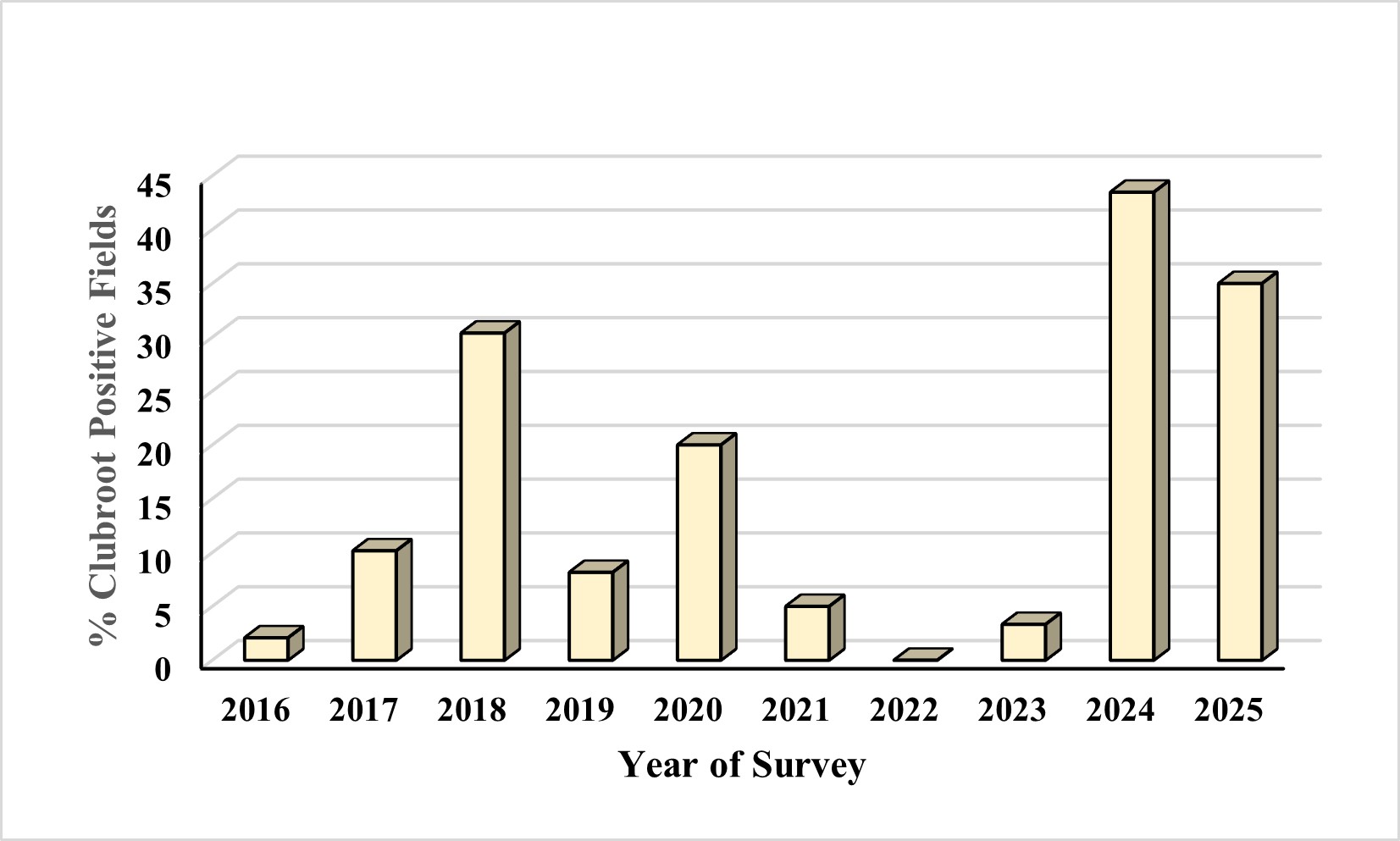
Results: The results of the clubroot survey in North Dakota indicate that 7 of the 94 fields surveyed had canola roots with galls infected by the clubroot pathogen. All the clubroot positives were found in Cavalier County, with a sudden increase in clubroot observed in 2024, rising to 48% of clubroot-infected canola fields, and this trend continued in 2025 with a 35% incidence (Figure 1). These clubroot-positive findings represent the highest incidence since the 2018 endemic. The rise in clubroot could be attributed to the breakdown of clubroot resistance in first-generation clubroot-resistant cultivars released by different companies. A drastic change in crop production practices by growers, such as crop rotation every 4 years, is urgently needed. This situation calls for a collaborative effort between researchers, farmers, and policymakers. Additionally, growing multiple cultivars by a grower can spread the risk and provide some insurance to the crop.
Figure 1: Fields with clubroot infections found in the last ten years of the survey in Cavalier County.