

Banner
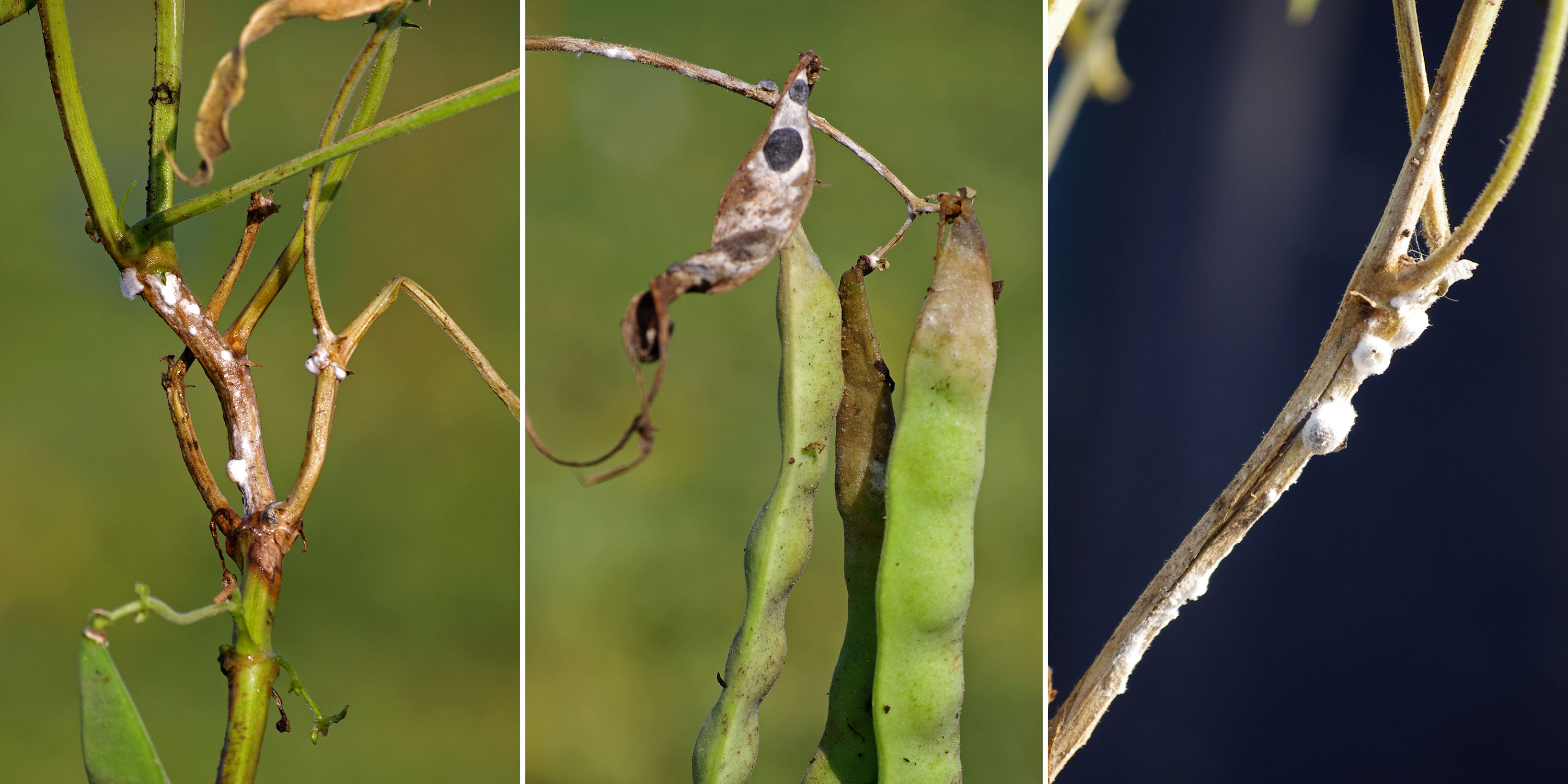
Photo Credit:
Michael Wunsch
Title
Key management considerations for soybeans in fields where white mold is a concern
Authored on
Body
The cool, wet weather experienced during the 2025 season resulted in elevated white mold pressure in soybeans and rotation crops, particularly dry beans and sunflowers. The elevated white mold pressure observed in 2025 will result in higher Sclerotinia disease pressure in the affected fields the next time that soybeans and other susceptible crops are grown.
Research conducted over the past 15 years by the Carrington Research Extension Center, with testing conducted in Carrington and Oakes, has resulted in the development of rigorous recommendations for maximizing the profitability of soybean production under white mold pressure.
- Seeding soybeans to wide (28 to 30-inch) rows reduces white mold severity but does not maximize yields unless white mold pressure is extreme. In testing conducted across many years and locations and on over 50 soybean varieties differing in architecture, including bushy and highly branched types, soybean yields were only maximized in 28 or 30-inch rows (versus 14-, 15-, 21- or 22.5-inch rows) if the incidence of white mold-infected plants exceeded 50% at the end of the season. Unless at least half of the plants had white mold at the end of the season, yields were maximized with narrow or intermediate row spacing. Seeding soybeans to wide rows only resulted in an increased soybean market grade (versus 14- to 22.5-inch rows and because of reduced contamination of the grain with the black resting structures of the Sclerotinia fungus) if the incidence of white mold-infected plants exceeded 35% at the end of the season.
- Intermediate row spacing maximized soybean yields under white mold pressure. In our research studies, this corresponded to 21- or 22.5-inch row spacing.
- Reducing soybean seeding rate to 100,000 viable seeds/ac (versus 140,000 or higher viable seeds/ac) reduces white mold pressure but only maximizes yields if at least 15% of the canopy is diseased at the end of the season.
- Susceptibility to white mold increases with soybean maturity. Within each soybean maturity length, soybean varieties differ in susceptibility to white mold, but – on average – susceptibility of varieties increases with maturity length. The likelihood of observing an economic return to a fungicide application targeting white mold increases with maturity length.
- When conditions favor white mold as soybeans enter bloom, the efficacy of a single fungicide application targeting white mold in soybeans is maximized by applying when 90-100% of plants have reached the R2 growth stage or as soon as the canopy closes, whichever occurs first.
- When conditions favor white mold as soybeans enter bloom, the efficacy of a two-application fungicide program is maximized when the first application is made when 15-65% of plants have reached the R2 growth stage or as soon as the canopy closes, whichever occurs first. In maturity group 0 soybeans, the second fungicide application should be made 7 days after the first. In maturity group 1 soybeans, which have a longer bloom period (and thus a longer period of susceptibility to white mold), the second application should be made 14 days after the first or three fungicide applications should be made 7 days apart.
- The efficacy of fungicides against white mold is sharply improved by calibrating fungicide droplet size relative to canopy closure. In testing conducted with TeeJet nozzles seeded to narrow and intermediate row spacing, fine droplets maximized white mold management if canopy closure averaged <75%; medium droplets, if canopy closure averaged 75-90%; coarse droplets, if canopy closure averaged 90-100%. Preliminary results suggest that the same droplet size optimums apply to Hypro/John Deere nozzles. In testing with Wilger nozzles conducted in soybeans seeded to narrow and intermediate row spacing, coarse droplets maximized white mold management if canopy closure averaged <90%; very coarse droplets, if canopy closure averaged 90-100%. Canopy closure can be visually estimated or evaluated with the Canopeo cell phone app (https://canopeoapp.com/#/login). Droplet size testing is in progress for soybeans seeded to wide rows; preliminary results will be posted to the NDSU Carrington REC website later this winter.
- Comparative fungicide efficacy results for white mold in soybeans are available by searching for ‘NDSU Carrington plant pathology’ or clicking on https://www.ndsu.edu/agriculture/ag-hub/research-extension-centers-recs/carrington-rec/research/plant-pathology . Scroll down to the soybean white mold section. The comparative efficacy summaries will be updated later this winter to include results from the 2025 season.
Michael Wunsch, Ph. D.
Michael.Wunsch@ndsu.edu
Research Plant Pathologist
