

Cover crop biofumigation in soybeans: first field results from North Dakota
Soil-borne pathogens are a consistent constraint to soybean production across North Dakota and the northern Great Plains, but management options remain limited. Chemical fumigation is not viable at the field scale and long-term varietal resistance and crop rotation require extended timelines to be effective. Biofumigation using Brassica cover crops has emerged as a biologically-based alternative, relying on the hydrolysis of glucosinolates into isothiocyanates during residue incorporation to suppress soil-borne pathogens (Sennett et al., 2021; Walker et al., 2022).
In North Dakota, winter camelina has already demonstrated the capacity to reduce soybean cyst nematode populations under field conditions (Acharya et al., 2019), supporting the potential for brassica-based biofumigation systems in the region. Beyond disease-related mechanisms, winter-hardy cover crops address additional agronomic challenges common to the Northern Great Plains, including wind erosion, low residue environments, and early-season nitrogen losses. Brassica cover crops actively grow in late fall and early spring, protecting the soil surface, reducing nitrate leaching, increasing soil biological activity, and improving overall system resilience (Blanco-Canqui et al., 2015; Cabello-Leiva et al., 2023).
This is a summary of first-year agronomic results from the Carrington REC, focusing on cover crop establishment, biomass production, nitrogen capture, and soybean yield and stand response. Disease incidence was not measured during this phase, and results are presented as an agronomic evaluation of this emerging biofumigation system.
Wheat was planted in spring 2024 and harvested in August. Winter cover crops were seeded in September 2024 following wheat harvest using a randomized complete block design with four replications. Each treatment was replicated three times within each block. Treatments included (1) Winter Camelina, (2) Pennycress, (3) Cover Crop mix (winter camelina + pennycress), (4) Cover crop mix (winter camelina + pennycress + radish), and (5) No cover crop/control.
Cover crops overwintered and were growing in early spring 2025. In mid-May, cover crops were mowed and incorporated at full flowering to initiate biofumigation. Soybeans were planted shortly after incorporation. Figure 1 illustrates the complete agronomic process of wheat, cover crop biofumigation, and soybean crop, organized by steps and year.
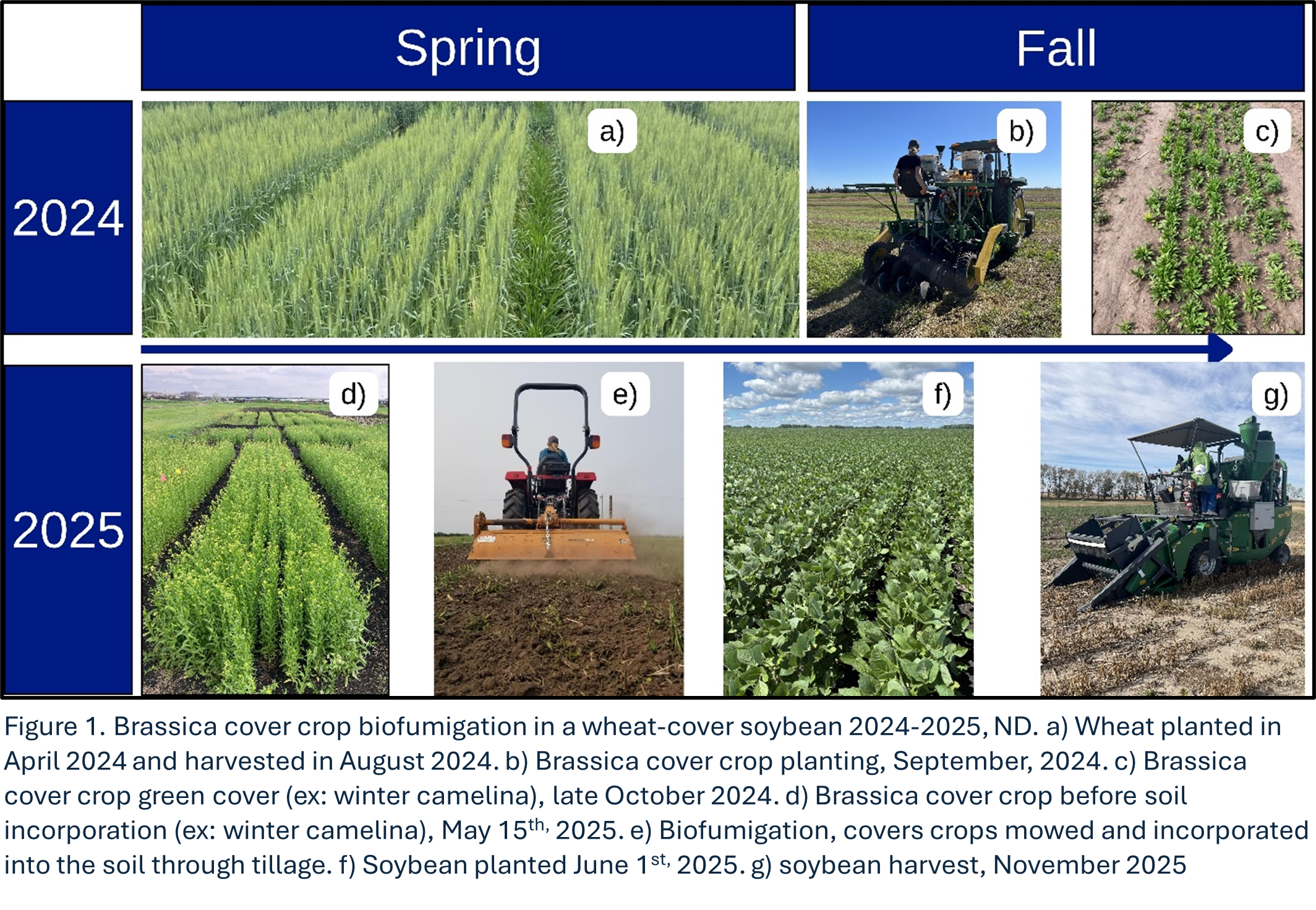
Cover crop biomass and nitrogen content were measured before cover crop termination in May 2025. Soybean yield and plant population were estimated at soybean harvest, November 2025.
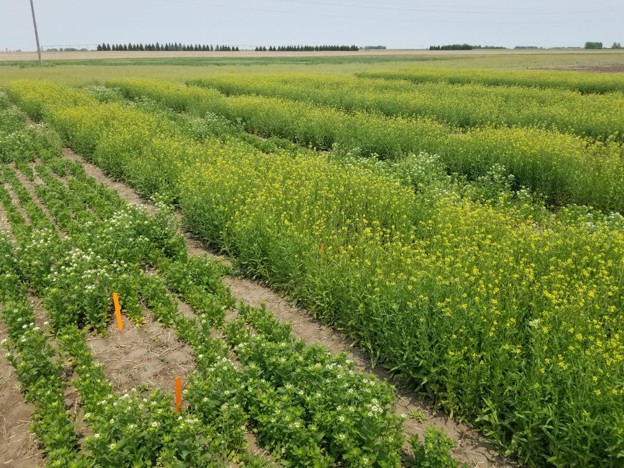
Winter brassica cover crops established successfully and produced substantial spring biomass at Carrington, providing excellent spring green coverage. Average biomass exceeded 2,000 pounds of dry matter per acre, supported by favorable moisture conditions. Camelina produced the highest biomass value, approaching 2,600 pounds per acre. Cover crops were incorporated at full flowering, an optimal stage for biofumigation activity.
Brassica cover crops also captured meaningful amounts of nitrogen in aboveground biomass. Treatments containing camelina accumulated approximately 80 to 100 pounds of nitrogen per acre, representing nitrogen retained in the system during a period when leaching risk is typically high. This nitrogen was returned to the soil following incorporation.
Soybean yield averaged approximately 44 bushels per acre across treatments. Yield was slightly but significantly reduced by cover crop treatments compared to the control, with differences of approximately three bushels per acre. These yields were consistent with regional averages for soybeans planted in early June at Carrington. Soybean plant population was not affected by any treatment, indicating that cover crop residue and incorporation did not interfere with soybean emergence or early establishment.
Results from this first year indicate that winter brassica cover crops can be successfully integrated into a wheat–soybean rotation in central North Dakota. This experiment was conducted on soils with no known history of soil-borne pathogens, under a well-managed crop rotation and generally low stress conditions. Under these circumstances, soybean yields were similar among treatments, indicating that the biofumigation system did not dramatically affect crop performance when disease pressure was low.
Winter camelina and pennycress demonstrated excellent winter survival and strong spring growth, even following a cold winter. These cover crops provided early-season soil cover, reducing erosion risk during a vulnerable period, and reached flowering in late April and early May. Early flowering supported pollinator activity, adding ecological value to the system, while active spring growth protected the soil surface.
A key agronomic benefit observed was nitrogen retention. Winter cover crops scavenged soil nitrate during late fall and early spring, a period when nitrogen is highly prone to leaching. Approximately 80 to 100 pounds of nitrogen per acre were captured in aboveground biomass and returned to the soil following cover crop incorporation, improving nutrient cycling within the system.
Although soybean yield was not increased under low disease pressure, the absence of major yield penalties highlights an important opportunity. In fields with higher soil-borne disease pressure, biofumigation may provide a clear advantage by reducing early-season stress while maintaining yield potential. These results support continued refinement of winter brassica biofumigation systems as a proactive management tool that combines disease-suppression potential with soil protection, reduced nitrogen leaching, and increased system diversity for North Dakota soybean producers.
Sergio Cabello-Leiva was the Soil Scientist at the Carrington REC prior to his current role with the Minnesota Soybean Research and Promotion Council.
Sergio Cabello-Leiva
scabelloleiva@agmgmtsolutions.com
Director of Research, Minnesota Soybean Research and Promotion Council
Szilvia Yuja
Szilvia.zilahisebess@ndsu.edu
Soils Research Specialist (Carrington REC)
