

Effect of Rainfall During the Harvest Interval on Barley Preharvest Sprouting
(Research Report, Carrington REC, December 2025)This research report evaluates pre-harvest rainfall impacts on barley seed including test weight, protein, sprout damage, and germination.
Barley nearing maturity is highly vulnerable to quality degradation during late-season rainfall. As grain transitions from the soft dough stage through physiological maturity and into dry-down, its natural dormancy mechanisms are gradually lost. When rainfall, high humidity, or prolonged wetting occur during this window, kernels may absorb moisture and initiate germination on the head (preharvest sprouting; PHS). PHS is a major concern for both feed and malting markets, but the economic risks are greatest for malting barley, where enzymatic activity, starch integrity, and uniform germination are essential for malt production.
PHS is driven by a simple biological trigger. Once mature kernels imbibe enough moisture, the hormonal balance between abscisic acid (ABA) and gibberellic acid (GA) shifts, signaling germination. Rainfall late in the season accelerates this process, especially when temperatures are warm and drying conditions are poor. Barley with poor dormancy, either genetically or due to environmental conditions during grain fill, is particularly susceptible. Repeated rainfall events, heavy dews, and extended periods of humidity above 85% are sufficient to damage quality even if kernels do not visibly sprout.
Producers often observe sprout damage after storms that occur when grain moisture has already fallen below 18%. At this point the crop is close to harvest and any re-wetting event can lead to rapid enzyme activation. Once activated, enzymes such as alpha-amylase begin breaking down starch, directly reducing test weight, altering grain hardness, and weakening end-use performance. Even moderate sprout damage can result in rejected malting contracts, downgraded feed grades, and/or substantial price discounts. For producers, understanding environmental drivers of PHS and the effect of moisture amounts and timing is key in the harvest decision.
This research report evaluates pre-harvest rainfall impacts on barley seed including test weight, protein, sprout damage, and germination.
Methods
The trials were split plot arrangement with irrigation timing being the main plot effect and the split-plot factor was a foliar mineral application. The goal was to apply water at three different times during grain dry-down, marginal (18-20% moisture), wet (15-17% moisture) and dry (12-14% moisture). The study was conducted in both 2024 and 2025. In 2024, the dry-down period was wet and the irrigation treatments were modified. Treatment one was no additional water, treatment two was one irrigation event at wet harvestability and treatment three was two irrigation events at both marginal and wet harvestability (Figure 1). In 2025, the dry-down period had little rainfall, and irrigation happened one time at marginal, wet or dry harvestability (Figure 2).
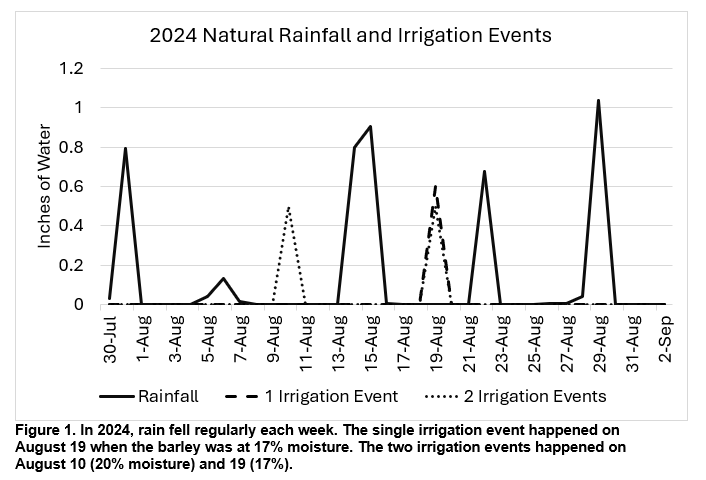
Figure 1. In 2024, rain fell regularly each week. The single irrigation event happened on August 19 when the barley was at 17% moisture. The two irrigation events happened on August 10 (20% moisture) and 19 (17%).
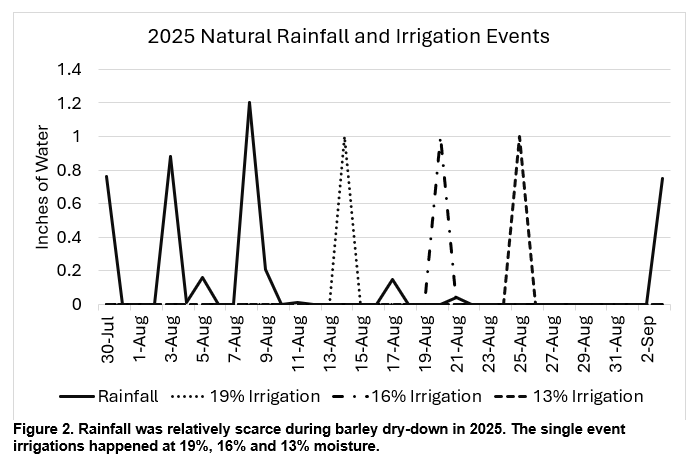
Figure 2. Rainfall was relatively scarce during barley dry-down in 2025. The single event irrigations happened at 19%, 16% and 13% moisture.
Data collected during the season included planting date, harvest date, rainfall, and irrigation events. Seed data included test weight, protein (NIR), immediate germination (dried one day after harvest), delayed germination (dried and stored 30-60 days after harvest) and sprout damage (partial processing by Anheuser-Busch). The foliar product (Stoller Sugar Power) was applied at 32 oz/acre at soft dough stage. Data analysis was completed using the ANOVA function in Genovix.
Results
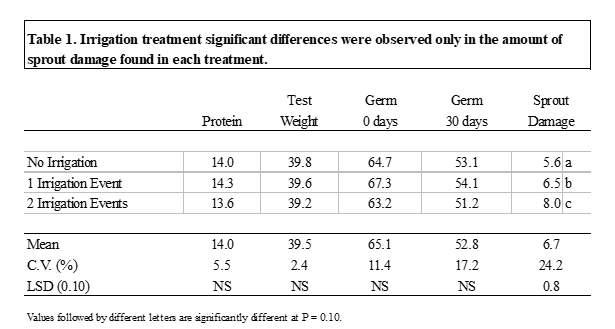
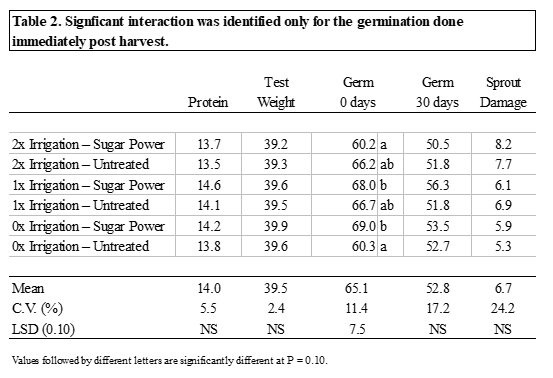
The trial was planted on May 10, 2024. Several major storms occurred during the 2024 growing season and left the trial severely lodged. Since yield was not a major component of the trial, it was harvested on September 3, 2024. The moisture average during harvest was 13%. Across all traits, no significant differences were observed between Sugar Power and the untreated check. However, sprout damage differed significantly among irrigation treatments, although test weight, protein, and both germination measurements did not (Table 1). Significant differences were observed for the interaction between the foliar application and the irrigation events for only the germination done immediately after harvest, but this difference did not carry over into delayed germination or sprout damage (Table 2).
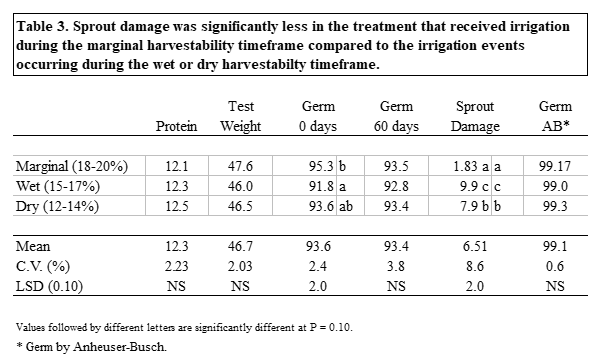
The trial was repeated in 2025 with planting and harvest dates within a day of 2024 dates. The harvest moisture was higher at 17% moisture due to the forecasted rainfall for the following day. As in 2024, Sugar Power did not significantly affect any seed quality trait. However, irrigation timing significantly influenced both sprout damage and harvest germination (Table 3). No interactions between irrigation timing and the foliar product were detected.
Discussion
Sprout damage values were tightly grouped in 2024, likely due to the consistently wet conditions during dry-down. When all treatments repeatedly experienced natural re-wetting, differences caused by controlled irrigation were minimized. In 2025, the drier conditions provided clearer treatment separation and highlighted how even a single rainfall or irrigation event after grain reaches ~19% moisture can sharply increase sprout susceptibility. It is also important to note that sprout damage was likely underreported, as values of 10% or greater were simply classified as “10+%.”
The effects of Sugar Power remain uncertain. In 2024, Sugar Power appeared to reduce sprout damage and increase germination in the one-irrigation and no-irrigation treatments, but the opposite pattern occurred in the two-irrigation treatment. Lodging, uneven maturity, and the prolonged wet period likely increased plot-to-plot variation and obscured treatment effects. In 2025, Sugar Power had no measurable impact on germination or sprout damage, and differences were associated with irrigation timing and not the foliar application.
Because Sugar Power is a foliar-applied mineral product, its performance is indirectly influenced by soil conditions. Variability arises from the soil’s inherent mineral supply and its ability to support uniform crop maturation. In fields where background nutrient availability is already sufficient to support a smooth dry-down process, additional foliar minerals may produce little visible effect. However, in soils with marginal micronutrient levels or imbalanced mineral profiles, the crop may be more responsive to supplemental foliar nutrition, particularly under weather conditions that disrupt normal dry-down. These are the environments where Sugar Power’s effects in reducing susceptibility to sprout damage may be more clearly observed. Ultimately, season-to-season weather variation (rainfall timing, humidity during maturation, and cooling periods) interacts with soil mineral status to determine how consistently such products perform.
This research was partially funded by the North Dakota Barley Council and Stoller.
