

Effect of Maturity Grouping on Row Spacing Recommendation in ND
(Research Report, Carrington REC, December 2025)The primary objective of this 2025 study was to determine whether soybean yield results from the 2024 demonstration represented an anomalous environmental interaction or if they signaled a need to revise current soybean row spacing guidelines for the semi-arid climate zones of Western North Dakota.
Soybean cultivation is expanding into Western North Dakota, but many of the management practices currently in use are based on research conducted under conditions typical of Central and Eastern North Dakota. One key finding from previous research is that narrower row spacing (less than 15 inches) generally leads to higher soybean yields compared to wider row spacing (greater than 15 inches). However, a 2024 on-farm demonstration near Wishek, ND, reported a counterintuitive finding where wide-spaced rows exhibited a 30% yield advantage over narrow-spaced rows. The primary objective of this subsequent 2025 study was to determine whether the yield results from the 2024 demonstration represented an anomalous environmental interaction or if they signaled a need to revise current soybean row spacing guidelines for the semi-arid climate zones of Western North Dakota.
Methods
The study was established near Wishek, ND, on May 28, 2025, employing a split-plot design with three replications. The treatment structure included three distinct row spacings: 15, 22, and 30 inches. Two soybean varieties, ND17009GT (maturity group 00.9) and ND2108GT73 (maturity group 0.8), were utilized to assess variety-specific responses. The earliest maturity variety, ND17009GT, was harvested on October 2, followed by ND2108GT73 on October 7. The study experienced a significant abiotic stress event with freezing temperatures occurring on September 6.
Results
The 2025 replicated study yielded results that contradicted the 2024 observation. Specifically, row spacings of 15 and 22 inches resulted in significantly higher yield compared to the 30-inch row spacing (Figure 1). Furthermore, statistical analysis indicated no significant yield differences between the two varieties tested. Seed count and height data revealed that the number of seeds did not significantly vary across row spacings or varieties, with an average of 96% of the seeds found above 10 cm from the ground across all treatments. The previous years where the 30-inch row spacing demonstrated superior yield could be related by a reduction in total rainfall during the critical August podding stage, suggesting a possible interaction between wide spacing and drought stress (Figure 2). Although close row spacing is known to promote rapid canopy closure for soil moisture conservation, the efficacy of different row spacings and maturity groups requires dedicated research on water use efficiency in semi-arid conditions. Plant height and test weight were found to be solely determined by variety and not influenced by row spacing, with variety 00.9 exhibiting significantly higher values for both parameters. This supports the general conclusion that pod height and plant height are primarily under genetic (varietal) control and are largely unaffected by the agronomic management practice of altering row spacing.
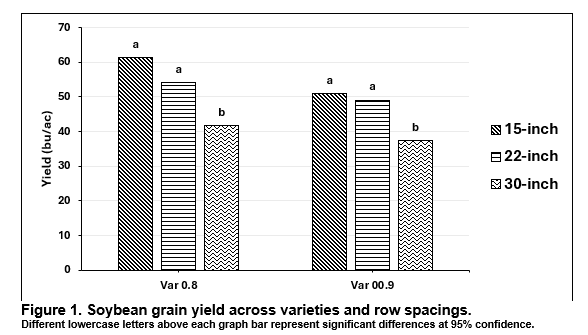
Figure 1. Soybean grain yield across varieties and row spacings.
Different lowercase letters above each graph bar represent significant differences at 95% confidence.
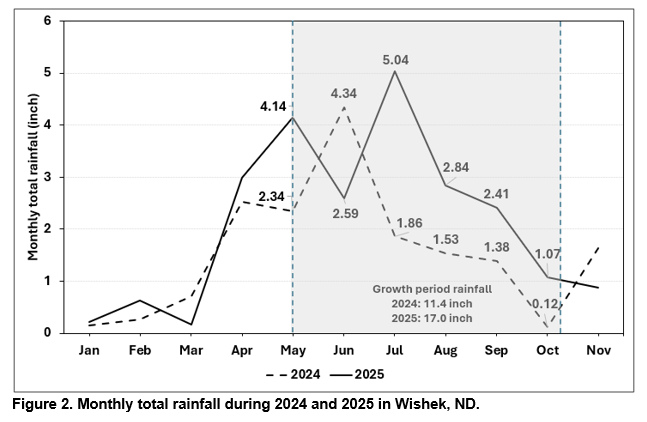
Figure 2. Monthly total rainfall during 2024 and 2025 in Wishek, ND.
The findings from the 2025 study suggest that the significant yield advantage observed with wider rows in the 2024 demonstration was an environmental anomaly likely linked to severe August drought conditions, and the results do not support a change in general row spacing guidelines for the region. Future research efforts should be strategically concentrated on evaluating the interaction between row spacing and variety selection specifically adapted for the drier climatic zones characteristic of Western North Dakota to provide optimal management recommendations for agricultural producers.
This research was partially funded by the North Dakota Soybean Council.
