

Planting Date and Hybrid Effects on Spring Canola at the Carrington REC (2023–2025)
(Research Report, Carrington REC, December 2025)This three-year summary selectively focuses on Carrington data from 2023, 2024, and 2025. Carrington provides a representative central-eastern ND environment where canola is frequently planted into well-managed rotation systems and typically experiences moderate rainfall and heat stress. The objective was to:
- Determine how planting date affects yield, development, and seed quality.
- Compare hybrid performance across shifting planting windows.
Assess year-to-year stability of the response curve and identify actionable recommendations for North Dakota growers.
Spring canola (Brassica napus L.) yield and quality in North Dakota are strongly influenced by planting date and hybrid. Because the region experiences variable early-season temperatures, intermittent spring moisture challenges, and occasional mid-summer heat episodes, determining the optimal planting window is essential for stabilizing yields from year to year.
This three-year summary selectively focuses on Carrington data from 2023, 2024, and 2025. Carrington provides a representative central-eastern ND environment where canola is frequently planted into well-managed rotation systems and typically experiences moderate rainfall and heat stress. The objective was to:
- Determine how planting date affects yield, development, and seed quality.
- Compare hybrid performance across shifting planting windows.
- Assess year-to-year stability of the response curve and identify actionable recommendations for North Dakota growers.
Methods
A six-date planting sequence was established beginning in late April or early May and continuing at 7–10-day intervals into early June each year. Hybrids included combinations of DK401TF, CP7250LL, L340PC, and other commercial lines depending on the year. Agronomic management followed local recommendations for fertility, weed control, and pest management. Each trial was designed as a split plot (Figure 1) and harvested at various dates after plots reached a suitable moisture after physiological maturity.
Data collected each year at Carrington included:
- Days to beginning bloom
- Flowering duration
- Days to maturity
- Seed yield (lb/ac)
- Seed oil (%)
- Test weight
- 1000-kernel weight
Environmental conditions differed over the years. 2023 featured cool July temperatures and good moisture. 2024 had relatively normal temperatures and moderate moisture but lower overall yields. 2025 provided favorable rain patterns and mild summer heat, supporting strong plant development and seed fill.
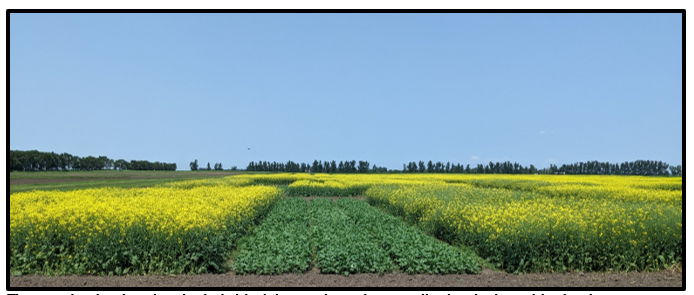
The canola planting date by hybrid trial was planted as a split plot design with planting date as the main plot and hybrid as the split plot.
Results
The 2023 season produced some of the strongest yields in the study (data not shown). Yields peaked at Date 4 (late May) at just over 4,000 lb/ac. Dates 3–5 all performed well, while the final planting (Date 6) dropped to near 2,000 lb/ac. The yield response curve followed a classic “bell shape,” with optimal yields centered around a mid-May planting date. Hybrid differences existed but were less important than planting date. The 2023 season demonstrated that Carrington’s environment can support exceptional yields when temperatures remain moderate during flowering and seed fill.
The 2024 season produced lower yields than in 2023 but maintained the same general planting-date pattern. The earliest planting date yielded around 2,020 lb/ac. Dates 2 - 4 produced similar yields with modest differences. Yields dropped sharply by Date 5 and Date 6. Hybrid × date interactions did not have a significant impact on yield at Carrington in 2024. Although 2024 yields were reduced compared to 2023, likely due to moderate moisture limitations and inconsistent early-season conditions, the relative response to planting date was extremely consistent: planting in early to mid-May still outperformed later planting.
The 2025 data are the most recent study results in the three-year series and closely aligns with the historical trends at Carrington (Table 1). Peak yield occurred around Date 2, typical for a mid-May planting (Figure 1). Yield declines after Date 2 were moderate but consistent. The later dates (5 and 6) still produced acceptable yields due to favorable mid-season conditions but never surpassed early dates. DK401TF performed strongly across all dates and appears well-adapted to Carrington’s environment. L340PC yielded competitively in several planting windows. CP7250LL provided high test weight but lagged in overall yield.
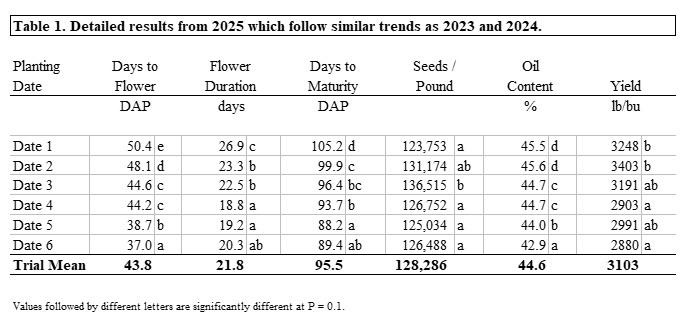
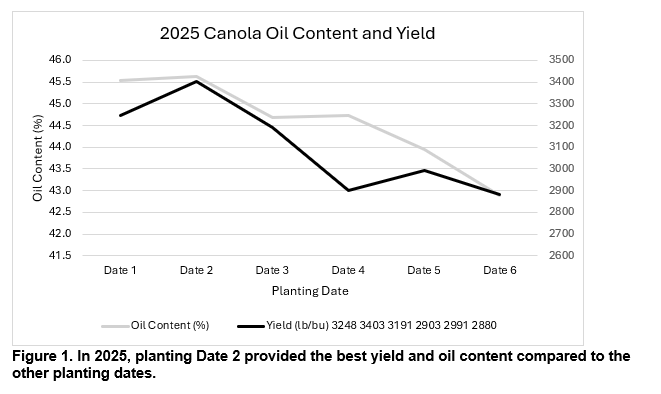
Figure 1. In 2025, planting Date 2 provided the best yield and oil content compared to the other planting dates.
Discussion
Across three years at Carrington, the planting date response curve remained remarkably stable despite varying environmental conditions. The data strongly support the following conclusions:
1. Early to mid-May is the optimal planting window. Dates 1–2 consistently produced the highest yields across all three years. In high-yield seasons like 2023, the peak shifted slightly later (Date 4), but Dates 2 through 4 all performed well. In moderate years like 2024 and 2025, the earliest plantings (Dates 1–2) reliably outperformed later ones. Thus, central ND growers should aim for planting between May 1 and May 15, depending on field conditions.
2. Yield penalties increased steadily with delayed planting. Date 4 and later saw gradual but consistent yield declines. Dates 5 and 6 were always lower yielding, regardless of weather. Even in favorable 2025 conditions, Dates 5 and 6 could not match earlier planting. Late planting consistently shortened vegetative development, reduced flowering duration, and limited seed fill, all mechanisms that explain the year-over-year yield decline.
3. Hybrid selection matters, but less than planting date. While hybrid ranking varied some years, planting date effects were universally stronger. Hybrid DK401TF showed excellent stability at Carrington in 2025. Hybrid L340PC performed well at intermediate planting dates. Hybrid CP7250LL showed strong test weight and acceptable oil content but lower yield. When growers select hybrids, they should determine which traits, in addition to yield, are important for crop value.
4. Weather patterns modify the ideal planting window where later planting dates shift reproductive phases to warmer and lower rainfall periods which stress cool-season canola. When growing seasons are cooler, such as in 2023, canola performs well even at later May planting dates. Moderate-yield years (2024, 2025) still favored early planting, with mid-May remaining the best balance for stand establishment, frost risk, and heat moisture stress avoidance. The consistent stability of the curve across three contrasting seasons strengthens confidence in recommending early-to-mid May as the optimum window.
This research was partially funded by the USDA National Institute of Food and Agriculture.
