

Optimizing Fungicide Application Timing, Fungicide Droplet Size and Soybean Seeding Rate for Improved White Mold Management in Soybeans in Oakes
(Research Report, Carrington REC, December 2025)Previous research from the CREC Plant Pathology team demonstrated that small adjustments to fungicide application timing, spray droplet size and seeding rate can improve white mold management in soybeans at little or no additional cost.
Sclerotinia stem rot (SSR), which is caused by Sclerotinia sclerotiorum (Lib.) de Bary, is a destructive disease of many crops worldwide (Boland and Hall 1994). Senescing soybean flower petals are considered the primary infection source, so fungicide application timing should be coordinated with growth stage to achieve appropriate SSR management in soybeans (Mueller et. 2004). Cooler temperatures within fuller canopies, which facilitate moist conditions, are favorable for disease development (Willbur et al. 2018, 2019).
Previous research from the CREC Plant Pathology team demonstrated that small adjustments to fungicide application timing, spray droplet size and seeding rate can improve white mold management in soybeans at little or no additional cost.
Four field experiments were conducted in Oakes in 2024 and 2025 under fields with a history of white mold and with supplemental overhead irrigation. The overhead irrigation was applied via a linear irrigation system as needed to optimize soybean yield potential. Objectives of the study are:
- Identify optimal fungicide application timing for one versus two fungicide applications and fungicide droplet size calibrated relative to canopy characteristics (% closure and growth stage (R1-R3)).
- Optimize fungicide droplet size for Sclerotinia stem rot management relative to canopy characteristics in soybeans seeded at different seeding rates in intermediate (21-inch) versus wide (28-inch) rows.
- Evaluate the performance of Hypro’s ‘3D’ drift-reducing flat-spray nozzles versus TeeJet extended range flat-spray nozzles applied for white mold management with fine, medium and coarse droplet sizes.
- Evaluate the impact of seeding rate on white mold management and soybean agronomic performance under white mold pressure.
The impact of fungicide application timing was evaluated on irrigated soybeans seeded to narrow (14-inch) and wide (28-inch) rows at 140,000 viable seeds/ac. Five application timings, each 2 to 4 days apart, were tested beginning at early bloom (target 50% of plant with an open blossom). Testing was conducted for a single fungicide application versus a two-application program, with the second application made 11-12 days after the first. Evaluations were made on the Xtend-type varieties Peterson Farms ‘22XF12’ (2024, planted May 28 and harvested Oct. 23-26) and Peterson Farms ‘22XF10’ (2025, planted June 3-4 and harvested October 9-10). Experimental design was a randomized complete block with a split-plot arrangement, with the number of fungicide applications (one versus two) as the main factor and fungicide application factor as the sub-factor. Every fungicide application timing treatment was applied to a pair of plots, one seeded to four 14-inch rows, and one seeded to two 28-inch rows. The fungicide Endura (5.5 oz/ac) was applied with a tractor-mounted sprayer equipped with Wilger Combo-Jet flat-fan nozzles. Each fungicide application timing was evaluated three times, once with each of the three droplet sizes previously shown to optimize white mold management with Wilger nozzles across the range of canopy characteristics typically observed during soybean bloom. Applications were made with Wilger 11003SR, 11003MR, and 11003DR at 40 psi (medium, coarse and very coarse droplets, respectively). In 2024, applications were made at 6.0 mph with 16 gal/ac spray volume. In 2025, applications were made at 6.5 mph (11003SR nozzles) and 6.4 mph (11003MR and 11003DR nozzles), with driving speed calibrated to maintain a constant 15.0 gal/ac spray volume.
The fungicide droplet size studies were established as a randomized complete block design with six droplet size treatments (fine, medium and coarse droplets with TeeJet XR flat-fan nozzles and with Hypro 3D angled flat-spray nozzles) compared to a non-treated control. Each fungicide droplet size treatment was applied to a block of six plots concurrently, three plots seeded to 21-inch rows (seeded at 100,000; 140,000; or 180,000 viable seeds/ac) and three plots seeded to 28-inch rows (seeded to 100,000; 140,000; or 180,000 viable seeds/ac). The Enlist-type variety Peterson Farms ‘23EN10’ was planted in 2024 (planted May 29, harvested Oct. 26-27); the Xtend-type variety Peterson Farms ‘PFS 22XF10’ was planted in 2025 (planted June 3-4; harvested October 10). The fungicide Endura (8.0 oz/ac) was applied at 6.0 mph in 15 gal/ac with a tractor-mounted sprayer equipped with a pulse-width modulation system. Pulse width was modified as needed to maintain constant driving speed and constant spray volume across nozzles differing in output.
Soybean growth stage, canopy height and canopy closure were assessed concurrent with each fungicide application, with canopy closure quantified with a visual estimate and with the cell-phone app ‘Canopeo’. White mold was assessed at R8 growth stage using a 0 to 5 scale representing the percentage of the plant impacted by Sclerotinia stem rot: 0 = 0%, 1 = 1-25%, 2 = 26-50%, 3 = 51-75%, 4 = 76-99%, 5 = 100%. Disease and yield data were evaluated with analysis of variance using SAS (version 9.4; SAS Institute, Cary, NC). To control the Type I error rate at the level of the experiment, the Tukey multiple comparison procedure was employed. Analyses were conducted with replicate and treatment as main factor effects.
Results
White mold disease pressure was sufficient to permit rigorous assessment of the impact of fungicide application timing and fungicide droplet size on disease management in 2024 but not in 2025. The percent of the canopy exhibiting white mold in the non-treated control at the end of the season averaged 2-4% in the fungicide timing studies and 3-9% in the fungicide droplet size studies in 2025, levels of disease pressure that are insufficient for rigorously differentiating small, incremental treatment effects in small-plot soybean white mold research.
In the fungicide timing study conducted in 2024, white mold management was optimized with a single fungicide application made when 90-96% of plants had reached the R2 growth stage or with the first of two sequential fungicide applications made 2-5 days earlier when 16-41% of plants were at the R2 growth stage (Table 1; analysis conducted on the average of all three fungicide droplet size treatments). Results were similar irrespective of soybean row spacing.
Table 1. Impact of application timing of the fungicide Endura (average response across medium, coarse and very coarse droplets) and droplet size calibrated relative to canopy closure for a single fungicide application versus two sequential applications in narrow rows. Impact of application timing of the fungicide Endura (average response across medium, coarse and very coarse droplets) for a single fungicide application versus two sequential applications in wide rows. Oakes, 2024.
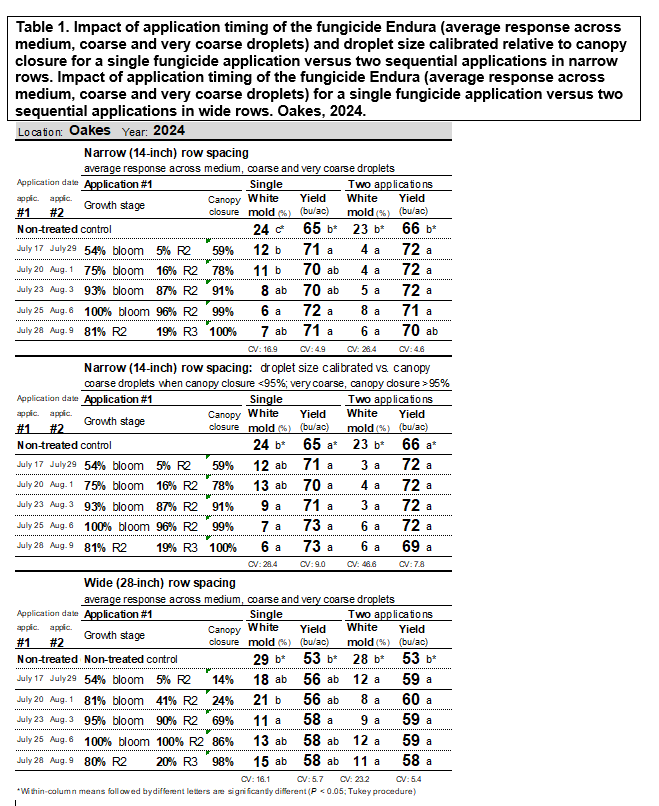
Calibrating fungicide droplet size relative to canopy closure improved white mold management and facilitated slightly later applications. In soybeans seeded to narrow (14-inch) and intermediate (21-inch) rows, previous research found that white mold management is optimized with Wilger nozzles emitting very coarse droplets when the canopy is at or near closure (> 95% closure) and with coarse droplets when the canopy is open. Calibrating fungicide droplet size on the basis of this research, white mold management was optimized with a single application made when 96-100% of plants were at the R2 growth stage and with the first of two applications made when 5-87% of plants were at the R2 growth stage (Table 1). A similar analysis optimizing fungicide droplet size was not possible for soybeans seeded to wide (28-inch) rows; previous droplet size research was not conducted on soybeans seeded to wide rows, and the limited droplet size testing conducted on soybeans seeded to wide rows in this project was insufficient to reach rigorous conclusions on optimizing droplet size relative to canopy characteristics.
In soybeans under white mold pressure seeded to intermediate (21-inch) rows, applying fungicides with medium droplets optimized the yield gain conferred by the fungicide when canopy closure averaged 82-88% and Hypro nozzles were utilized (Table 2). On average, medium droplets also maximized the yield gain conferred by the fungicide when TeeJet nozzles were utilized, but variability in droplet size response was higher for TeeJet nozzles and statistical separation was not observed.
Table 2. Impact of fungicide droplet size and nozzle manufacturer on white mold management in soybeans relative to seeding rate, canopy closure, and row spacing in Oakes, 2024.
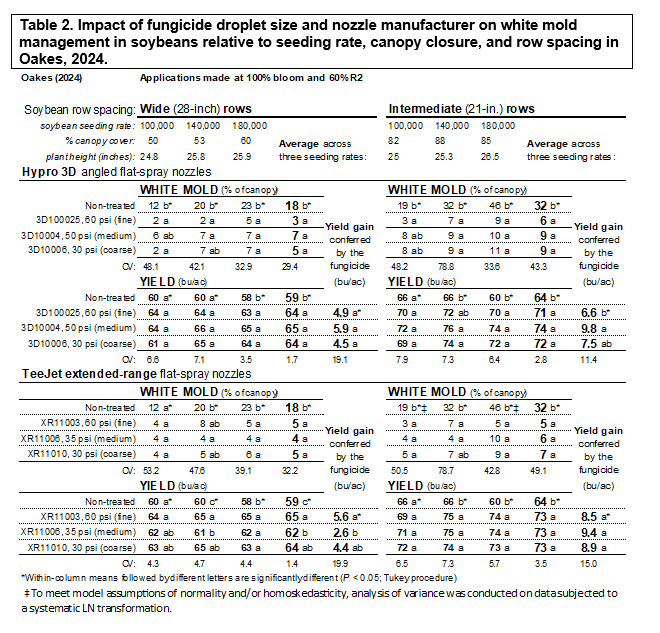
In soybeans under white mold pressure seeded to wide (28-inch) rows, applying fungicides with fine droplets optimized the yield gain conferred by the fungicide when canopy closure averaged 50-60% and TeeJet nozzles were utilized (Table 2). Medium droplets performed worst, and coarse droplets were intermediate. In fungicide applications made with Hypro nozzles to soybeans seeded to wide rows, the response to droplet size was different: statistical separation was not observed, but medium droplets consistently optimized the yield gain.
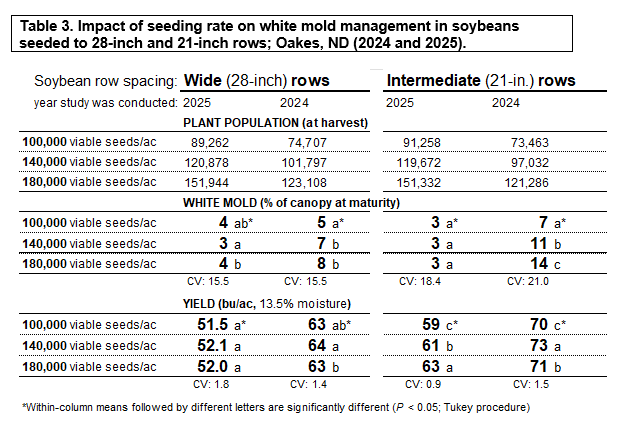
Seeding soybeans at 100,000 viable seeds/ac reduced white mold severity in 2024, when moderate white mold pressure was observed, but not in 2025, when white mold pressure was low (Table 3). Yields were maximized with higher seeding rates.
Table 3. Impact of seeding rate on white mold management in soybeans seeded to 28-inch and 21-inch rows; Oakes, ND (2024 and 2025).
Discussion
The results suggest that additional improvements in white mold management can be achieved by adjusting fungicide application timing and droplet size and soybean seeding rate.
Under conditions favoring white mold as soybeans entered bloom, optimal fungicide application timing for white mold management differed when a single versus two sequential fungicide applications were made.The application timing that optimized white mold management with a single fungicide application was 2 to 5 days later than the application timing that optimized white mold management with the first application of a two-application fungicide program. These results closely parallel findings from fungicide application timing research conducted with one versus two sequential fungicide applications targeting white mold in pinto, black, navy and kidney beans.
The response to fungicide droplet size observed in this project suggests that the fungicide droplet size recommendations developed for optimizing white mold management in soybeans seeded to narrow (14-inch) and intermediate (21-inch) rows may not apply to soybeans seeded to 28-inch rows. In soybeans seeded to intermediate rows with 82-88% canopy closure when fungicides were applied, medium droplets optimized yield gain with TeeJet and Hypro nozzles, consistent with prior research conducted with TeeJet nozzles. In soybeans seeded to wide rows with 50-60% canopy closure when fungicides were applied, medium droplets optimized yield gain with Hypro nozzles. Fine droplets maximized the yield gain with TeeJet nozzles, with medium droplets performing worst and coarse droplets intermediate. These responses on fungicide application with Hypro in wide rows are different than those observed in prior research conducted with TeeJet nozzles on soybeans seeded to narrow and intermediate row spacing. In that research, fine droplets optimized white mold management when the canopy was open (<75% closure), with coarse droplets performing worst and medium droplets intermediate.
The response to seeding rate observed in these studies suggests that seeding soybeans at 100,000 viable seeds/ac can reduce white mold disease pressure but may not optimize soybean yields. Under the low to moderate white mold pressure observed in these studies, seeding soybeans at 140,000 or 180,000 viable seeds/ac maximized yield.
This research was partially funded by the North Dakota Soybean Council.
References
Boland, G. J., and Hall, R. 1994. Index of plant hosts of Sclerotinia sclerotiorum. Can. J. of Plant Pathol. 16:93-108.
Mueller, D. S., Bradley, C. A., Grau, C. R., Gaska, J. M., Kurle, J. E., and Pederson, W. L. 2004. Application of thiophanate-methyl at different host growth stages for management of Sclerotinia stem rot in soybean. Crop Prot. 23:983-988.
Willbur, J. F., Fall, M. L., Bloomingdale, C., Byrne, A. M., Chapman, S. A., Isard, S. A., Magarey, R. D., McCaghey, M. M., Mueller, B. D., Russo, J. M., Schlegel, J., Chilvers, M. I., Mueller, D. S., Kabbage, M., and Smith., D. L. 2018. Weather-based models for assessing the risk of Sclerotinia sclerotiorum apothecial presence in soybean (Glycine max) fields. Plant Dis. 102:73-84.
Willbur, J., McCaghey, M., Kabbage, M., and Smith, D. L. 2019. An overview of the Sclerotinia sclerotiorum pathosystem in soybean: impact, fungal biology, and current management strategies. Trop. Plant Path. 44:3-11.
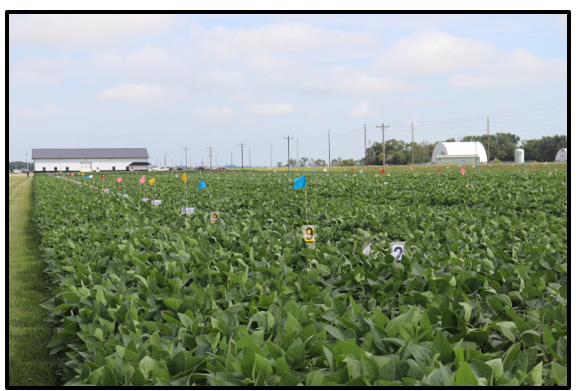
Fungicide application timing, fungicide droplet size and soybean seeding rate trial.
