

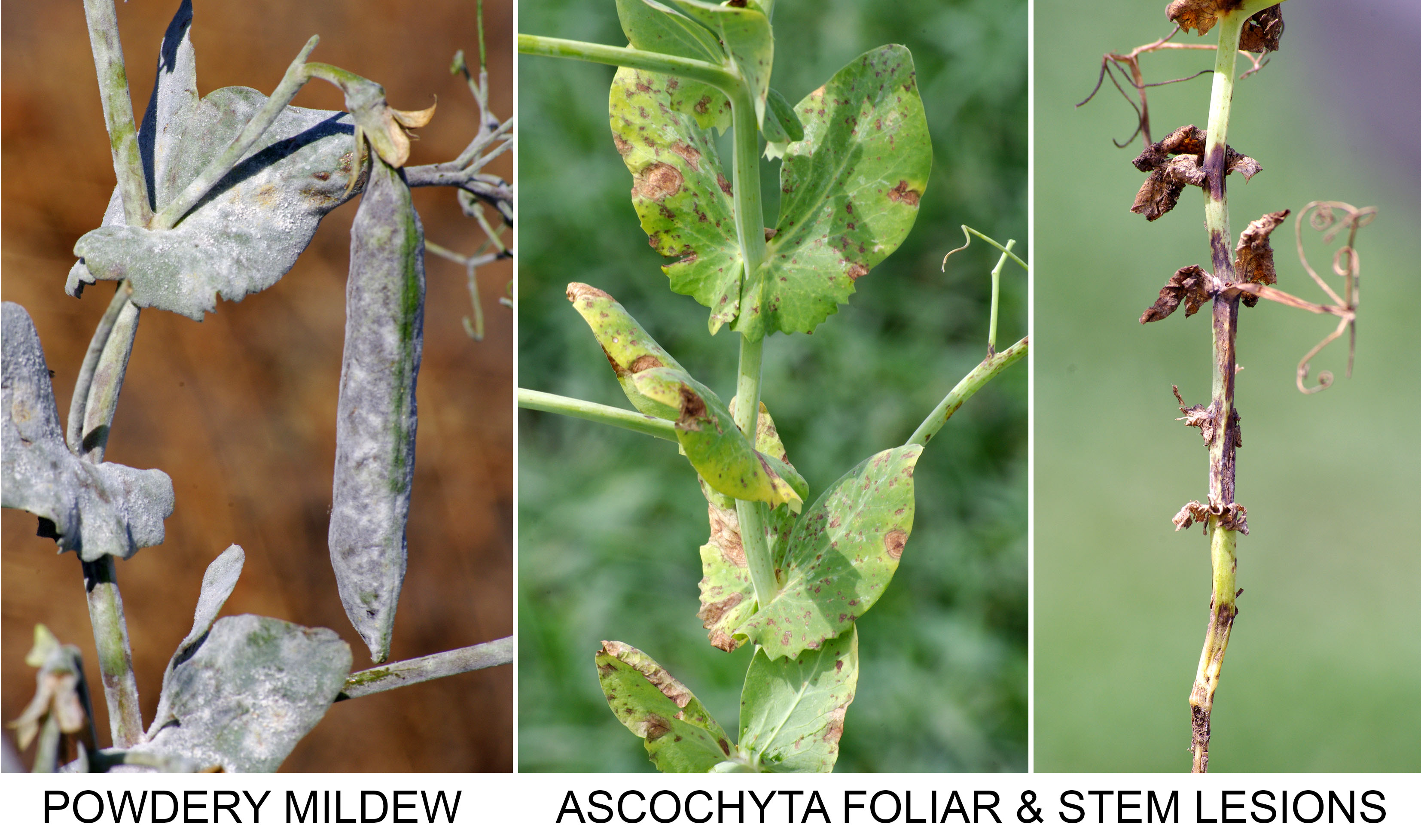
Optimizing Ascochyta and powdery mildew management in field peas with fungicides
Fungicide application timing and efficacy research conducted on field peas in Carrington from 2023 to 2025 has provided new insights on how to optimize management of foliar diseases in field peas with fungicides.
The optimal fungicide application timings for Ascochyta blight and powdery mildew management in field peas were different. The results indicate that producers seeking to manage both powdery mildew and Ascochyta blight in field peas with a single fungicide application will need to choose their application timing based on which disease they anticipate to be most yield-limiting.
Major findings:
- Season-long powdery mildew management was consistently achieved with a single application of Proline (5.7 fl oz/ac) when an average 3-5 pods/plant were fully filled in studies in which significant powdery mildew development did not occur until late pod-fill.
- Fungicides must be applied preventatively before disease development, and in some years powdery mildew develops at significant levels before field peas have 3-5 fully filled pods/plant. Applying Proline when peas averaged 1 fully filled pod/plant conferred full control of powdery mildew in 6 of 8 assessments. In the remaining 2 assessments (very late disease onset in ‘Navarro’ and ‘Empire’ peas, 2025), applying Proline when peas had 1 fully filled pod/plant conferred 50% control of powdery mildew, applying when peas had 2-3 fully filled pods/plant conferred 63% control of powdery mildew, and applying when peas had 3-5 fully filled pods/plant conferred 89% control of powdery mildew. When risk of powdery mildew is particularly high (warm, dry weather with overnight dew), applying fungicides when peas have 1-2 fully filled pods/plant is advised. When risk of powdery mildew is lower, delaying a fungicide application targeting powdery mildew until peas have 3-5 fully filled pods per plant is advised.
- Ascochyta blight management was optimized with a single application of Proline applied when field peas were in full bloom with first pods half- to full-length and flat. Consistent results were obtained across both years of testing (2024 and 2025) and all varieties tested (‘Navarro’, ‘Shamrock’, ‘Salamanca’ and ‘Empire’ in 2025; ‘Shamrock’ and ‘Empire’ in 2024).
- Delaro was the most effective fungicide for management of powdery mildew in field peas. Proline was the second-most effective fungicide. Higher application rates (Delaro, 10 vs. 12 fl oz/ac; Proline, 5.0 vs 5.7 fl oz/ac) conferred better disease control with both products, but use of the higher application rate was most important when applying Proline. Headline (6 fl oz/ac) and Quadris (6 fl oz/ac) were significantly less effective.
- Delaro was the most effective fungicide for management of Ascochyta blight and Ascochyta-associated lodging in field peas. Higher application rates (10 vs 12 fl oz/ac) conferred only modest improvements in disease management. Proline (5.7 fl oz/ac) was the second-most effective fungicide.
Neither ND Agricultural Experiment Station nor NDSU Extension endorse commercial products or companies even though references may be made to brand names, trademarks or service names.
Michael Wunsch, Ph. D.
Michael.Wunsch@ndsu.edu
Research Plant Pathologist
