

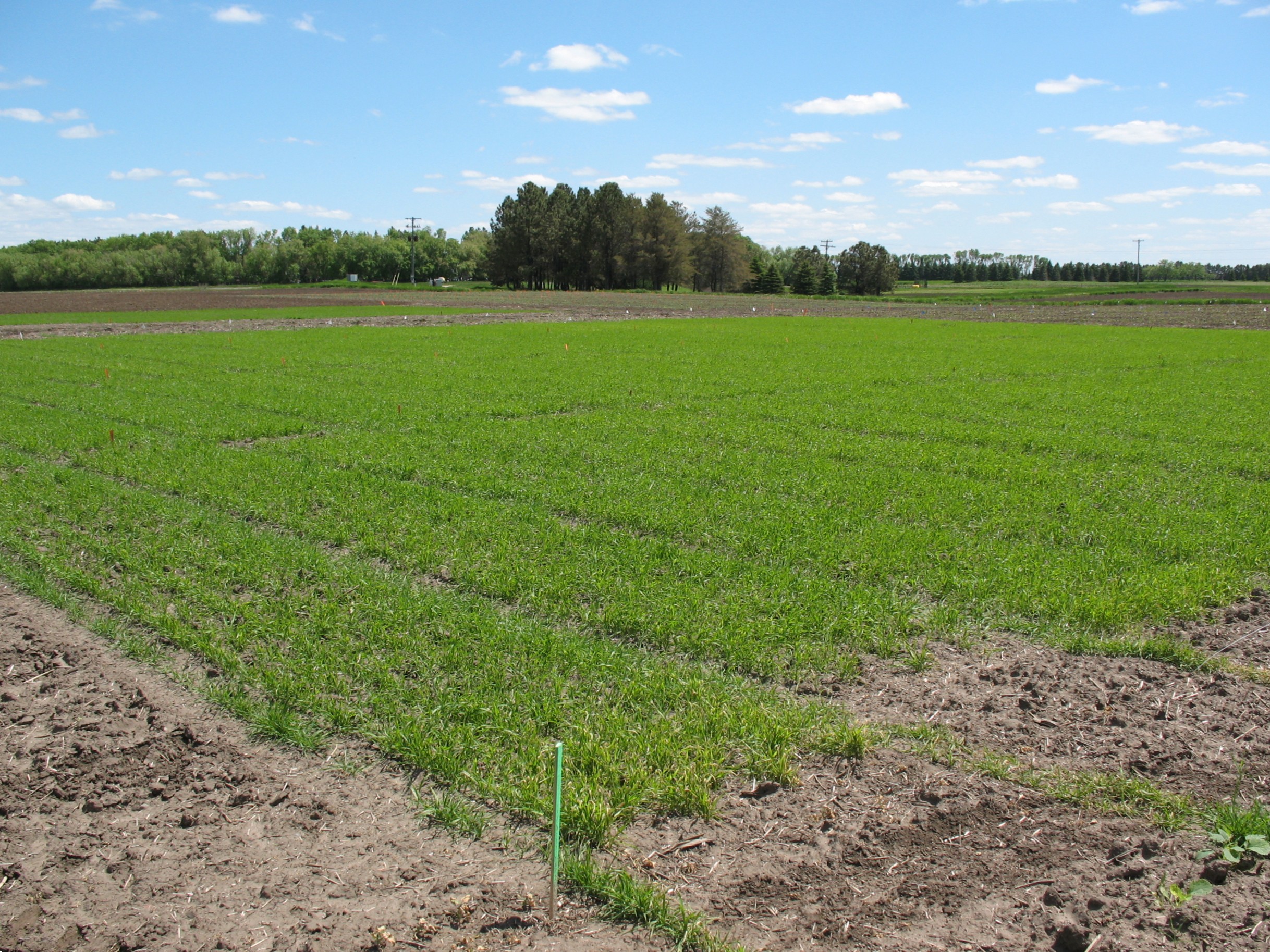
Five site-years of nitrogen fixing biologicals in spring wheat
Two biological products containing symbiotic nitrogen-fixing bacteria were evaluated at a total of 5 site-years, 2023 through 2025, at the NDSU Carrington REC and at the NDSU North Central REC in Minot. Envita, which is marketed by Azotic North America contains the bacterium species Gluconacetobacter diazotrophicus. Utrisha, which is marketed by Corteva Agriscience contains the bacterium species Methylobacterium symbioticum. The premise of the tested products is that once applied to a crop, the microbes fix atmospheric nitrogen into a plant-available form, potentially allowing for a reduction in nitrogen fertilizer applications. The bacteria that are in these products form symbiosis with non-nodule forming plants such as wheat and corn. They enter the plants through the tissues, stomata or root hairs. Once they infect the plant, they get carbohydrates from the plant in exchange for the nitrogen they fix, similar to legumes. Both bacterium species exist naturally in warmer climates but neither of them form spores, therefore they need a living host to survive and cannot endure our harsh winters, hence the need for repeated inoculation.
Methods
The products were tested under conventional tillage in Carrington in all three years and in a no-till system in Minot in 2023 and 2025. Utrisha and Envita were foliar applied to spring wheat at the end of the tillering stage (Feekes 5) on plots that had nitrogen applied at the 0 or 60 pounds per acre rate as a starter. Additionally, there were plots that received 0, 30, 60, 90, 120 or 150 pounds of nitrogen per acre as a starter without any biologicals, in order to be able to evaluate the effect of the products against a nitrogen yield response curve.
Treatments were replicated six times. The biological treatments were mixed with chlorine-free water on the field, right before application.
Results
Response to biological treatments was only assessed for site-years where yields responded to nitrogen rates (Figures 1, 3, 4 and 5), therefore the Minot site in 2023 was excluded from this analysis (Figure 2).
Out of the four responsive site-years, the biological products boosted spring wheat yields in only one, the, the Carrington site in 2024 (Figure 3). This boost occurred at the 60 pounds N starter rate but was not observed where no nitrogen was applied. The yield increases were statistically significant: +5.4 bushels/acre with Utrisha and +11 bushels/acre with Envita. Notably, this site-year was the only one that exhibited a linear response to nitrogen rates. Generally, nitrogen response follows a curve where yields eventually level off at a certain nitrogen rate. The linear yield response suggests that with the nitrogen rates applied we did not come close to the rate that would have satisfied the plants’ needs, therefore they remained hungry all season. This may have encouraged the plants to nurture the nitrogen fixing bacteria with carbohydrates in exchange for extra nitrogen. It may be the case that the plants are not willing to do that unless they are in dire need, which was the case in 2024.
Grain protein responded to nitrogen rates only at the Carrington site, but there was no protein response to biological products (Figures 6 through 10). This would make sense because boosting protein beyond a physiologically necessary minimum level is a luxury for the plants that they are inclined to do only if there is an easily available excess amount of nitrogen. However, biological nitrogen fixation is a costly source of nitrogen for the plants.
The results suggest that under certain conditions of nitrogen deficiency and rapid growth these products are able to boost yields but are unlikely to have any positive effect on grain protein. Synthetic nitrogen application remains a more reliable strategy for maximizing spring wheat yield and quality in the Carrington and Minot regions of North Dakota.
Funding
Four site-years of this research were funded by the North Dakota Wheat Commission.
The trials in Minot were conducted by Dr. Leandro Bortolon and the Minot site in 2025 was funded by the Agronomy Program of the NDSU North Central Research Extension Center.
Disclaimer
Neither ND Agricultural Experiment Station nor NDSU Extension endorse commercial products or companies even though references may be made to brand names, trademarks or service names.
Szilvia Yuja
szilvia.zilahisebess@ndsu.edu
Soils Research Specialist


