

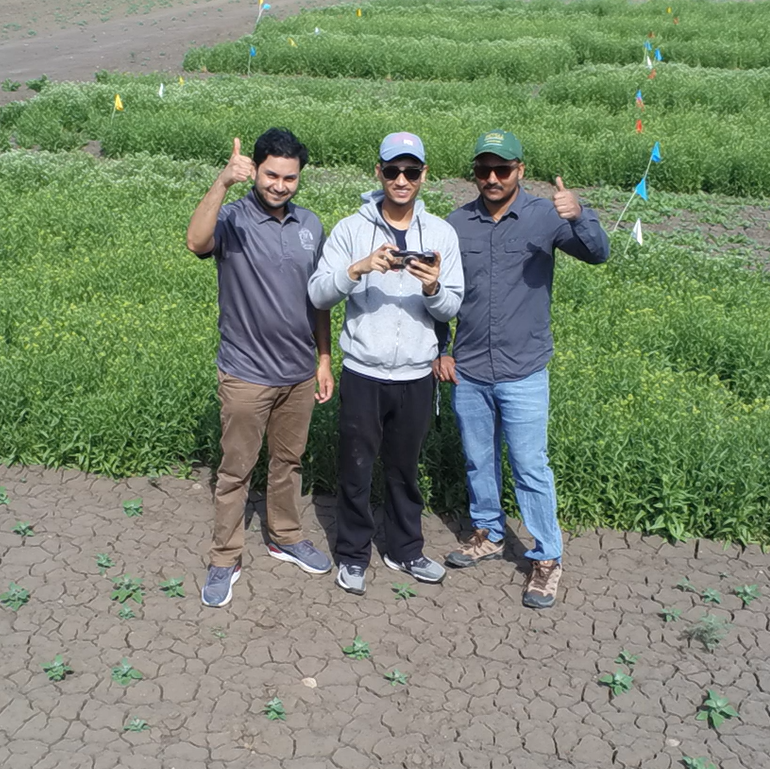
Summer research spotlight: using drones to improve crop protection and field monitoring at CREC
This summer, graduate students in Karn’s Lab at the NDSU Carrington Research Extension Center will be using drone technology to answer practical questions for North Dakota producers. Their work will focus on two important areas: improving fungicide application timing in wheat and using UAV imagery to better monitor crop growth and field variability.
Beating Wheat Scab on Time: Drone vs. Ground Fungicide Applications
Aman Mehta will be working on a field study evaluating whether spray drones can perform as effectively as a traditional ground sprayer for protecting wheat from Fusarium head blight, commonly known as wheat scab. This disease is a major concern for North Dakota wheat growers because it can reduce yield and grain quality while also increasing deoxynivalenol, or DON, levels in harvested grain. High DON levels can lead to price discounts or rejection at the elevator.
Fungicides can help manage scab, but timing is critical. Applications must be made during a narrow window when wheat is flowering. Unfortunately, that window often coincides with wet field conditions, making it difficult or impossible for ground sprayers to enter the field without causing rutting or delaying treatment. Spray drones may offer a useful alternative because they can fly over wet fields and apply fungicide without direct soil contact.
At CREC, Aman will help conduct a replicated field trial comparing three treatments: an untreated check, fungicide applied with a ground sprayer, and fungicide applied with a spray drone. Each application will use the same fungicide product and rate so that the main comparison is the delivery method. Water-sensitive spray cards will be placed near the wheat head height to evaluate spray coverage, which is an important factor in fungicide performance. Later in the season, the plots will be rated for disease, harvested for yield and test weight, and grain samples will be submitted for DON analysis.
The goal of this work is to provide growers with local, field-based information on how drone fungicide applications compare with conventional ground applications. If drones can provide effective scab management, they may become a valuable tool in wet years when timely ground application is not possible. The study will also help identify application practices and settings that improve spray coverage and performance.
Using UAV Imagery to Monitor Crop Growth and Field Variability
Rahul Khanal will be working on UAV-based crop monitoring research at CREC. His summer work will involve collecting drone imagery from research plots and analyzing those images to monitor crop growth, canopy development, and possible stress patterns across the field.
Drone imagery can provide a detailed view of field conditions that is difficult to capture from the ground alone. By flying over plots at key growth stages, Rahul will help collect plot-level image data that can be used to calculate vegetation indices, estimate canopy cover, and identify spatial differences in crop performance. These image-based measurements can then be compared with ground observations to better understand how crops respond to different treatments, management practices, or field conditions.
This work supports the broader use of drone technology in research station trials and on-farm studies. UAV imagery can help researchers collect data more efficiently, improve the accuracy of field evaluations, and better communicate results to farmers. Over time, these tools may help producers make more informed decisions about crop health, input management, and field variability.
Together, these projects highlight the growing role of drone technology in modern agriculture. From timely fungicide applications in wheat to improved crop monitoring across research plots, students in Karn’s Lab are working to generate practical information that can support more efficient, profitable, and resilient farming systems in North Dakota.
Rupak Karn, Ph. D.
Rupak.Karn@ndsu.edu
Precision Agriculture Specialist
Rahul Khanal
Rahul.Khanal@ndsu.edu
Graduate Student
Aman Mehta
Aman.Mehta@ndsu.edu
Graduate Student
