

What is phenology?
The first data I collected in the orchard this season was all about phenology. Phenology is simply when a particular event or growth stage happens. In my case, I recorded when each fruit cultivar had green buds and when they were flowering. Why is this useful? Knowing phenology helps us with a few things.
- Predicting when bud break, flowering, and harvest will happen in the future
- Choosing fruits that are adapted to our seasons in ND
- Predicting pest and disease activity
- Timing plant care correctly (pruning, fertilizing, etc.)
- Seeing how our environment changes over time
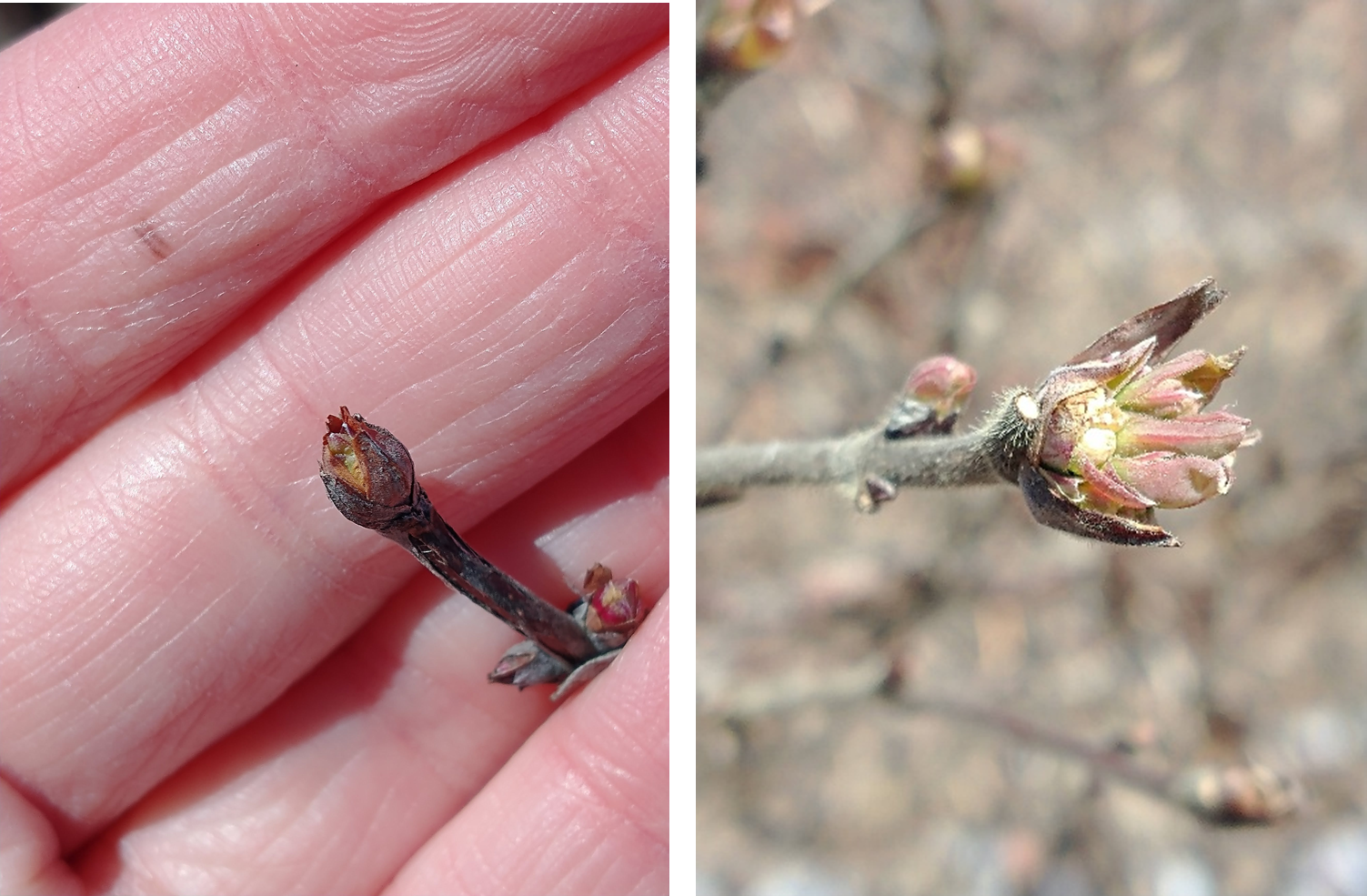
I have already learned some interesting things just by paying attention to phenology. I had read that Russian haskaps bud break earlier than Japanese haskaps, but the difference in-person is incredible. The Japanese (left) and Russian (right) haskap buds below were photographed on the same day.
I also learned that out of the apples here, Zestar is the earliest. I observed grapes in Fargo for two previous summers for my master’s research. The grapes here are flowering later by comparison.
You can do phenology research, too. It can be as simple as recording when your own plants start flowering each year. I even found a research project where you can enter phenology observations online. The project, Nature’s Notebook, collects information about species all over the USA. They have a goal of four million observations this year.
I tried it out with some of my apple observations.
The website does take some exploring to figure out. But if this kind of research interests you, I recommend trying it. Here is the link: https://www.usanpn.org/nn
I hope you are having a great summer!
Elizabeth Krause
Elizabeth.Krause@ndsu.edu
Fruit Project Manager
