Title

Using Soil Amendments for Treating Soil Sodicity in Tile-drained Soils

(SF2302, July 2026)
Summary

This publication shares long-term soil salinity and sodicity data on a tiled field and the negatives impacts soil sodicity can have on the performance of tile drainage system. Publication details the effects of sodicity on slowing the infiltration of excess soil water into the tiles through the sodic layers.

Lead Author
Lead Author:
Naeem Kalwar, Soil Health Specialist, NDSU Langdon Research Extension Center
Other Authors

Larry Cihacek, Soil Scientist, NDSU School of Natural Resource Sciences

Availability
Availability:
Web only
Publication Sections

Nearly 20% of North Dakota soils are affected by excessive levels of water-soluble salts (saline soils), sodium (sodic soils) or both (saline-sodic soils) due to the glacial deposits or parent materials from which they are formed. These soils generally have shallow water tables or wetness that influence their salinity or sodicity. To remove excess water and control soil wetness, tile drainage can be used to lower the water table. It is important to distinguish between “gravitational soil water” and “capillary soil water” in these soils.

“Gravitational soil water” is water that usually originates from precipitation or water that is held in the soil pores due to a high subsurface water table, causing a saturation of pores in the soil profile. This is water that would normally move through the soil profile due to gravity downwards and is intercepted and removed by tile drains. When excess water is removed from the soil profile, it removes excess salts with it and dries the soils, allowing the soils to warm up more quickly in spring. Farmers can then begin their field work and crop seeding earlier, extending the short growing season to improve crop productivity.

“Capillary soil water” is water wicked up from a water table due to the attraction or surface tension of water molecules to surrounding soil particles. Gravity has little effect on capillary water. Through capillary movement, this water can bring excess salts and sodium to the soil surface, impacting the topsoil. The amount of capillary water movement in soils is dependent on soil texture with water reaching the soil surface in clay soils from water tables up to 6 feet deep (Seelig, 2000). Water tables this deep are usually below the installed tile lines. Capillary soil water is not intercepted and removed by tile drains.

Soil salinity is caused by excessive levels of water-soluble salts (for example, table salt: Na+ + Cl-). High levels of ions (positive and negative) from soluble salts inhibit normal water uptake by plant roots, even when soils are visibly wet, resulting in water-deficient (drought-stressed) plants. This process is called the “osmotic effect,” which can affect seed germination by preventing seeds from absorbing water. Thus, saline areas may have poor and delayed germination compared to nonsaline areas. This effect is more visible and widespread during drier weather because rainfall increases free water availability and salt dilution.

Soil salinity is determined by analyzing representative soil samples for electrical conductivity (EC). Soil EC measures the amount of dissolved salts in the soil water surrounding plant roots and is related to soil water content. The Saturation Paste Extract method most closely represents the actual soil’s salinity levels (Rhoades, 1996; Whitney, 2015). However, other methods using 1:1, 1:2 or 1:5 soil-to-water ratios have been successfully used to estimate the soil salt content. However, one must keep in mind that with these methods, EC values may be lower due to dilution of the salts with water.

Saline soils having high levels of calcium (Ca2+)-based salts will have good structure. The Ca2+ ions encourage aggregation of soil particles called flocculation (clumping together), resulting in improved soil structure with well-defined pores facilitating optimum water movement through the soil profile, depending upon texture. The flocculation is due to the Ca2+ ions acting as a binder between soil particles. Since they have smaller hydrated ionic size, Ca2+ ions bond with the negative charges of soil particles more tightly than other ions. Magnesium (Mg2+) ions are also divalent and can promote flocculation; however, due to their larger hydrated ionic size, the bond between soil particles and Mg2+ ions is weaker than Ca2+. In addition, the larger hydrated ionic size of Mg2+ allows more water into the structural layers of clay minerals (or sheets) which can result in increased swelling of soils resulting in slower water infiltration (Ellis and Caldwell, 1935, Rost, 1936).

In contrast to saline soils, sodic soils are highly saturated with Na+ ions at the soil exchange sites (negative charges of clay and humus particles that attract positively charged chemical ions). This results in clay and soil organic matter (SOM) particles breaking away from soil aggregates as Na+Clay- and Na+SOM- combinations. That process is called dispersion, which is the opposite of flocculation (Seelig, 2000). Soil dispersion is the breakdown of soil aggregates, resulting in poor soil structure and much smaller/tighter pore space with greater attraction of capillary water. Due to poor soil structure and smaller pore space, sodic soils can form dense soil layers, resulting in very slow water and air permeability throughout the soil profile. Soil dispersion can also make salinity issues worse by slowing water infiltration, allowing salts to accumulate rather than leach from the soil. Sodicity can be measured directly by analyzing representative soil samples for sodium adsorption ratio (SAR) and exchangeable sodium percent (ESP) or by converting percent sodium (%Na+) into SAR (DeSutter et al., 2015). The characteristics for saline, sodic and saline-sodic soils are shown in Table 1.

The following should be noted:

  • If Na+ is present as a free salt, it will not cause dispersion, as the positive charges of Na+ ions will be neutralized by the negatively charged chemical ions such as sulfates (SO42-) or chlorides (Cl-).
  • However, due to the constant exchange of positively charged ions like Ca2+, Mg2+ and Na+ between soil water and the soil clay and SOM particle negative charges, high levels of Na+ based salts in the soil water can result in sodicity, as more clay and SOM negative charges will be saturated with Na+ over time.
  • Clay soils will infiltrate water slower than sandy soils; however, higher sodicity levels can drastically reduce the soil water infiltration irrespective of soil texture. A clay soil without dispersion issues will infiltrate water much faster than the same clay soil having dispersion.

Removal of excess soil water also removes excessive salts from the soil profile. However, removing the excess salts before remediating sodicity with Ca2+ salts leaves more Na+ behind, causing soil dispersion and reducing water infiltration (moving into) and percolation (moving through) in the soil profile, reducing the effectiveness of tile drainage. This occurs because Na+ is attached to the negative charges of clay and SOM and is not very mobile in soil water. On the other hand, Ca2+ is essential for good soil structure and is mobile in soil water as part of water-soluble salts. Amendments that add free Ca2+ can offset the negative effects of Na+ on soil particle aggregation, structure and pore space, and they can maintain or restore the water movement characteristics of the soils.

The added Ca2+ displaces Na+ from the negative charges on the soil clay and SOM particles, resulting in improved aggregation and structure. The displaced Na+ ions then attract negatively charged chemical ions in soil water and convert into salts. As part of a salt, Na+ is mobile in soil water. Also, initially, displacement of Na+ from the soil particle charges and conversion into a salt will raise the salt (electrical conductivity, or EC) levels. Amendment application should be followed by salinity remediation practices, because the amendment needs to be moved into the soil by seasonal precipitation or irrigation with good-quality water (if available). It is important to note that Na+ is least soluble/leachable as a carbonate (CO32-) or bicarbonate (HCO3-)-based salt. Most soluble Na+ salts most often will be Cl-based, followed by SO42--based. The most commonly used soil amendments for sodicity are gypsum (CaSO4•2H2O), commercial ag lime (CaCO3), spent or beet lime (CaCO3 + beet pulp containing macro and micro nutrients), sulfuric acid (H2SO4), elemental sulfur (S°) and calcium chloride (CaCl2•2H2O).

Table 1. Characteristics of saline, sodic and saline-sodic soils (from USDA Handbook No. 60).

Soil TypepHElectrical Conductivity (EC)1
(mmhos/cm)
Exchangeable Sodium Percent (ESP)
(%)
Sodium Adsorption Ratio (SAR)
1mmhos/cm – millimhos per centimeter; 1 mmhos/cm = 1 deci-Siemens per meter (dS/m)
Saline<8.5>4<15<13
Sodic>8.5<4>15>13
Saline-sodic<8.5>4>15>13

Common Soil Amendments and Their Chemical Reactions

Soil amendments are not normally necessary to mitigate salinity. However, sodicity does need to be converted to salinity through soil amendment before it can be mitigated in the following descriptions of the soil chemical processes that involve soil amendments. Note that soil clay and SOM particles are referenced as “colloids” in the reactions.

Gypsum (CaSO4•2H2O):

Gypsum is a naturally occurring mineral, mined from formations of gypsum rock where it occurs on the earth’s surface. It is also produced by most power plants as a product of scrubbing sulfur gases from the combustion gas stream with finely divided lime. This is the most economical source of gypsum in North Dakota.

When gypsum is added to sodic soils, the following reactions will take place:
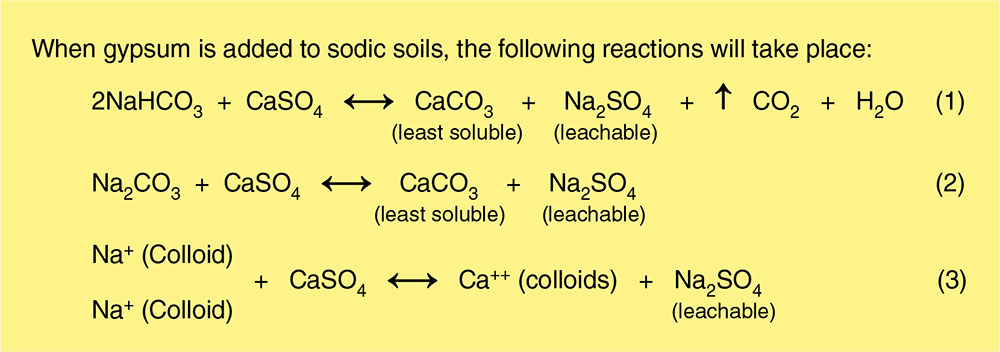
Figure 1
When gypsum is added to sodic soils, the following reactions will take place:

Lime (CaCO3):

Lime, also called agricultural lime, is finely ground limestone mined from formations of limestone rock. This material is available only in limited quantities due to a lack of mineable limestone formations in North Dakota. Spent lime or beet lime is available from sugarbeet processing factories as a byproduct of the sugar refining process at most factories. Beet lime has a lower calcium carbonate equivalent (CCE) than agricultural lime due to impurities imparted in the beet refining process. It results in the same reactions in soil as agricultural lime, but higher rates are needed to compensate for its lower CCE. Lime is an effective amendment only in soils below pH 7.0 because its solubility decreases as soil pH increases.

When beet lime or agricultural lime is added to sodic soils, the following reactions will take place:
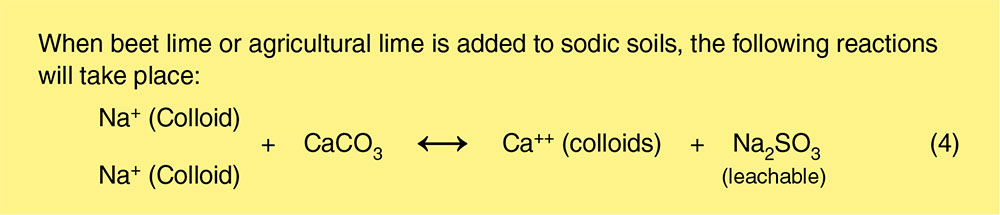
Figure 2
When beet lime or agricultural lime is added to sodic soils, the following reactions will take place:

Sulfuric Acid (H2SO4) and Elemental Sulfur (So):

Both H2SO4 and S° can be used as amendments, especially where sodium bicarbonate (NaHCO3), as well as calcium carbonate (CaCO3 or free lime), is abundant in the soil. Generally, these soils would have pH values greater than 8.5. H2SO4 changes NaHCO3 into Na2SO4 as well as dissolving CaCO3 to release free Ca2+ as pH is decreased. It is essential for adequate free Ca2+ to be released to displace Na+ from the soil colloids.

If elemental sulfur (S°) is used, it will first need to be oxidized to sulfate-sulfur (SO42-) through biological oxidation. Then SO42- converts into H2SO4 after reacting with the soil water (H2O). Soil reactions will then be similar to those with sulfuric acid above. However, biological oxidation of S° is very slow in soils above pH 7 due to the bacteria responsible for the oxidation preferring low soil pH.

When H2SO4 is added to sodic soils, the following reactions will take place:
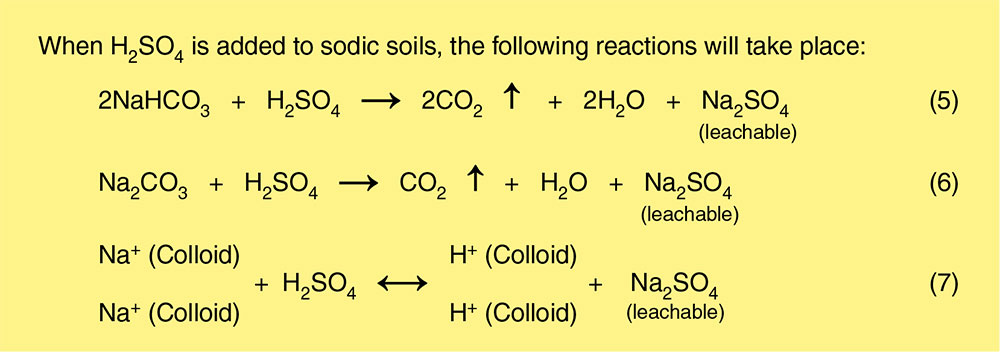
Figure 3
When H2SO4 is added to sodic soils, the following reactions will take place:

Calcium Chloride (CaCl2•2H2O):

Calcium chloride is a highly soluble salt that supplies soluble calcium directly to the soils. This material is often used as liquid ballast in tractor tires. Its reactions in sodic soils are similar to those of gypsum.

When CaCl2•2H2O is added to sodic soils, following reaction will take place:
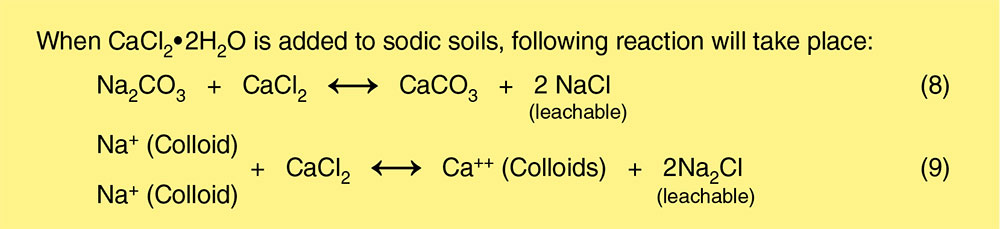
Figure 4
When CaCl2•2H2O is added to sodic soils, following reaction will take place:

Failure to apply the amendments that add and raise soil Ca2+ levels compared to Na+ before tiling can potentially worsen sodicity due to leaching of salts before the sodicity can be converted into salinity. After this happens, it can still be corrected, but it will require higher amendments rates, resulting in higher costs and longer time for remediation.

Calculation of Soil Amendment Rates

Historically, soil sodicity had been measured by analyzing soil samples for exchangeable sodium percent (ESP). Recently, most agricultural soil testing laboratories measure sodicity by analyzing sodium adsorption ratio (SAR). SAR levels can be converted into ESP by using the following formula:
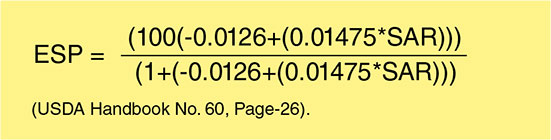
Figure 5
SAR levels can be converted into ESP by using the following formula:

In addition, SAR values can be substituted for ESP (Oster et al., 1999).

Then ESP/SAR and cation exchange capacity (CEC) values of the 1st foot are used to calculate the milliequivalent of exchangeable Na/100 grams of soil by using the following formula:
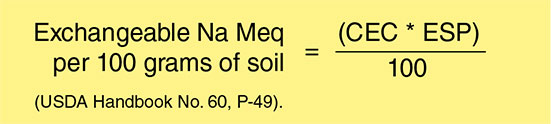
Figure 6
Then ESP/SAR and cation exchange capacity (CEC) values of the 1st foot are used to calculate the milliequivalent of exchangeable Na/100 grams of soil by using the following formula:

Note: for the calculation of soil amendment rates, the actual CEC should always be measured by analyzing representative soil samples by using the “sodium saturation and ammonium extraction method” instead of the summation or addition method. In case of high salt levels (which are almost always high in most unproductive areas), analyzing CEC through the summation method will give artificially higher values compared to the sodium saturation and ammonium extraction method and is not very useful for soil remediation. The summation method is only an estimate of the CEC based on the cation content of the soil. Thus, saline soils with a high free salt content will have a high cation content and a high CEC, while acid soils will have a low cation content and a low CEC. A higher CEC value will result in over estimation of the soil amendment rates.

The milliequivalent of exchangeable Na/100 grams of soil numbers are then multiplied by 1.7 to get tons of 100% pure gypsum/acre-foot. The objective of soil amendment is to replace the amount of Na+ with an equivalent amount of Ca2+ to improve soil structure and water movement throughout the soil profile. Generally, it is not economical to lower the amount of Na+ below 5% of the total amount of cations in a soil. If application of amendments other than gypsum is desired, Table 2 can be used to calculate the rates of different materials compared to rates of 100% pure gypsum.

Figure 7
Differences in amendment purities can be compensated by using the following formula:

Table 2. Tons equivalent to one-ton of 100% pure gypsum for various soil amendments1.

AmendmentPurity
(%)
Tons
Equivalent to 1 ton
of Pure Gypsum
(100%)
Suitable for
1From: Reclaiming Sodic and Saline/Sodic Soils. Drought Tips Number 92-33, University of California Cooperative Extension, 1993.
Gypsum1001.00Soil and Water
Sulfur1000.19Soil
Sulfuric Acid1000.61Soil and Water
Ferric Sulfate1001.09Soil
Lime Sulfur1000.78Soil and Water
Calcium Nitrate1001.06Soil and Water
Calcium Chloride1000.86Soil and Water
Figure 2
Photo Credit:
NDSU Photo
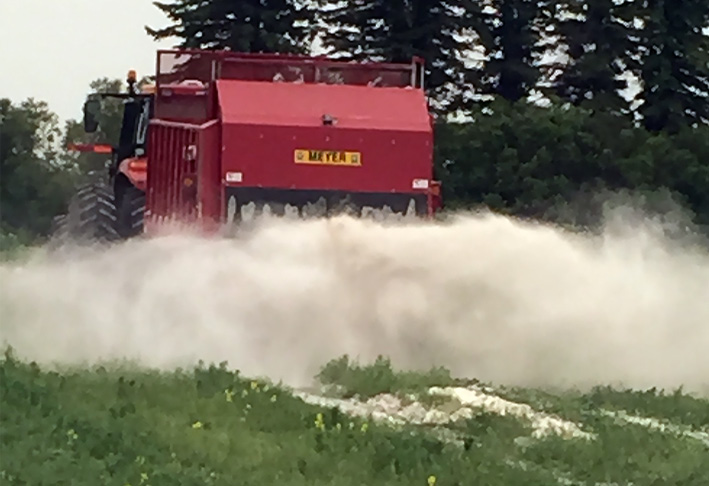
Application of powder-form gypsum in progress. The NDSU Langdon Research Extension Center, Cavalier County, North Dakota.


Considerations for Use of Gypsum and Other Amendments with Tile Drainage

The following points should be considered when preparing to use soil amendments for sodic or saline-sodic soils being drained:

During Periods of High Precipitation:

  • Tiling may drain excess water in a timely manner where good soil water infiltration or permeability exist. Check with Web Soil Survey to evaluate soils for drainage restrictions.
  • If the potential fields have unproductive or marginal areas, consult NDSU Extension publication “Evaluation of Soils for Suitability for Tile Drainage Performance” (SF1617) and sample these areas 3 to 4 feet deep in 1-foot increments. This is the zone above the actual or potential tile line depth. Analyze the soil samples for EC (salinity) and SAR (sodicity) levels by using the saturated paste extract method. This is a relatively inexpensive activity compared to tiling and will help make the best-informed decisions.
  • If sodicity is established based on the soil SAR results, consider applying the soil amendments before tiling, as amendments will start converting the sodicity issue into a salinity issue as soon as the amendment becomes soluble. Once sodicity begins to be addressed, soil structure conditions will begin improving, as will water infiltration. Tiling will help drain excess water and begin to leach salts.
  • If salinity is the issue based on soil EC levels, planting a salt-tolerant annual crop or a perennial salt-tolerant grass mix on the saline or saline-sodic areas can be beneficial. Growing plants will reduce evaporation, use excess soil water and intercept capillary rise of soil water while reducing the water-soluble salts at or near the soil surface.

During Period of Low Precipitation:

  • During lower rainfall weather, tiling entire fields may not be necessary as average annual growing-season groundwater depths may lower naturally.
  • Tiling, by itself, under low rainfall may not lower salinity very quickly because moving the excess water-soluble salts into the deeper soil depths will require sufficient rainfall for leaching.
  • Under lower rainfall weather, salinity levels can actually increase despite tiling due to the increased evaporation and resulting capillary rise of soil water. Soil capillary water is not usually removed by tile drains.
  • If the potential fields have unproductive or marginal areas, consult NDSU Extension publication “Evaluation of Soils for Suitability for Tile Drainage Performance” (SF1617) and sample these areas 3 to 4 feet deep in 1-foot increments, and analyze soil samples for EC (salinity) and SAR (sodicity) levels by using the saturated paste extract method. Again, this is a less expensive activity compared to tiling.
  • If sodicity is established based on the soil SAR results, consider applying the soil amendments before tiling, as amendments will start converting the sodicity issue into a salinity issue as the amendment becomes soluble. Once sodicity begins to be addressed, soil structure conditions will begin improving, as will water infiltration. Tiling will help drain excess water and begin to leach salts.
  • During periods of lower precipitation, despite applying amendments, conversion of sodicity into salinity will take a longer time — potentially several years. Most amendments are of low solubility and need water from precipitation to dissolve them in order to be most active.
  • Tile installation on sodic or saline-sodic fields, by itself, will not remediate sodicity and will require application of amendments at some point in time. In the meantime, leaching of salts may reduce soil aggregation and cause soil dispersion, thereby reducing water infiltration and percolation within the soil profile, which reduces tile effectiveness.
  • If salinity is the issue based on soil EC levels, planting a salt-tolerant annual crop or a perennial grass mix on the saline or saline-sodic areas can be beneficial. Growing plants will reduce evaporation, use excess soil water and intercept capillary rise of soil water along with the water-soluble salts.

Reduced tile drainage performance is more likely to occur in finely textured (silty or clayey) soils with a much lesser extent in coarser-textured (sandy) soils. Once drainage performance is reduced, little can be done economically to restore the effectiveness of the drainage system. Drainage performance is controlled by good soil structure in the soil profile. Once the soil is dispersed water movement is restricted and the addition of +2-charged cations such as calcium responsible for maintaining soil structure cannot move into the soil to restore the structure destroyed by Na+.

Producers can take precautions prior to tile installation on soils where poor drainage performance is likely to occur. These precautions include the following:

  1. Knowing the soil series (soil types) in the field under consideration for drainage.
  2. Evaluating the soil chemical characteristics for each of the soils mapped in the field.
  3. Evaluating the soil properties for suitability for having tile installed.
  4. Verifying soil types and chemical characteristics (items 1 and 2 above) by deep soil sampling and testing.

The NDSU Extension publication “Evaluation of Soils for Suitability for Tile Drainage Performance” (SF1617) describes how to obtain the information listed above. Using these precautions can help avoid installing drain tiles where poor subsurface drainage is likely, thereby achieving the desired effects on soil productivity. In addition, Soil Testing Unproductive Areas (SF1809) explains how to correctly sample and analyze for soil salinity and sodicity. Soil tests to determine EC and SAR can be obtained from most commercial soil testing laboratories.

Final Considerations

Research data and observations are not conclusive at this point. However, since most soils drained in North Dakota have a clayey texture, these soils will generally infiltrate water slower when compared with silty or sandy soils. However, a clayey soil with high to very high dispersion and/or swelling will infiltrate water at a much slower rate than the same clay type soil not having these issues. Reducing soil dispersion and/or swelling combined with no or minimum-till practices and adopting practices that help increase soil organic matter will improve soil particle aggregation, structure, pore numbers and size, water infiltration and permeability. Regional water tables extending across sections, townships and counties are controlled by landscapes and the characteristics of the underlying compacted glacial till deposits (Arndt and Richardson, 1988; Winter, 2001).

Observations on an 12-year-old tile drainage system at the NDSU Langdon Research Extension Center, 11 years after applying soil amendments, have shown that soil sodicity, landscape and the area subsurface water table interact with the effectiveness of the drainage system. These observations give us the preliminary answers to the following questions:

1. Does soil sodicity negatively affect tile drainage performance?

Generally, soil sodicity has negatively affected the performance of tile drainage at this site, and despite heavy rains and standing water at the soil surface, sometimes it takes days for the lift station pump to start draining excess water. That can happen with time (generally three to five days). Another indication of slower water infiltration is roughly no change in groundwater depths for two to three days, even after a heavy rain. Specific examples are shown in Figures 3, 4 and 5.

  • In 2019, the Langdon NDAWN recorded 1.52 inches from Sept. 9 to 13, and there was visible standing water at the soil surface in areas with high sodicity levels in the 0 to 12-inch depth (SAR = 16.2) (Figure 3). The areas with lower sodicity (SAR= 10.6) (Figure 4) in the surface zone did not have any standing water on Sept. 13. The lift station pump did not run for three to five days to start draining the excess soil water because water was not draining into the tile system. This was also observed after 3.92 inches of rain on Aug. 9, 2021(Figure 5).

2. Will tiling lower soil salinity under wet and dry weather conditions?

Tiling clearly lowered soil salinity (EC) levels during wet weather in 2016. However, under drier weather conditions, salinity levels had actually increased in 2017-2025. That is due to the lack of rainwater to force the excess water-soluble salts into deeper depths and offset increased rise of capillary water due to increased evapotranspiration. Tile drains capture gravitational soil water due to precipitation but not capillary water drawn from a water table.

3. Does the drained water from a tiled field increase salinity and sodicity levels of the surface water resources?

Yes, based on the long-term tile-drained water quality data (2015-2025), the drainage water has added conductivity; total dissolved solids; total hardness as CaCO3; total alkalinity as CaCO3, SAR, Ca2+, Mg2+, Na+, SO42-, HCO3- and Cl-; total nitrogen; nitrate + nitrite nitrogen; copper; zinc; selenium and bromide to the surface water resources. Over time, depending upon the site-specific soil chemistry, tile drainage water can add these minerals/elements to the surface water resources.

In summary, tile drainage does improve soil quality and soil health, leading to improved and more consistent crop yields. However, soils are a complex entity and resource that interact not only with the climate but also with the original parent material, landscape and subsurface hydrology. Soil surveys provided by USDA-NRCS through Web Soil Survey should be consulted when considering installing tile drains to determine whether specific soils may have inherent characteristics that could affect the effectiveness of the drainage system. The Web Soil Survey can be found at https://websoilsurvey.sc.egov.usda.gov/App/WebSoilSurvey.aspx.
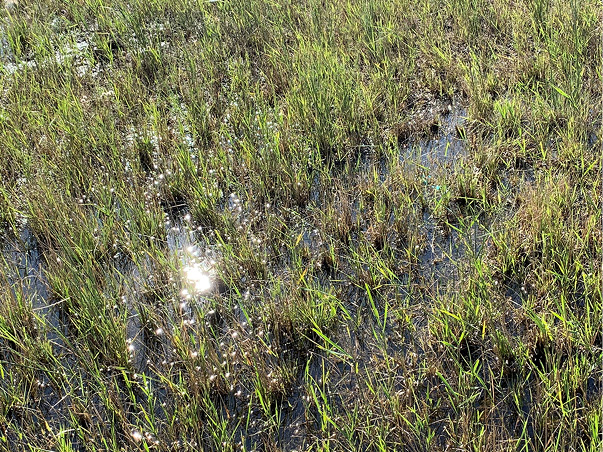
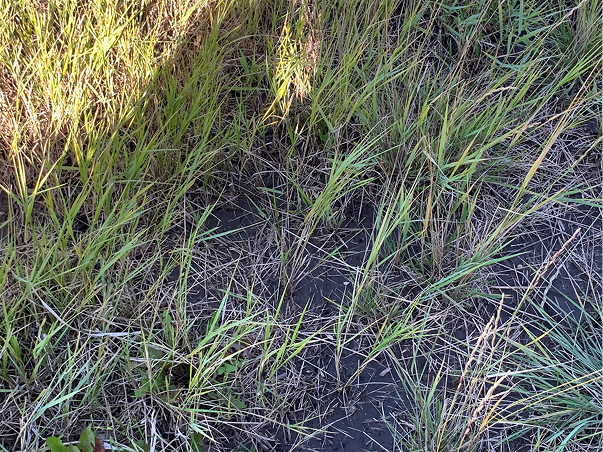
Figure 3
Photo Credit:
NDSU Photo
Visibly standing water on the surface of plot/treatment that had a high surface sodicity level (SAR = 16.2 in the 0-12” depth) on Sept. 13, 2019, at the NDSU Langdon Research Extension Center, Cavalier County, North Dakota.
Figure 4
Photo Credit:
NDSU Photo
No standing water on the surface of plot/treatment that had low surface sodicity level (SAR = 10.6 in the 0-12” depth) on Sept. 13, 2019, at the NDSU Langdon Research Extension Center, Cavalier County, North Dakota.
Figure 5
Photo Credit:
NDSU Photo
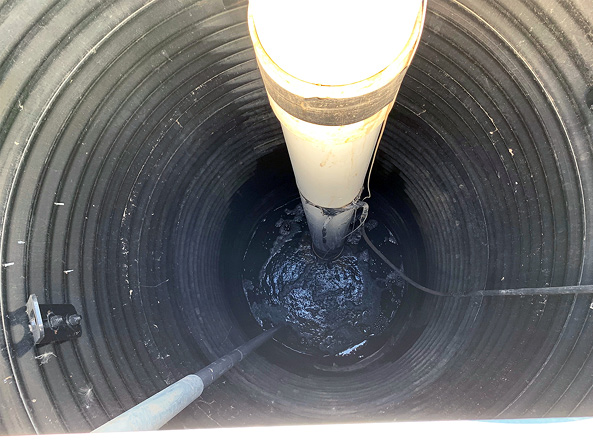
Tiling pump not pumping any tile-drained water, as it took three to five days for the excess soil water to infiltrate through the soil layers for tiles to collect and drain it on Sept. 13, 2019, at the NDSU Langdon Research Extension Center, Cavalier County, North Dakota.

Additional Reading

Arndt, J.L., and J.L. Richardson. 1988. Hydrology, Salinity and Hydric Soil Development in a North Dakota Prairie Pothole System. Wetlands 8:93-108. doi:10.1007/BF03160595.

Chen, L., and W.A. Dick. 2011. Gypsum as an Agricultural Amendment, General Use Guidelines. The Ohio State University Extension Bulletin 945.

Cihacek, L., N. Kalwar, B. Goettl, and L. Prasad. 2025. Evaluation of soils for suitability for tile drainage performance. NDSU Ext. Bul. SF1617 (Revised). August 2025. 12 p. https://www.ndsu.edu/agriculture/extension/publications/evaluation-soils-suitability-tile-drainage-performance

DeSutter, T., D.W. Franzen, Y. He, A. Wick, J. Lee, B. Deutsch, and D. Clay. 2015. Relating Sodium Percentage to Sodium Adsorption Ratio and Its Utility in the Northern Great Plains. Soil Sci. Soc. Am. J. doi:10.2136/sssaj2015.01.0010n

Ellis, J.H., and O.G. Caldwell. 1935. Soils Division, University of Manitoba, Canada. Alkali Soils, Magnesium Clay “Solonetz”. Trans.3rd Intern. Congr. Soil Sci. 1:348-350. 1935

Franzen, D., C. Augustin, T. DeSutter, and N. Kalwar. 2024. Managing saline soils in North Dakota. NDSU Ext. Bul. SF1087 (Revised June 2024). 12 p. https://www.ndsu.edu/agriculture/extension/publications/managing-saline-soils-north-dakota

Franzen, D., N. Kalwar, B. Gottl, and T. DeSutter. 2024. Sodicity and remediation of sodic soils in North Dakota. NDSU Ext. Bul. SF1941 (Revised, July 2024). 8 p. https://www.ndsu.edu/agriculture/extension/publications/sodicity-and-remediation-sodic-soils-north-dakota

Hanson, B. 1993. Reclaiming Sodic and Saline/Sodic Soils. University of California publication drought tips 92-33. University of California, Richmond, CA.

Kalwar, N., T. DeSutter, D. Franzen, and C. Augustin. 2016. Soil testing unproductive areas. NDSU Ext. Bul. SF1809 (Revised, June 2025). 8 p. https://www.ndsu.edu/agriculture/extension/publications/soil-testing-unproductive-areas.

Oster, J.D., I. Shainberg and I.P. Abrol. 1999. Reclamation of salt-affected soils. In R.W. Skaggs and J. van Schlifgaarde (eds.) Agricultural Drainage. Agron. Monogr. 38. pp. 659-691. ASA, CSSA, SSSA, Madison, WI. https:/doi.org/10.2134/agronmonogr38.

Rhoades, J.D. 1996. Salinity: Electrical conductivity and total dissolved solids. In D.L. Sparks et al. (eds.) Methods of Soil Analysis. Part 3. Chemical Methods. pp. 417-435. ASA and SSSA. Madison WI.

Rost, C.O. 1936. Characteristics of Some Morphological Solonetz Soils of Minnesota. Agronomy Journal 28(1):92-105.
https://doi.org/10.2134%2Fagronj1936.00021962002800020002x

Seelig, B. 2000. Salinity and sodicity in North Dakota soils. NDSU Ext. Bul. EB 87.

Soil Survey Staff. 2026. Web Soil Survey. USDA-NRCS.
https://websoilsurvey.sc.egov.usda.gov/App/WebSoilSurvey.aspx (Accessed 03/30/2026).

USDA Soil Salinity Laboratory Staff. 1954. Diagnosis and improvement of saline and alkali soils. Agriculture Handbook No. 60. U.S. Government Printing Office, Washington, D.C.

Whitney, D.A. 2015. Soil salinity In M. Nathan and J. Gelderman (eds.) Recommended chemical soil test procedures for the North Central Region. North Central Regional Research Publication No 221 (Revised) Univ of Missouri Experiment Station Bulletin SB 1001. Columbia MO. https://extension.missouri.edu/media/wysiwyg/Extensiondata/Pub/pdf/specialb/sb1001.pdf

Winter, T.C. 2001. The Concept of Hydrologic Landscapes, J. Am. Water Res. Assn. 37:335-349. doi:10.1111/j.1752-1688.2001.tb00973x.