
Flax Production for Oil and Seed in North Dakota
(A1038, Revised September 2026)A general publication on flax production and pest management in North Dakota.
Fertilizing Flax
Use soil testing as a guide for applying fertilizer.
A maximum of 80 pounds per acre of nitrogen (soil plus N fertilizer) should be present in a conventionally tilled field and 50 pounds per acre of N in a long-term no-till field. Nitrogen should be limited to these levels to avoid excessive vegetative growth and lodging (Table 1).
If the environment is favorable for higher yields, a higher N release from organic matter will provide the additional N needed in most situations.
Phosphorus application is generally not recommended for flax production. Research data suggested flax showed no yield response to added phosphorus fertilizer. Phosphorus can be applied to flax to maintain soil levels needed for more responsive crops such as wheat or corn; however, no increase in flax yield should be expected regardless of the soil test level.
| Soil Test Potassium, ppm | |||||
|---|---|---|---|---|---|
| Soil N plus fertilizer N required1 | VL 0-40 | L 41-80 | M 81-120 | H 121-160 | VH 161+ |
| lb/acre (top 2 feet) | K2O2 lb/acre | ||||
| 80 | 77 | 54 | 32 | 10 | 0 |
Nitrogen recommendation = 80 pounds of nitrogen (N) per acre minus STN minus PCC. STN is soil test nitrate nitrogen sampled to 2 feet in depth. PCC is previous crop nitrogen credit (40 pounds of N per acre if the previous crop was an annual legume). 1 - N is limited to 80 pounds per acre for flax grown with conventional tillage and 50 pounds per acre for flax grown in a long-term no-till field. | |||||
Zinc deficiency may occur on flax in North Dakota, so information on zinc levels should be requested when soil testing. If soil zinc levels (DTPA extract) are less than 1 part per million (ppm), zinc application is recommended before or at seeding.
Recommendation details for fertilizer use in flax are in NDSU Extension publication SF717, “Fertilizing Flax.” (https://www.ndsu.edu/agriculture/extension/publications/fertilizing-flax-0)
Harvesting and Storage
Flax maturity can be judged by the color of the bolls. Flax should be harvested when 90% of the bolls turn brown. The stems may remain green after the bolls are ready to harvest.
Flax with green stems is the most difficult of all grains to cut. Sharp, well-adjusted cutter bars are essential.
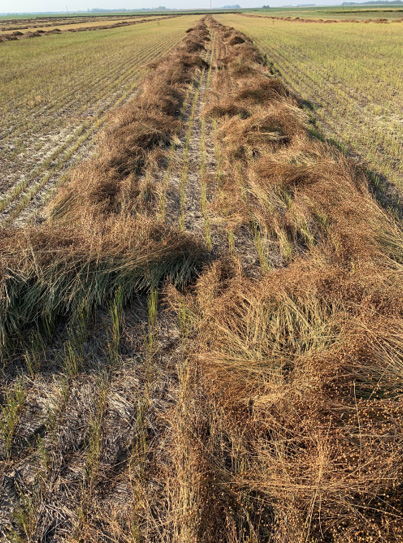
Flax can be straight-combined if maturity is uniform and green weeds are not a problem. If flax is swathed and pickup combined later, a tall stubble (4 to 6 inches) is desirable to hold the swath off the ground and allow for even drying. Using swath rollers can help settle the swaths into the stubble to reduce wind damage and aid pickup combining.
Follow manufacturers’ recommendations to reduce seed damage during combining. Some combines have special rollers ahead of the cylinder to fracture the flax boll. The flax seed coat is damaged easily, so proper adjustments are necessary. Yellow-seeded varieties are more susceptible to seed damage because of their thinner seed coat.
Flax seed is safe to store at 10% moisture short term with cool seed temperatures and at 8% long term at warm, 70-degree summer temperatures. Flax needs to be stored at a lower moisture content (7%) at warmer temperatures. Higher moisture will result in heating and mold growth. For an estimated allowable storage time add 6 percentage points to the flax moisture content and use an AST table for cereal grains. For example, 11% moisture flax would be equivalent to 17% wheat.
Drying flax may be required in some years. Natural air drying during October is expected to successfully dry flax to the short-term storage moisture content. A minimum airflow rate and expected drying time is shown in the following table.
| Moisture Content | Airflow (cfm/bu) | Fan Time (days) |
|---|---|---|
| 13% | 1.00 | 33 |
| 11% | .75 | 37 |
| 1.00 | 28 |
The resistance to airflow is much greater for flax than for wheat. A centrifugal fan will be required, and the depth will need to be limited to about 8 feet. Typically, natural air drying is limited for a flax moisture content of 13% or less. High-temperature drying is an option for drying flax. The resistance to airflow will be high, so the airflow rate and drying time will be lower than those experienced with other crops. Since flax is an oil crop, use care to prevent dryer fires similar to when drying oil sunflower.
Flax seed often comes from the combine with large amounts of green weed seed dockage. A good management practice is to remove green weed seed before storage.
Systematic bin monitoring is recommended. Flax storage should be managed similarly to other grains and oilseeds. The flax should be cooled with aeration for 20 to 30 degrees for winter storage and kept cool (below 40 degrees) as long as possible during spring and summer. Producers must also have tight storage bins, as even small holes or cracks can cause bin leakage.
Enter flax bins with caution. Flax seed in storage flows easily and supports limited weight. Lives have been lost by people falling into seed flax bins and becoming engulfed and dying from suffocation.
Insect pests in stored grain are not usually a problem in short-term storage. If flax seed is stored for a year or more, then monitor for hard-bodied grain weevils.
References
Growing Flax – Production, Management and Diagnostic Guide. Fifth Edition. Flax Council of Canada.
(https://www.flaxcouncil.ca/agronomy/grower-manual)
This publication was authored by Duane R. Berglund, professor emeritus and former Extension agronomist, and Richard K. Zollinger, professor emeritus and former Extension weed specialist, NDSU, 2007.