
A Preview of Grazing Cover Crops in North Dakota Cash Cropping Systems
(Research Report, Carrington REC, December 2020)Experiments to better understand the impacts of cattle integration in cash cropping systems.
Livestock integration into cash cropping systems is a way to gain multiple use of each acre of land per year. If a reliable system is identified, it is a way to reduce land requirements and increase synergy between crop and livestock enterprises. There are barriers to adopting this practice in North Dakota, including limited heat units, water deficit, and time or equipment availability. Overcoming these barriers can require creativity since no two growing seasons are the same. It is also difficult to find the right type of information needed to make decisions specific to our region, particularly when considering cost/benefit to both crop and livestock enterprises. To counter this, a large collaborative project was initiated in 2019, through funding from the North Central Region Sustainable Agriculture Research and Education (NCR-SARE) grant program to test cover cropping systems and how they affect soil health properties, animal performance, and ultimately, the bottom line. This project is unique in that it covers applied research and outreach in a holistic manner for both crop and livestock systems.
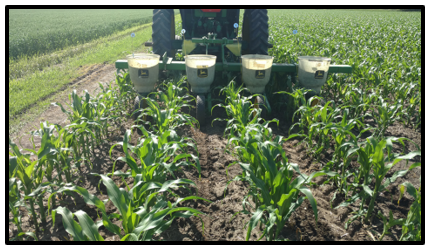
Large plot research and on-farm experiments were in initiated in 2019 and continued into 2020 to better understand the impacts of cattle integration in cash cropping systems. The research plots consisted of growing either wheat or corn as the primary crop. After harvest, spring wheat plots were direct-seeded with a cover crop mix consisting of turnip, radish, lentils and contained volunteer wheat. Corn plots were seeded to turnip, radish, lentil, barley, and rye at the corn V5-6 growth stage using a modified and off-set plate planter. Grazing of these plots occurred in late fall (late Oct. to mid-Nov.). Separate plots were established that either had no cover crops or had cover crops but were not grazed. Some of the agronomic research questions being studied during this time include changes that occur in the soil microbial community, soil compaction, nutrient composition, or crop yield changes by including livestock (vs. only cover crops or no cover crops). From the cattle perspective, we are testing performance of animal grazing compared to a drylot setting, both in terms of daily gain and marbling quality. In the end, these treatment combinations allow us to calculate the economic cost/benefit of the different enterprises. Concurrently, on-farm demonstrations occurred at three locations to test feasibility of adopting cover crop grazing. The goal of these demonstrations was to encourage the adoption of cover crop grazing in corn to learn more about the success rate, challenges, and limitations that occur in our region.
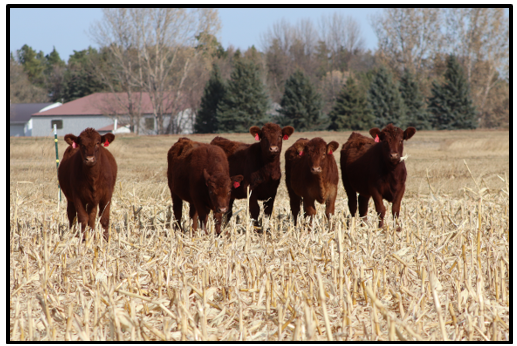
While COVID-19 has significantly altered the plans for outreach over the last year, there will be concerted efforts to increase the knowledge sharing and lessons learned from this project as more results and impacts are known. As it turns out, these two growing seasons have presented a wide array of conditions that are sure to teach us a lot about the factors that determine success for livestock integration. Stay tuned to learn more in the coming months!
Partial funding for this project was provided by the North Central Region Sustainable Agriculture Research and Education.
