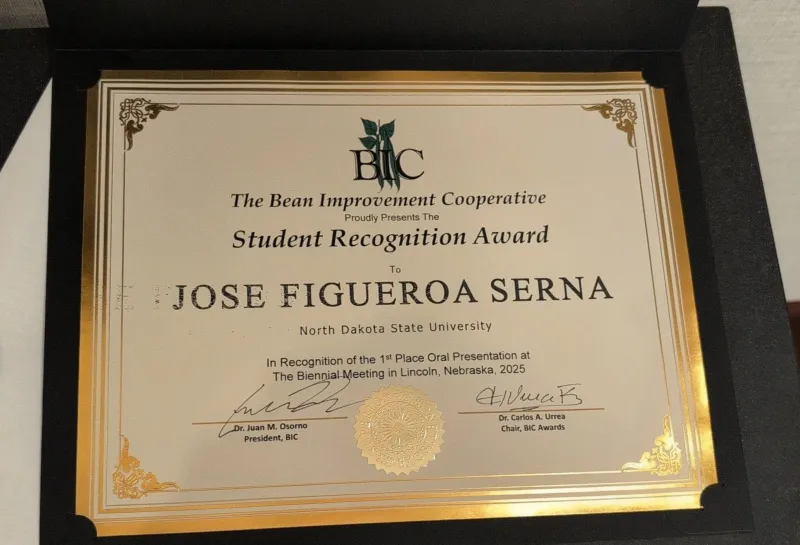
NDSU Plant Sciences Graduate Student Earns Award
Jose Figueroa-Cerna, graduate student and assistant breeder in the Plant Sciences department at NDSU, recently earned first place as the “best student oral presentation” at this year’s Bean Improvement Cooperative (BIC) meeting, held November 3–6, 2025, in Lincoln, Nebraska.
Jose, originally from Zacapa, Guatemala, presented on "A Framework for Genomic Selection in Dry Bean Breeding: From GBS to SNP Chip Development".
This study aimed to develop a GP pipeline tailored to the North Dakota State University (NDSU) dry bean breeding program to support genomic selection (GS) applications. Full abstract can be read below.
The project was founded through the USDA-ARS under the Predictive Crop Performance Project for Common Bean.
A special thank you to the coauthors: Nusrat Khan, Phillip E. McClean, Rian Lee, Jayanta Roy, and Juan M. Osorno.


Presentation Abstract:
Genomic prediction (GP) has the potential to accelerate genetic gain in dry bean (Phaseolus vulgaris L.) breeding by enabling earlier and more accurate selection decisions. This study aimed to develop a GP pipeline tailored to the North Dakota State University (NDSU) dry bean breeding program to support genomic selection (GS) applications. Phenotypic data were collected over four years from 427 advanced breeding lines representing multiple market classes and gene pools, encompassing eight traits that spanned agronomic (Seed yield, 100-seed weight, plant height, days to flowering, and days to maturity), quality (canning quality), and disease-resistance characteristics (White Mold -Sclerotinia sclerotiorum (Lib.) de Bary- and Common Bacteria Blight -Xanthomonas axonopodis pv. phaseoli (Smith) Vauterin, Hoste, Kersters & Swings-. Genotyping-by-sequencing (GBS) produced ~400,000 SNPs, which were quality-filtered to 109,000 high-confidence markers. Three GS models (Bayes A, Bayes B, and rrBLUP) were evaluated using the complete dataset, yielding moderate to high prediction accuracies (0.33 – 0.92) depending on the trait. To narrow down the number of SNPs for marker optimization and chip design purposes, genome-wide association studies (GWAS) and the additive effect of the GS analyses identified 4,440 SNPs as significantly associated with phenotypic variation among traits. After design and quality control, a chip containing 3,867 SNPs was developed. For validation purposes, two populations were genotyped; the first one (192 genotypes) was used in GS for Soybean Cyst Nematodes (SCN, Heterodera glycines Ichinohe) resistance, yielding a prediction accuracy of 0.80 based on cross-validation results. In contrast, the second population (217 genotypes) yielded a prediction accuracy based on cross-validation of 0.53 for protein content. These results highlight the value of marker optimization in enhancing GP accuracy and demonstrate a scalable framework for integrating genomic tools into dry bean breeding pipelines.