
Overview of Community Health Assessment Toolkit
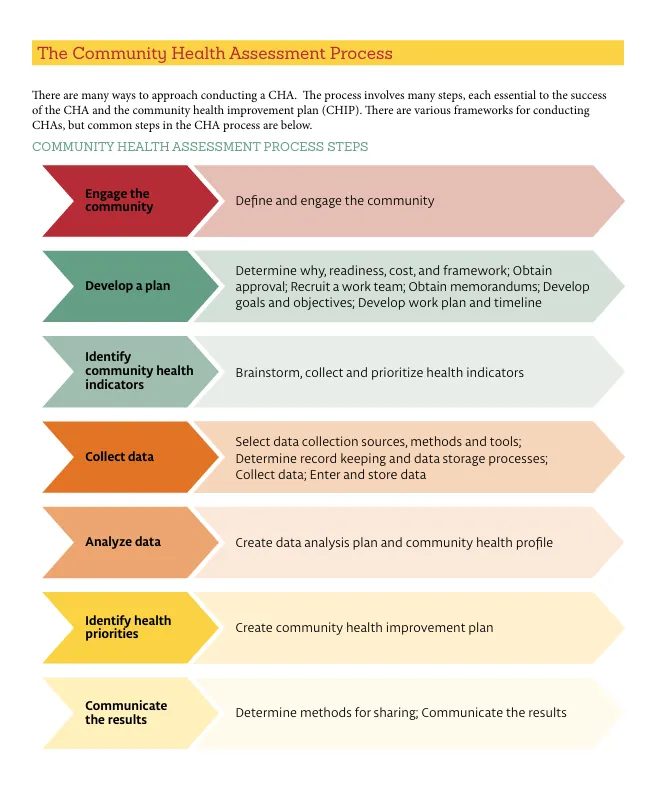
A community health assessment (CHA) or community health needs assessment (CHNA) is a systematic review process to determine key health issues. Tribes, states, counties, and communities may engage in a CHA to identify its citizens’ health needs. The development of a plan to address these needs is the goal of completing a CHA. This plan is often called a community health improvement plan or CHIP. CHAs also help move entities towards attaining public health accreditation. Public health accreditation is a designation that a public health entity meets the quality and performance criteria designated by the Public Health Accreditation Board. Tribal input and considerations were included in creating these criteria throughout their development. Criteria focuses on evidence-based standards in improvement and protection of the public’s health and are based on the 10 Essential Services of Public Health. Gaining public health accreditation is a lengthy process that includes time-intensive planning, documentation, infrastructure development and service provision improvement. In turn, meeting the standards and measures set forth by the accreditation criteria has numerous benefits (Public Health Accreditation Board, 2013):
- Identifying areas that a health program excels in
- Prioritization of long-standing concerns
- Stimulus for continued quality improvement in daily practice
- Performance and improvement opportunities
- Increased transparency and accountability within the health department
- Competitiveness in funding opportunities
- Improved management process
- Accountability with external stakeholders
- Improved communication with governing bodies
- Coordination of public health services
- Exercising tribal sovereignty
Completing a CHA is one of the first steps in reducing health disparities. The CHA provides formal identification of issues and needs; successful current approaches; opportunities to improve the efforts to reduce disparity; opens communication among stakeholders to work together towards disparity reduction; can provide previously unavailable funding resources to assist in disparity reduction; and guides the development of a plan to address the identified health disparity.
Interested in accessing, "Engaging Tribal Nations of North Dakota in Conducting Community Health Assessments" toolkit?
Email us at aiphrc.ndsu@ndsu.edu