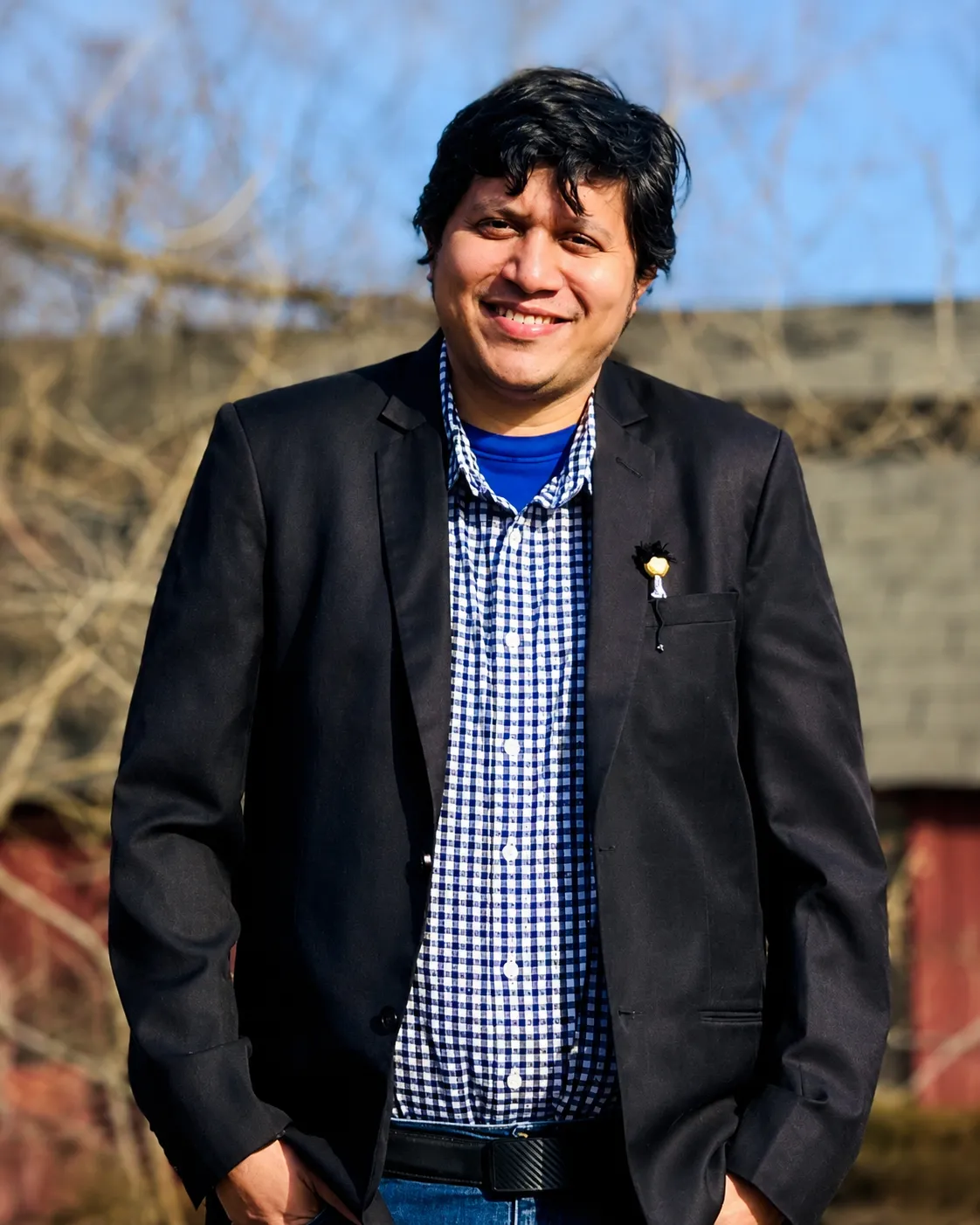
Challey Spotlight: Nasih Alam
Background and Academic Journey
Nasih Alam brings together literature, history, and a deep interest in the lives of ordinary people who experienced extraordinary circumstances.
Before beginning his doctoral work in history at North Dakota State University, Nasih built his academic foundation in English language, literature, history, and culture. He earned a bachelor’s degree in English from East West University in Bangladesh in 2010 and a master’s degree in English from the same university in 2012. From 2013 to 2022, he taught English language, literature, history, and culture at several universities in Bangladesh.
After coming to NDSU, Nasih completed an MA in English in 2024 and is now a third-year PhD student in the Department of History.
That background across literature and history shows up in the way he approaches his current research. Nasih is interested not only in what happened in the past but also in how people told stories about survival, captivity, power, and freedom. His work asks readers to look beyond famous political figures and major institutions to understand better how ordinary people navigated difficult historical moments.
Nasih is in the thick of preparing for his comprehensive exam, diving into a book and making notes each day. Once he gets through the exam, he’s set on writing a seven-chapter dissertation that zeroes in on European and African American captives from the late eighteenth to late nineteenth centuries. His main argument? These captives weren’t just passive victims. Many of them took strategic steps to protect themselves, gain their freedom, and navigate the tricky and often perilous situations they faced.
Research Focus and Insights
Nasih studies captivity narratives, a field he often explains in simpler terms as the study of prisoners of war.
That way of describing his research came from experience. While attending a conference in South Dakota, he was speaking with someone before his presentation and mentioned that he had worked on captivity narratives. The person asked what “captivity” meant. Nasih quickly reframed the topic as “prisoners of war,” and the idea immediately became clearer.
That moment stayed with him. It reminded him that good research communication is not about making work less serious. It is about making it understandable.
His research focuses on European and African American captives from the late eighteenth century through the late nineteenth century. He is especially interested in the ways captives exercised agency. Historians have often portrayed prisoners of war primarily as victims, and many certainly faced danger, uncertainty, and hardship. But Nasih’s work points to a more complicated picture. Some captives worked as scouts, shared information, collaborated with captors, gathered intelligence, or operated between competing groups in ways that helped them survive.
In that sense, his research challenges simple categories. Captives were not always passive figures acted upon by others. They could also be decision makers, negotiators, informants, and, in some cases, double agents working to ensure their own safety and security.
One figure who helped draw Nasih to this topic was Sarah Wakefield, a captive during the U.S.-Dakota War of 1862 who later wrote Six Weeks in the Sioux Tepees: A Narrative of Indian Captivity. Her story complicated the way he thought about captivity narratives and the people at their center. Nasih became interested in how individuals in captivity understood their own experiences, how they described those experiences afterward, and how their choices shaped the historical record.
Broader Impact and Public Engagement
Nasih sees his work as part of a bottom-up approach to history, emphasizing the importance of connecting with broader audiences and fostering shared understanding.
Rather than focusing only on presidents, generals, or political leaders, he studies ordinary people and underrepresented groups whose decisions also shaped historical events. People caught in captivity, war, displacement, or uncertainty were not simply background figures in larger political stories. They made choices, built relationships, adapted to danger, and sometimes influenced events in ways that are easy to overlook.
“My work focuses on ordinary people,” Nasih said. “By reading my dissertation or book, my readers will realize that ordinary people matter a lot in history.”
That is why Nasih believes his research matters beyond academia. By studying captives and prisoners of war, he hopes to help readers see that history is not only shaped by those in formal positions of power. It is also shaped by people whose stories are harder to find, harder to interpret, and often more complicated than traditional accounts suggest.
Winning the Challey Institute’s recent 3-minute thesis pitch competition helped Nasih think more deeply about how to share that message.
The competition challenged him to take a complex research project and present it clearly to a general audience. He came away with a stronger sense that scholars need to be able to tell a story, not just present information.
“After seeking guidance, I learned that it was important for me to tell a tale within three minutes,” Nasih said. “It changed the way I thought about communicating my research.”
For Nasih, the experience changed the way he thinks about communication in two ways. First, it reminded him that scholars need to practice explaining their work to wider audiences using simple words and examples. Second, it pushed him to think about how to describe his research in as few as 30 seconds during everyday conversations.
Challey Experience and Student Support
The Challey Institute has become an important part of Nasih’s experience at NDSU.
Before becoming involved with Challey, Nasih had fewer opportunities to build connections outside his department. Through Challey programs, he found a broader intellectual community, developed friendships with students and colleagues across campus, and gained new opportunities to grow as a scholar and communicator.
“Without Challey, my experience at NDSU would not have been so fulfilling,” Nasih said. “I would not have meaningful connections and a lot of friends and colleagues from other departments.”
He points to the Pluralist Lab, Communication Lab sessions, and Dr. John Bitzan’s graduate seminar courses as especially meaningful. The Pluralist Lab gave him a space to exchange ideas with others across disciplines. Communication Lab helped him sharpen the way he presents his research. Bitzan’s graduate seminars gave him new perspectives on classroom teaching, discussion, and the value of giving students room to speak respectfully and authentically.
For Nasih, these opportunities show why support for graduate students matters. Financial support is important, but students also need strong mentorship, honest feedback, and a university environment that gives them room to grow. That support also helps students see themselves as part of a larger community. Nasih is grateful for the donors, faculty, staff, and friends of the Challey Institute who make student programs possible. Their support creates opportunities for students to build relationships, test ideas, receive feedback, and share their work with audiences beyond the classroom.
Professional Motivation and Future Goals
Nasih is motivated as a scholar by his belief that ordinary people play a significant role in history.
His work is driven by the idea that historical understanding is incomplete when it focuses only on elites or official decision makers. The lives of captives, prisoners of war, and underrepresented groups reveal how people without formal power still made consequential choices. They adapted to uncertainty, protected themselves when possible, and sometimes shaped the actions of those around them.
As he progresses with his dissertation, Nasih aims to expand this research into a broader project that encourages readers to reconsider concepts like captivity, agency, and survival. He’s interested in challenging traditional narratives and highlighting that individuals often labeled as victims possess their own strategies, relationships, and means of influence.
His experience with the 3-minute thesis pitch also gave him a clearer professional goal: to become better at communicating research in ways that reach people outside his field. Whether in the classroom, at conferences, or in public-facing conversations, Nasih wants to explain complex ideas with clarity.
Beyond Research
Outside of his work as a graduate student, Nasih enjoys watching soccer and cricket highlights, spending time with his family, and watching movies and documentaries.
He also tries to stay grounded through the highs and lows of academic life. Nasih describes life as his best teacher, a teacher that reminds him not to become too discouraged by failure or too carried away by success.
“I treat life as my best teacher,” Nasih said. “Life teaches us that you will fail more than you succeed. So, it is important to remain level-headed and not go overboard with successes and failures.”
That humility comes through in the way Nasih talks about his research, his growth, and the people who have helped him along the way. He studies people who faced uncertainty and hardship but still found ways to act in difficult circumstances. In many ways, that is also how he approaches his own development as a scholar: with curiosity, persistence, and a willingness to keep learning.
His work focuses on a fundamental yet impactful concept: history isn’t just about the notable and powerful figures. It also encompasses the experiences and stories of everyday people, whose lives, decisions, and perspectives should be acknowledged and remembered.