Challey Spotlight: Aditya Goyal
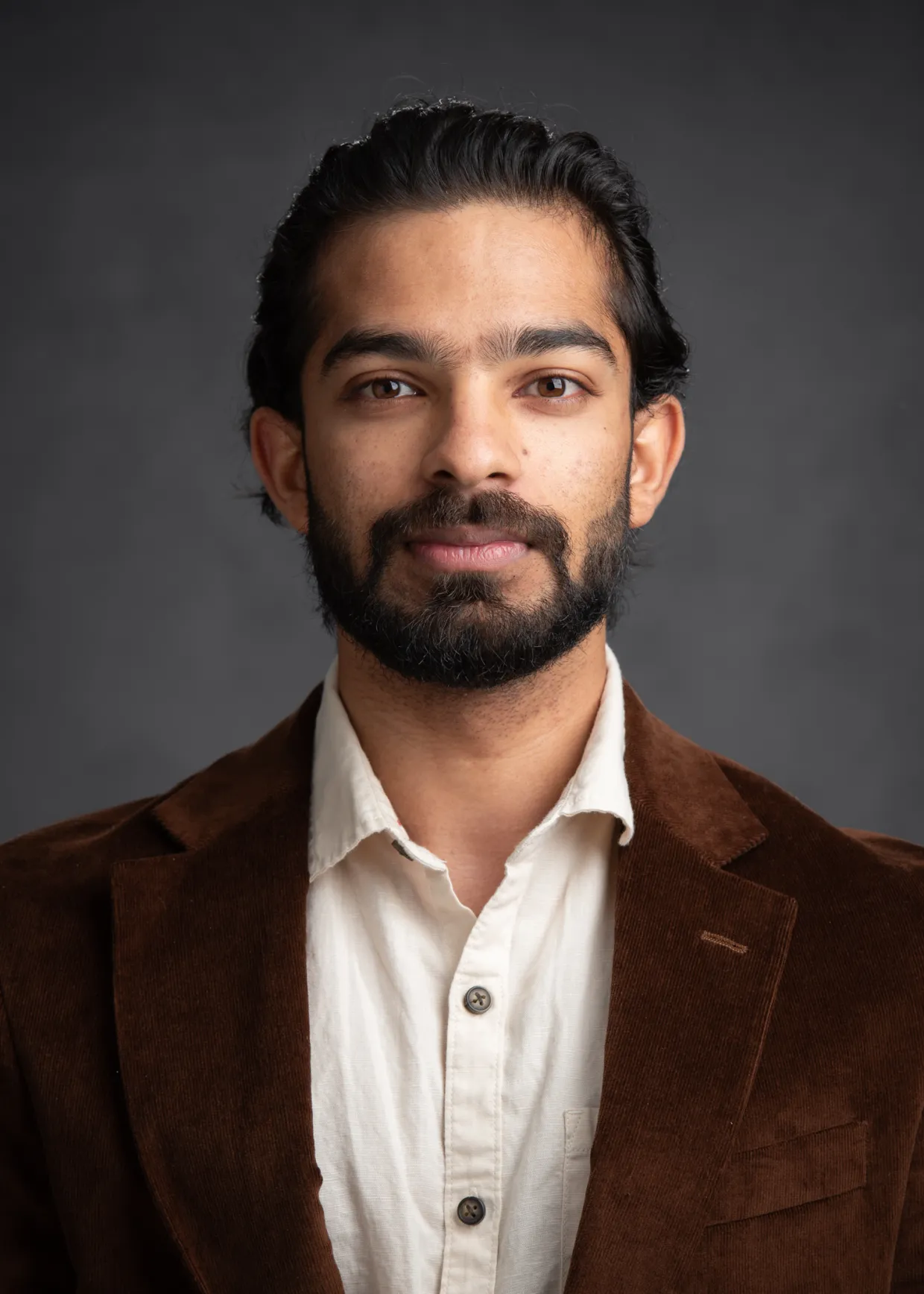
Background and academic journey
Aditya Goyal’s path into research began not with abstract theory, but with a concrete environmental problem. While completing his master’s degree in physics in India, he worked on removing methylene blue dye from water, a serious contamination issue across parts of India and Bangladesh. That project introduced him to the power of research as a practical tool for solving real-world problems and set the direction for much of what followed.
Trained initially in physics, Goyal developed a research approach grounded in careful experimentation and rigorous methodology, which enabled him to move fluidly across disciplines, from physics to materials science and nanotechnology. That adaptability proved pivotal when a visiting Fulbright scholar, who later became his PhD advisor, recognized the potential in his work and encouraged him to continue his research in the United States. He ultimately joined North Dakota State University as a PhD student in materials and nanotechnology, where he worked on calcium peroxide nanoparticles for phosphate removal in eutrophic lakes, research that combined environmental need with applied materials science and led to a provisional U.S. patent.
Along the way, Goyal realized that addressing environmental challenges required a deeper understanding of ecological systems themselves. He pursued a concurrent master’s degree in environmental engineering to strengthen the link between his materials research and real-world application. His commitment to academia was also shaped by family influence—his mother, who holds a PhD in English, spent her career teaching and mentoring students. With guidance from mentors who emphasized impact alongside publication, these experiences solidified his view that research should not end in the lab but should demonstrate clear value beyond it.
Research focus and insights
Goyal often describes his work in simple terms: using science to solve environmental problems created by modern materials. Whether addressing plastic pollution, water contamination, or agricultural runoff, his research focuses on developing sustainable alternatives that reduce environmental harm without sacrificing performance.
One central thread of his current work centers on replacing petroleum-based plastics with biodegradable alternatives. Goyal is especially interested in reducing reliance on single-use plastics by developing materials that can support a more sustainable, circular economy. The challenge, he notes, is not just making materials biodegradable, but making them functional. Conventional plastics are durable, inexpensive, and effective. Sustainable alternatives must meet similar standards while also breaking down safely and efficiently after use.
His research actively confronts the common assumption that biodegradable materials are inherently inferior. In practice, these materials face fundamental limitations, including reduced rigidity and premature degradation. Goyal’s work uses nanotechnology coatings and advanced material design to address those barriers, improving durability while preserving environmental benefits. Rather than presenting sustainability as a trade-off, his research seeks practical solutions that close the gap between environmental responsibility and everyday usability.
At the Challey Institute, Goyal has found a framework that aligns closely with his goals. He points to the Institute’s emphasis on human flourishing as especially influential, shaping how he communicates his work and why it matters. Through Challey, he has had opportunities to translate technical research into op-eds and public-facing writing, helping broader audiences understand what the science is doing and why it is relevant. That experience reinforced his belief that research gains value when people can quickly grasp its purpose and potential impact.
Read his op-ed on his research here.
Broader impact and public engagement
Across his projects, Goyal hopes to encourage policymakers and the public to think more seriously about how environmental policy intersects with material innovation. His work on plastics has led him to examine regulatory gaps, particularly the uneven adoption of plastic policies across the United States. While many coastal states have enacted bans or limits on certain plastics, many inland states have few or no comparable regulations.
That uneven landscape raises essential questions about environmental outcomes, incentives, and innovation. Goyal sees his research as part of a broader conversation about how policy and technology can move together, offering alternatives rather than relying solely on restrictions. In his view, better materials paired with thoughtful policy can make environmental progress more feasible and less disruptive.
Communicating that nuance requires balance. Goyal acknowledges that early in his career, his work leaned heavily on technical detail. Over time, through public engagement and experience, he has learned to pair rigor with clarity. The goal is not to oversimplify, but to explain complex ideas in ways that help people understand why they matter. When that balance is achieved, he believes research can inform decisions rather than overwhelm them.
Although his work is global in scope, Goyal does not limit its relevance to a specific community. Environmental challenges, in his view, cross boundaries. Whether addressing water quality, plastic waste, or agricultural runoff, he sees his research as contributing to solutions that benefit people broadly rather than targeting a single population.
Professional motivation and future goals
What motivates Goyal most is progress, even in small increments. A single promising result, a visible improvement in a material, or a successful early test can be enough to reaffirm that the work is moving forward. Recognition also plays a role, whether through publication, patents, or public interest, not as an endpoint, but as confirmation that the research is resonating beyond the lab.
Looking ahead, he plans to continue building on both applied and fundamental research. While much of his current work focuses on practical applications, he is increasingly interested in exploring the underlying chemistry that enables sustainable materials. Recent grant submissions reflect that shift, pairing applied projects such as biodegradable packaging with more foundational studies of how these materials function at the molecular level.
He is also advancing the real-world testing of his patented calcium peroxide nanoparticle technology, moving it from laboratory validation toward broader implementation. That combination of theory, application, and translation reflects how he envisions his future career: research that begins with fundamental science and ends with tangible environmental improvement.
Beyond research
Outside the lab, Goyal describes himself as highly social and community-oriented. He is actively involved in a wide range of student organizations at NDSU, from outdoor and climbing clubs to technical and cultural groups. Those spaces offer a counterbalance to research and expose him to people with different interests, backgrounds, and perspectives.
He sees that engagement as more than recreation. Interacting with diverse communities helps him step outside disciplinary silos and think more broadly about how science fits into everyday life. Whether collaborating in a lab or connecting through shared activities, he values environments that encourage curiosity, conversation, and connection.
At its core, Goyal’s work reflects a consistent theme: using scientific tools to solve real problems while keeping people, not just data, at the center of the effort.