Challey Student Spotlight: Julia Nelson & Karsten Larson
A Different Kind of Classroom
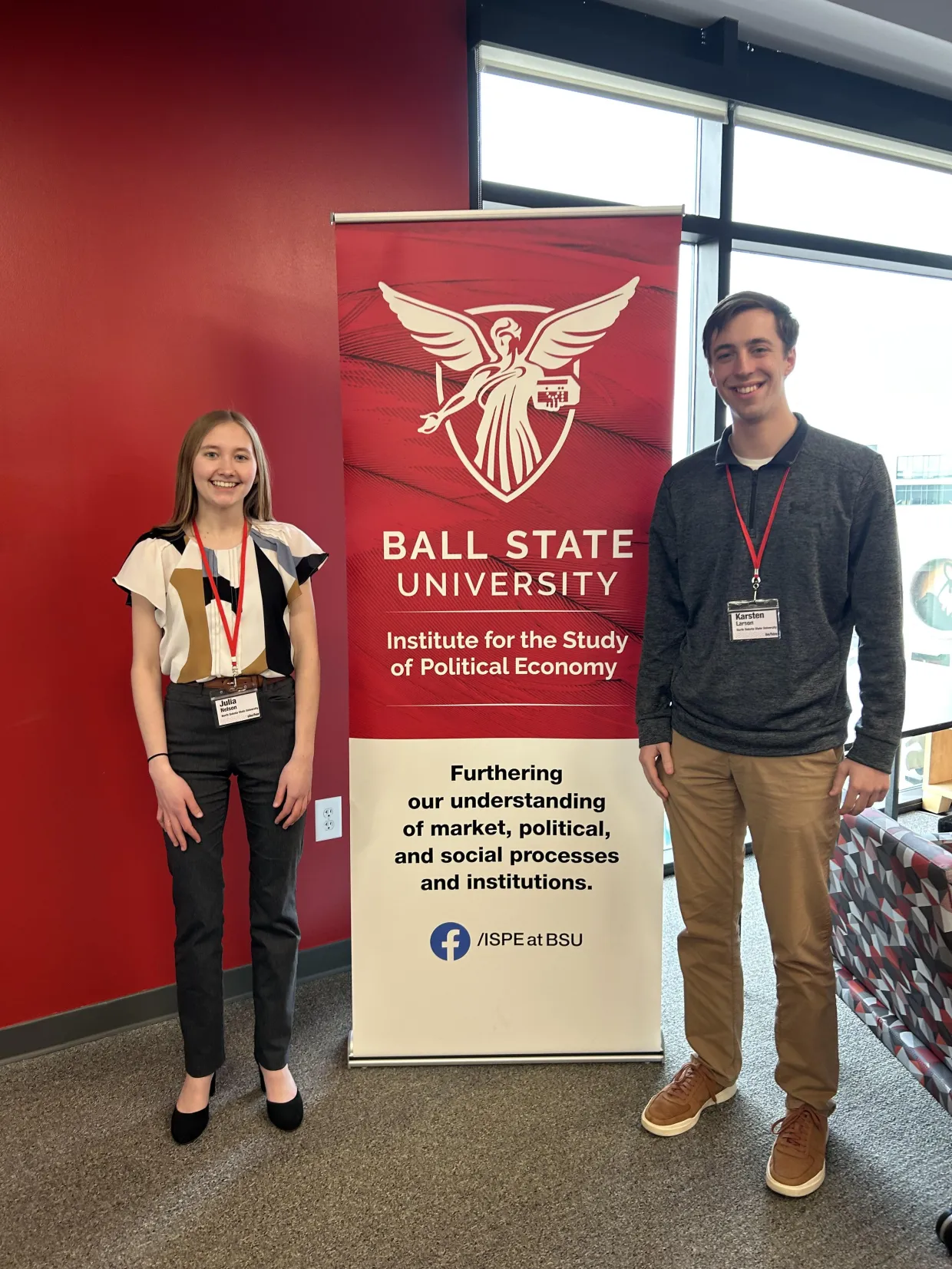
In late February, two Challey Institute students boarded a flight to Fishers, Indiana — not for an internship or a job fair, but for two days of serious intellectual discussion with a small group of undergraduates from across the Midwest. The occasion was the Spring Student Discussion Colloquium, hosted by Ball State University's Institute for the Study of Political Economy, which was centered on the 250th anniversary of Adam Smith's The Wealth of Nations. Julia Nelson and Karsten Larson came back with more than talking points. They came back thinking differently.
Meet Julia and Karsten
Julia Nelson is finishing her undergraduate degree in applied economics at NDSU and is simultaneously pursuing a master's degree in agribusiness and applied economics. Her longer-term plan is law school, a path she's been intentional about. Economics, she says, is the ideal foundation for that ambition. "It incorporates a lot of important details in analytics, as well as how markets and how people make decisions," she explained. "Those are really good skills to learn before you go to law school."
Karsten Larson is completing a B.S. in Computer Science with a minor in Artificial Intelligence and a Certificate of Private Enterprise, maintaining a 4.0 GPA throughout. His academic work has included machine learning research for the USDA on oat disease detection and, more recently, the development of autonomous AI agents for personalized education at NDSU. He was drawn to the Challey Institute through the scholarship program and stayed for the ideas. "I'm just generally interested in markets and those surrounding areas," he said. "That's what kept me around."
Both students were introduced to the Challey Institute through the scholarship program and courses taught by Dr. John Bitzan. Julia credits that early involvement with broadening her thinking well beyond her coursework. "Challey does a good job of intersecting economics and business ideas and putting them together," she said. Karsten put it more plainly: "Before, I had no idea what school choice or rural healthcare even was. Now, when I see those topics come up, I actually have an opinion."
An Intense Book Club, In a Good Way
The colloquium brought together roughly 15 to 20 students from Indiana and Kentucky universities, and two from North Dakota. Participants read excerpts from The Wealth of Nations alongside supplementary articles before arriving and then spent two days in structured yet free-ranging discussions guided by a faculty moderator. Karsten described it simply: "One big intense book club, but intense in a good way."
Julia had walked in knowing almost nothing about the event. Dr. Bitzan had emailed a group of students asking about their availability, and the details beyond that were sparse. "We went in not exactly knowing what to expect," she said, "it turned out to be a really good event." What struck her most was how applicable Smith's ideas remained. "A lot of the students had applications in economic fields that drew upon different aspects of Smith," she noted. "All of the modern insights that can be applied to his work, that's what really stood out."
For Karsten, the conversation itself was the draw. "Reading Smith, I kept seeing parallels with today," he said. "Everyone was trying to apply his ideas to some sort of modern-day event, like tariff policy, or how government functions. I liked seeing what other people took away."
Global Perspectives, Local Impact
One of the colloquium's more unexpected gifts was the range of people in the room. Julia found herself learning about students heading to Belize to study crime statistics and meet with government officials — research that had given them a very different lens on economic development than her own. Karsten connected with a student working in defense contracting research. "That's something I would totally not have come upon on my own," he said. "I don't think I would have found that in North Dakota."
The discussions also pushed both students into unfamiliar intellectual territory. A section on colonial power and influence left a particular impression on Julia. "My previous understanding was that colonial influence was a thing of the past," she said. "Looking at how current society still carries some of those influences was really interesting." Karsten found himself reconsidering something he thought he understood: Smith's perspective on American independence. "I just thought the Americans had enough and did it on their own," he said. "But here was Smith in Scotland, arguing for greater independence from the mother state. I didn't realize people in Britain were recognizing that."
The Bigger Picture
Back in Fargo, the colloquium has become part of a broader pattern for both students, with the Challey Institute's reading groups notably enhancing Julia's communication skills and preparing her for law school through active engagement with theory.
Karsten credits Ben Klutsey, a speaker Challey had on pluralism, with changing how he approaches disagreement. "First, I want to understand the other person better, so I'm not debating a straw man," he said. "That's changed how I approach debates and disagreements."
Why It Matters for Other Students
For students wondering whether they should get involved, both Nelson and Larson see real value in taking that step. Their experiences suggest that no single type of student benefits from Challey programming. What matters more is a willingness to engage, ask questions, and be open to unfamiliar perspectives.
“There’s something for everybody,” Nelson said. “Whether it’s discussion or just attending an event, there are so many different things you can do.”
Larson’s advice was even more direct: “Just go ahead and get involved. All it’s done is increase how I view the world and how I take things in.”
That may be the strongest takeaway from their trip to Indiana. A 250-year-old book was the starting point, but the experience was really about something larger: learning how to think more carefully, listen more openly, and take ideas seriously in conversation with others. For Nelson and Larson, that is exactly the kind of opportunity that continues to make the Challey Institute matter.