From the Classroom to the Conference Stage
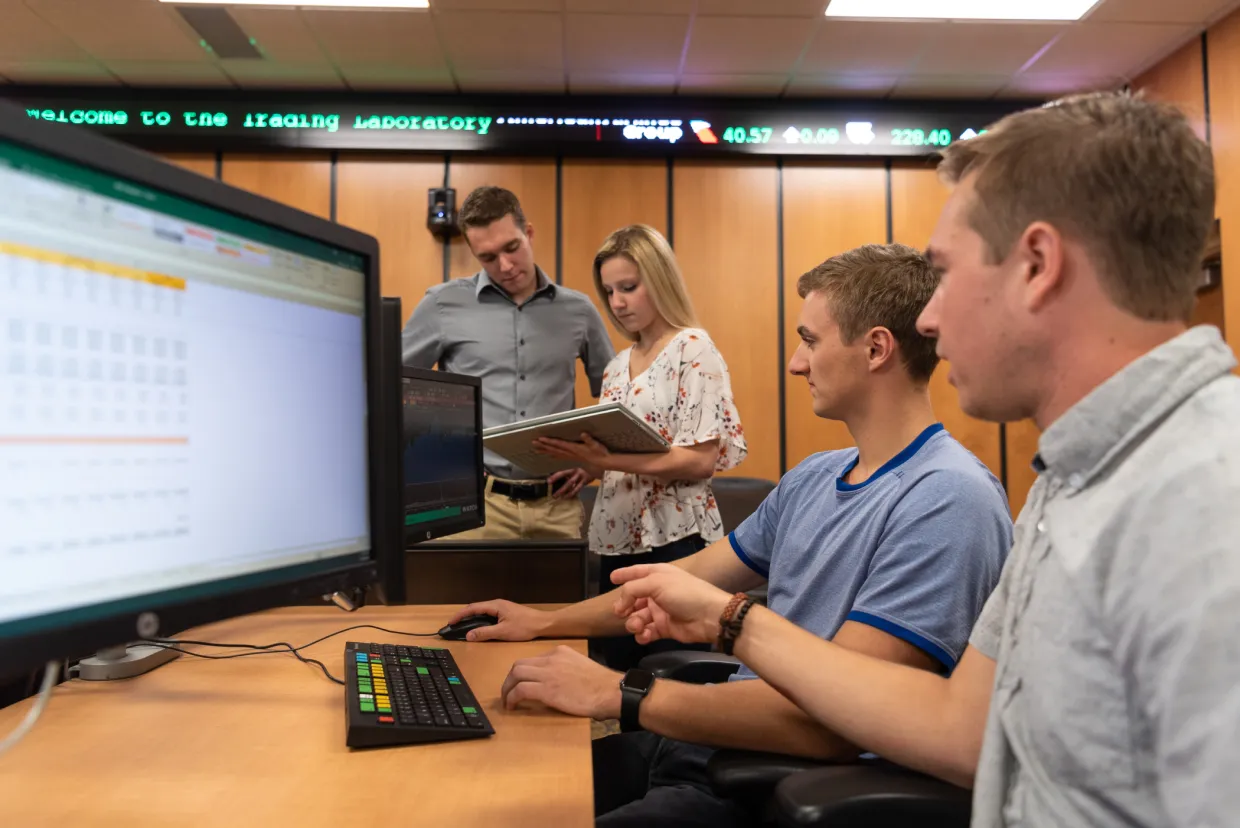
When most students think about “research,” they picture a final paper turned in for a grade. For three NDSU College of Business students, research became something else entirely: a chance to help build real academic work, defend it in front of experts, and represent NDSU at a professional conference in Denver, Colorado.
This fall, Jaxon Nankivel, Sean Schiefelbein, and Samuel Peterson traveled with Professor Oudom Hean to present research in a room filled with academics and graduate students, many of whom were surprised to see undergraduates at the front of the room. As Jaxon put it, they were among the youngest groups there, and in his sessions, he did not see other undergrads presenting.
What brought them to Denver was not a single class assignment, but months of digging into data, building models, revising drafts, and learning how to explain complex ideas clearly.
How it started: a class, a conversation, and a “yes.”
All three students found their way into research through everyday moments that turned into opportunities.
For Jaxon, it started in Hean’s international finance class. After hearing that Hean might hire a research assistant, he followed up at the end of the semester and began working with him in March. What made him say yes was simple: he wanted more quantitative work, more learning, and the chance to publish and present.
For Sean, the path was less linear. He was also in international finance, stayed engaged in class, and then later talked with Hean after a Challey event about markets and crypto. That conversation opened the door to becoming a research assistant. He was looking for something meaningful when internship plans had not worked out, and he liked the chance to learn analytics and research alongside other motivated students.
For Sam, it began in Finance 330, a data analytics course. Early in the semester, Hean approached him after class to ask if he had ever considered the master’s program. That conversation pulled him into research at a time when he was unsure what he wanted after graduation and wanted a more challenging, analytics-heavy direction.
What it’s like working with Professor Hean
The students described Hean’s mentoring style as both supportive and demanding, in the best sense.
Jaxon emphasized that he is “hands off” in day-to-day work: he gives direction, provides help when needed, and leaves room for students to figure things out and work at their own pace.
Sean noted that Hean’s depth of knowledge stood out immediately, especially in his questioning of students. In class discussions and presentations, Hean pushed them to know what they were saying and why, not just repeat a conclusion.
That dynamic built confidence. Sean described learning to commit to an answer, defend it, and stay open-minded when challenged.
And in Denver, the mentoring became even more personal. Jaxon said the trip gave them more time to talk with Hean one-on-one and as a group, including conversations about career paths and what they were studying.
The research, in plain language
The students worked on two projects, each with a straightforward real-world question.
Jaxon and Sean’s work focused on banking consolidation and innovation. In Jaxon’s plain-language description: if banking becomes more concentrated, similar to how a monopoly can form in a market, what does that do to innovation? To measure innovation, they used patents.
Sam’s research asked a different question: Can broader internet access improve health outcomes? His simple summary was direct: more expansive internet connectivity can lead to better health outcomes.
Across projects, one theme surprised them: research is not as straightforward as it looks from the outside. Jaxon said the hard part was often the unglamorous work of getting usable data. It is not just downloading a spreadsheet. It involves finding niche datasets, cleaning them, and matching them up.
Sean also said the experience changed how he thinks: research revealed how interconnected everything is, and how quickly a model can be challenged by a variable you did not consider.
Presenting in Denver: higher stakes, better feedback
For Jaxon, presenting in Denver was exciting but also a step up from anything he had done. He enjoys presenting, but this was a new audience with deeper expertise, and that raised the pressure.
The surprise was how constructive the feedback was.
After one presentation, an audience member approached Jaxon to say she was impressed that he was an undergrad and admitted she would not let her own undergraduates present her research.
Sean and Sam described similar reactions: a PhD student told them she did not start doing this kind of work, including regression modeling, until her doctoral program.
They also learned what “real” academic questions feel like. Sean mentioned that conference feedback highlighted a missing piece in their analysis, specifically questions around endogeneity, and that even the back-and-forth between professors became part of what made the experience valuable.
For Sam, one comment stuck out because it rewarded intellectual honesty. An economist praised him for paying attention not only to significant results, but also to the “insignificant” ones, because it forces you to think harder about what else might be going on.
What changed for them and what comes next
Each student described the experience as a turning point, not just a resume line.
Sean said research became a significant talking point in job interviews and helped him develop a more analytical mindset, including forming hypotheses, finding data, running analyses, and interpreting results. He sees it as preparation for a career path leaning toward finance and research work.
Sam said the experience shifted his interest from purely financial analytics to research-driven business intelligence and led him toward an MBA. Outside of school, he is also building a business selling agricultural spray drones in North Dakota and Minnesota, and he credits the MBA with helping him handle the business side.
Jaxon said the experience opened his eyes to what is possible at NDSU, including travel, professional connections, and stronger opportunities to build his resume. He plans to begin an MBA program this spring and is still exploring long-term directions, including research-related opportunities.
Their advice to students on the fence
The students did not sugarcoat it. Research takes work. But they were consistent on the bottom line: it is worth it.
Sam’s advice was straightforward: if you do not have something firmly set in the near future, research is worth prioritizing because it becomes one of the most meaningful experiences you can point to later.
Jaxon added that what many people miss is the relationship you build with a professor. From the outside, it can look like “doing someone else’s work,” but the mentoring and opportunities are more nuanced than that.
And in Denver, they saw another side of academia that most students never get: a community of people who genuinely care about ideas, data, and discovering what is true, plus the chance to meet people who will challenge your thinking and sharpen your work.