IoT tools helping to further FEWS research in North Dakota
An important component of NDSU’s Food, Energy and Water Security research is accelerating the development of agricultural technologies. And one way NDSU is incorporating this is through the Internet of Things tools.
IoT is a network of physical devices, vehicles and other physical objects embedded with sensors and software that connect and exchange data with other devices and systems over the internet.
One method is LoRaWAN (Long Range Wide Area Network), a wireless communication system designed for long-range coverage with minimal power consumption, enabling devices to operate for years on small batteries. It connects remote sensors to central gateways, making it well-suited for large, distributed environments. In agriculture, compact, rugged LoRaWAN-enabled devices can continuously monitor equipment, soil conditions, crops, and livestock, providing real-time data with minimal maintenance. This makes LoRaWAN a key enabler of Internet of Things (IoT) solutions for efficient, data-driven farming.
"FEWS is about giving North Dakota producers science-based tools to better manage their resources," said Frank Casey, associate director of the North Dakota Agricultural Experiment Station and principal investigator for NDSU's FEWS project. "As a soil physicist, I spent years collecting field data by hand. Now our scientists can see soil and weather conditions in real time, across many sites, at a fraction of the cost. That expands the kinds of problems they can solve. Partnerships with ARS, Grand Farm and DCN make it possible to scale this across the state."
The IoT technology is being implemented at NDSU’s Research Extension Centers across the state. There is also a telecommunications pole in front of the Peltier Complex on the NDSU campus, and another on the northwest corner of the Veterinary Diagnostic Laboratory at 4035 19th Ave North. “Combined, these two locations provide coverage for our Main Station research plots and livestock facilities,” said Aaron Reinholz, NDSU Agriculture Technology Executive Project Manager.
IoT is also a part of NDSU’s collaboration with Grand Farm and the Dakota Carrier Network (DCN).
DCN is owned by 13 independent rural broadband providers across North Dakota. It has built a strong technology platform that delivers high-quality data for precision agriculture research and other uses. Its network already reaches much of the state. It can be extended to additional locations—including commercial farms, extension centers, and other sites—with the long-term goal of covering every acre of North Dakota.
“Along with our rural broadband owners, DCN is leveraging our 70,000 miles of fiber optics in North Dakota to advance precision agriculture by providing the high-speed, secure connectivity needed to support data-driven farming and agricultural research. Through partnerships with NDSU, Rural Extension Centers, and Grand Farm, DCN has deployed fiber, private 5G, and IoT infrastructure that enables researchers and producers to collect, transmit, and analyze real-time data from sensors, autonomous equipment, and field monitoring systems,” said Todd Domres, DCN manager of owners and government relations. “This connectivity supports innovations in precision crop and livestock management, automation, and remote sensing.”
DCN is also helping users prepare for greater automation. Its IoT management platform enables users to set rules and automate processes, supporting faster, more informed, data-driven decisions.
John Rickertsen, Hettinger REC research agronomist, is using sensors to monitor temperature, humidity, leaf moisture and soil wetness to help control fusarium head blight in spring and durum wheat. High humidity and rainfall can promote spore production in wheat heads; knowing the specific conditions can help researchers determine whether the weather was favorable for infection during the crucial flowering period.
“This information can be correlated to the infection we see in the trial and will allow pathologists to fine-tune their prediction models to our region,” Rickertsen said. “It gives me weather and soil moisture data right from my research study.”
Rickertsen said he hopes to deploy more sensor stations across his plot area to bolster his research data.
“I can see deploying more of these sensor stations through my plot area, and the addition of soil moisture data in my trials will be quite useful,” Rickertsen said. “Typically, these sensors would need to be manually downloaded at the station or connected to the cellular network. This is either inconvenient, time-consuming, or, in the case of connecting to the cellular phone network, expensive. The LoRaWAN network we now have installed is perfect for the deployment of multiple sensors that we use now and will be adding more of in the future.”
Another researcher utilizing IoT technology is Lindsay Malone, NDSU assistant professor of conservation agronomy.
Malone's research aim is to reduce tillage to improve agricultural sustainability. One challenge of planting soybeans in the region is the amount of residue left over from the previous year's corn crop.
“Our springs are slow to warm up, so very little decomposition happens before planting,” Malone said. “Without tilling, there is a lot of material to cut through in order to achieve good seed-soil contact.”
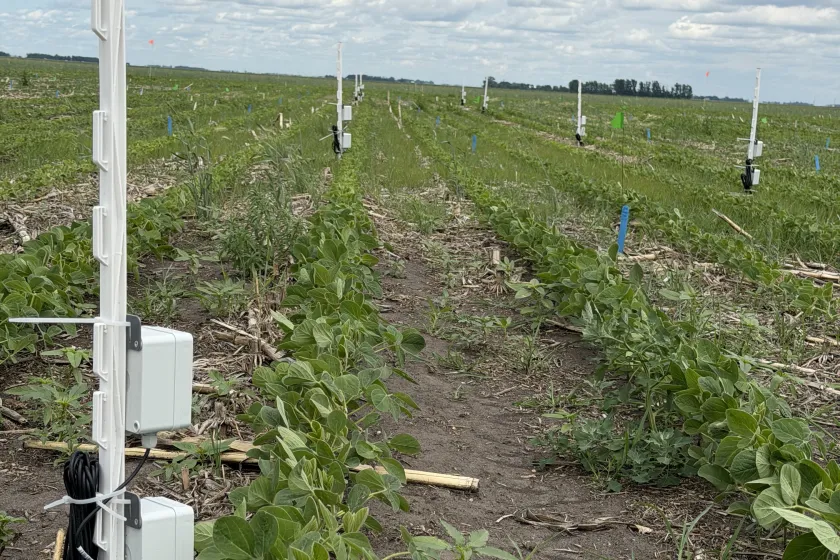
Malone’s team used LoRaWAN-compatible sensors to work with the IoT NDSU is establishing at facilities such as the RECs across the state and at Grand Farm near Casselton. Malone’s team partnered with Grand Farm to use plots to test four levels of corn residue.
The specific sensors are Terros 11 from Meter and they measure soil moisture and temperature. They are attached to a Decent Labs data logger that communicates via LoRaWAN.
“One of the things we might see with different amounts of crop residue is changes in soil moisture and temperature, so we wanted to track those throughout the season,” Malone said. “It was really helpful to look at the sensor data in real time, and essentially check on the sensors remotely.”
“We’re repeating this study at another location in 2026, and hopefully going to be able to use more of the IoT options with NDSU Agriculture in the future,” Malone added.
At the Carrington REC, IoT technology is being implemented in several areas in 2026.
“We have a number of different sensors that we would plan to use this year,” said Carrington REC director Mike Ostlie.
That includes using soil moisture sensors to inform irrigation strategies and to provide real-time information about when plants need more water.
“Some of the sensors we are planning to use so that we can get more precise weather data,” Ostlie said. “We would like to complement the already existing and extensive NDAWN station data with field-specific data to capture more of the weather variability, which is ultimately going to improve our data quality.”
There will also be experimentation with water-level and temperature sensors in cattle pens to ensure the water will not freeze in the winter. Ostlie said Carrington REC is also interested in trying new sensors, including a tree-stem growth monitor and a photosynthetically active radiation sensor.
“The technology behind these sensors offers a number of benefits compared to data loggers and similar technology that we have used in the past,” Ostlie said. “One of the benefits is that the data is continually transmitted so that you do not have to worry about storage limits on some of the devices themselves. You can view the data remotely and in near real-time, without a cell service subscription or WiFi access in the field. This allows you to check more frequently if the device is recording or if there are errors, and allows more timely access to the information.”
The NDSU Food, Energy and Water Security initiative projects receive funding from the United States Department of Agriculture’s Agricultural Research Service.