Civic Civility: Having Civil Conversations in Our Communities
Larry C. Skogen, President emeritus, Bismarck State College
To Educate American Indians: An early 20th Century History
12-1:15pm, March 4, 2025
See the presentation here on the NPEIs YouTube Channel
Abstract: From 1900-1909, the National Educational Association (in 1906 renamed the National Education Association) included a Department of Indian Education. For that decade, Indian school educators met at the NEA annual meetings, participated in general sessions of the association, held department meetings at which they presented papers about their unique work at Indian boarding and day schools, and discussed contemporary currents in Indian affairs related to their collective challenges. At the conclusion of the meetings, selected addresses from these meetings were published in the Journal of Proceedings and Addresses of the National Educational Association. These presentations provide an important record of the work of Indian school educators, and as published, are often cited by scholars of Indian education. However, the story of the creation and operation of the Department of Indian Education remained untold, and the papers cited in scholarly work are often edited versions rather than the papers as presented during those meetings.
To Educate American Indians: Selected Writings from the National Educational Association’s Department of Indian Education, 1900-1904,” solves these two deficiencies by covering the creation of the department and the circumstances of each of its annual meetings. It also contains selected complete addresses found published in other periodicals or in manuscript form held in archives. A second volume covering 1905-1909 is forthcoming in fall 2025.
Biography: A native of Hettinger, N.D., Dr. Larry C. Skogen holds degrees from Dickinson State University (B.S. in secondary education), University of Central Missouri, Warrensburg (M.A. in history), and Arizona State University, Tempe (Ph.D. in history).
Retired from a career in the U.S. Air Force, Dr. Skogen has been involved in education as a high school teacher and as a college faculty member and administrator in a variety of military and civilian institutions, including the United States Air Force Academy and the New Mexico Military Institute. In 2007 the North Dakota State Board of Higher Education appointed him as the sixth CEO of Bismarck State College (BSC). In 2013 he was selected as the interim chancellor of the North Dakota University System and returned to BSC as president in 2015. He retired from that position and became president emeritus in 2020.
He is author of Indian Depredation Claims, 1796-1920, published by the University of Oklahoma Press in 1996, and in 2024 the University of Nebraska Press published his To Educate American Indians: Selected Writings from the National Educational Association’s Department of Indian Education, 1900-1904.
This event was co-sponsored with Humanities ND and NDSU’s School of Education.
If you have any questions or comments, then please contact Dennis Cooley at dennis.cooley@ndsu.edu or ndsu.npei@ndsu.edu.
Civil Civility
Civil Conversations on Controversial Topics
Rep. Karla Rose HansonDistrict 44 Representative, North Dakota House of Representatives
Civil Conversations on Controversial Topics
12-1:15pm, December 10, 2024, The Reimers Room, McGovern Alumni Center
See the presentation here on the NPEIs YouTube Channel
Abstract: Imagine a conversation about abortion or guns with someone who has different views than you. Would it be frustrating? Impossible? Easy? Fun? Growing up, many of us were taught to avoid talking about politics, religion, sex, and other issues with polarized opinions. As a result, it can be challenging to have a calm, civil discussion about controversial topics. As a state legislator, Rep. Karla Rose Hanson has not shied away from working on contentious issues. Leaning on her experiences working with people with different ideological views and authoring bills to prevent gun violence and protect reproductive freedom, she'll share ideas for having more civil conversations on controversial topics.
Biography: Rep. Karla Rose Hanson has served in the North Dakota House since 2016, representing District 44. She has sponsored and passed legislation related to suicide prevention, improved access to diabetes health care, expanded health care for veterans, and criminal justice reforms that improve lives while saving money. Hanson serves on the House Appropriations Committee, which writes the budget for North Dakota's higher education institutions. Hanson is a graduate of NDSU and works as a corporate communications professional outside of her legislative work. She lives in north Fargo with her husband, two sons and several critters.

An Evening With Louise Erdrich
Public Fora Series
Civil Civility: Having Civil Conversations in Our Communities public fora series hosted by the Northern Plains Ethics Institute for:
Building the Relationship: Will We Trust Government Again?
Rebecca BinstockExecutive Director, North Dakota Ethics Commission
Tuesday, October 29, 202412:00 - 1:30pmThe Reimers Room at the McGovern Alumni Center
See the presentation here on the NPEIs YouTube Channel
Abstract: For the past half century, citizens’ confidence in governments has steadily declined. While many factors impact a citizen’s relationship with government and her ability to be confident in decisions made by those we elect, research demonstrates social, political, and economic developments since the 1960s have fundamentally affected our ability to trust government. Nonetheless, community advocates have demonstrated our relationship with government can be stronger and increase our confidence in those we elect, in a system that supports the relationship of government and citizens, enacts meaningful transparency measures, fosters a well-informed electorate, and values objective journalism.
Biography: Rebecca Binstock has been serving as the Executive Director of the North Dakota Ethics Commission since September 2022.
Binstock graduated from the University of Minnesota, Minneapolis, MN, in 2006, with a B.A. in Biology, Society, and Environment. She then continued her education, earning a M.S. in Education, Teaching, & Learning from Northern State University in Aberdeen, South Dakota, in 2009. Binstock taught biology, chemistry, and physics at Aberdeen Central High School in Aberdeen, South Dakota from 2007 to 2009. She then attended the University of North Dakota School of Law and graduated magna cum laude in 2012.
Binstock began her legal career as an associate with Zuger Kirmis & Smith, focusing on insurance defense and litigation. In 2013, she accepted a term law clerk position with the Honorable Judge Daniel Hovland with the United States District Court for the District of North Dakota. She transitioned to serve as the pro se law clerk for the District Court in 2014 and continued to serve in that role until commencing her service with the Ethics Commission. Binstock also has been an Adjunct Professor at the University of Mary and is owner of Simple Sugar LLC, a local cotton candy company.
If you have any questions or comments, please contact Dennis Cooley or ndsu.npei@ndsu.edu.
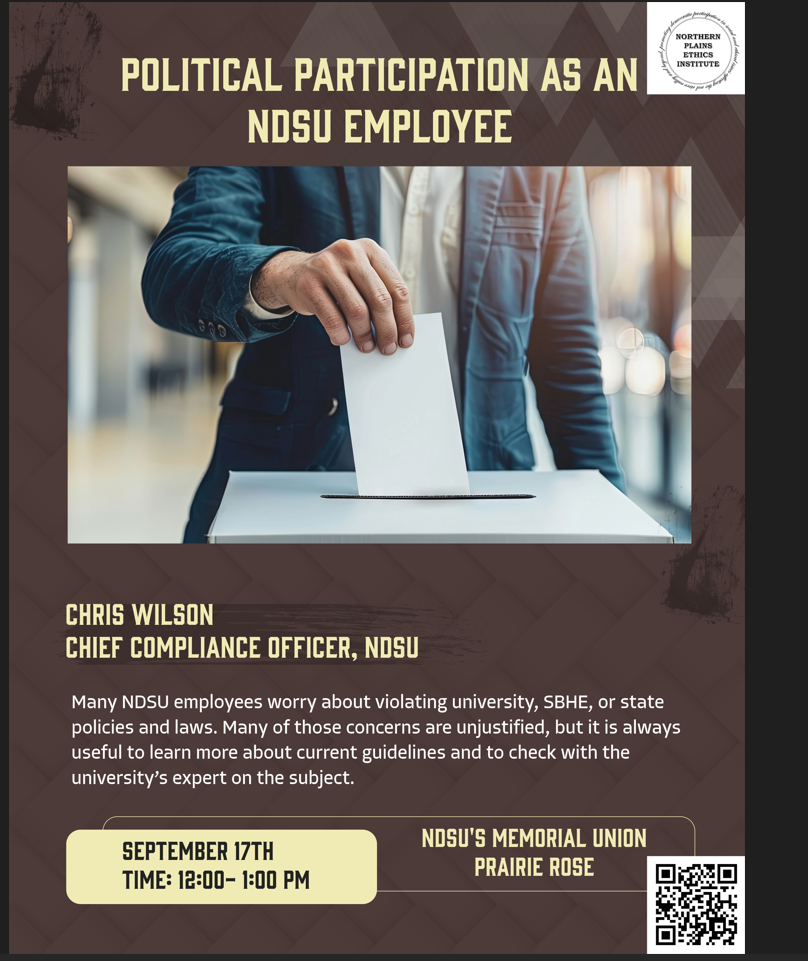
Political Participation as an NDSU Employee
Public Forum: Chris Wilson, Chief Compliance Officer, NDSU
See the forum on the NPEIs YouTube Channel here
Being part of the political process is a right, but many NDSU employees worry about violating university, SBHE, or state policies and laws. Many of those concerns are unjustified, but it is always useful to learn more about current guidelines and to check with the university’s expert on the subject.
The forum is open to the public, although question priority will go to NDSU faculty, staff, and students.
Chris Wilson is NDSU’s Chief Compliance Officer. He has been with NDSU since 2012. Wilson served previously as NDSU’s General Counsel (2015-2024) and Chief of Staff and as NDSCS’ General Counsel from 2013 through 2015.
Before coming to NDSU, Wilson was the Associate General Counsel of Miami University in Oxford, OH. Prior to that, He was a corporate attorney with Bond, Schoeneck & King, PLLC, a law firm nationally known for its representation of higher education institutions.
Wilson received his law degree from Cornell Law School and his undergraduate degree from Duke University. He is currently working towards his Ph.D. in education at NDSU.
The Northern Plains Ethics Institute’s mission is to promote democratic participation in social and ethical issues affecting the Northern Plains and beyond. The NPEI fulfills its charge by engaging citizens in various discussions focusing on what kind of society they want to live in and how they go about creating it.
Ethical Dilemmas We Face in a Rapidly Changing Landscape = Humanity + Technology
A Northern Plains Ethics Institute for a Public Forum with:
Thomas Creely, Ph.D., Associate Professor & Creator/Director Ethics & Emerging Military Technology Graduate Program, U.S. Naval War College
Ethical Dilemmas We Face in a Rapidly Changing Landscape = Humanity + Technology
Watch ther forum on the NPEIs YouTube Channel here
A presentation of and conversations about the AI, Bio, Neuro, Information, and other disruptive technologies posing significant challenges to individuals and society.
Creely is creator and director of the Ethics and Emerging Military Technology Graduate Certificate Program at the U.S. Naval War College, which conducts research on ethics of emerging disruptive technologies contributing to policy. He has collaborated with Five Eyes The Technical Cooperation Project ELSEI, Special Competitive Studies Project, Defense Advanced Research Projects Agency, DOD Chief Digital and Artificial Intelligence Office, Defense Innovation Board, Cyber Solarium 2.0, and IEEE Society for Social Implications of Technology. He also serves as a subject matter expert in Women, Peace, and Security and serves on the WPS General Committee and Faculty Advisory Council.
This event is sponsored by NDSU’s College of Arts and Sciences, Tri-College University, Humanities ND, the Dakota Digital Academy, The Northern Plains Ethics Institute, and the Crosswinds Institute. Additional information can be provided by Dennis Cooley, NPEI Director, at NDSU.NPEI@ndsu.edu or 701-231-7038.

Artificial Intelligence and Its Societal Impact: Truths, Half Truths, and Misconceptions
Ahmed Kamel, Ph.D., MBA, Professor of Computer Science and Management Information Systems, Offutt School of Business, Concordia College
February 6, 2024, Memorial Union’s Prairie Rose, North Dakota State University
Abstract: The public introduction of chatGPT and other similar systems has sparked a lot of public and media attention to the field of Artificial Intelligence (AI). The result is a mixture of facts, hype and misinformation, concerning what AI is, and what it can and cannot do for and to society. The study of AI is now several decades old with many successes and failures. We will discuss the current landscape of AI, its strengths and weaknesses, where it had successes and failures and its potential impact on society.
Biography: Professor Kamel’s research interests are in artificial intelligence and knowledge-based systems. His past research has been diverse in the area of knowledge-based systems: He worked in the representation of physical devices, in software support for engineering design, and in the integration of linked problem-solving agents. His interests also include the social impact of computers and their applications. He has published many articles in these areas in refereed journals and conference proceedings. He has also been an invited speaker at several national and international events.
The event is sponsored by the Northern Plains Ethics Institute (NPEI), College of Arts and Sciences, Dakota Digital Academy, and Tri-College University.
Additional information can be provided by Dennis Cooley, NPEI Director, at NDSU.NPEI@ndsu.edu or 701-231-7038.
The Israeli-Hamas War in a Strategic Context
Roby Barrett, Ph.D., Middle East Institute, Washington, DC
Abstract: The implications of the current conflict between Israel and the Palestinian HAMAS faction are extremely complex with much more far-reaching implications than the headlines suggest. The primary conflict pits Israel against one of its most tenacious foes, HAMAS the militant Palestinian version of the Muslim Brotherhood. It is not clear that Israel will be able to achieve its military much less its political goals. At a regional level, it pits Israel against Iran and its proxies in the region significantly undermining the strategies of successive Israeli governments to stymie Palestinian political ambitions while simultaneously courting recognition and economic ties with Arab states opposed to any expanded Muslim Brotherhood influence. In addition, the conflict has increased the potential for political instability among the Western-oriented states who currently have official relations with Israel. In the background, Iran has enhanced its own prestige and demonstrated its ability to play the spoiler to ill-conceived Israeli and Western notions of what is strategically attainable and sustainable in the Middle East. Finally for the West, the war has proven to be a major distraction from is arguably the more strategically important events in Eastern Europe. This presentation places the current war within its historical context i.e. Gaza as a perpetual irritant since 1948 – and then it examines the conflict within a broader regional and international construct that includes projections about short- and medium-term implications and outcomes.
Biography: Dr. Roby C. Barrett is a Fellow at the Middle East and North Africa Forum at Cambridge University and a scholar and Gulf expert with the Middle East Institute, Washington, D.C. Dr. Barrett is the author of numerous books and articles on the Middle East and Southwest Asia including The Cold War and the Greater Middle East, 2007, and The Gulf and the Struggle for Hegemony, 2016.
Originally trained as a Russian and Soviet expert, Dr. Barrett is a former Foreign Service Officer with responsibilities in intelligence and special operations. He was the Arab Gulf team leader in the Office of National Intelligence simulations on Russia in the Middle East and a keynote speaker at Joint Canadian-U.S. Intelligence Conference on Gulf Security, Washington, D.C. As a Senior Fellow with the Joint Special Operations University, U.S. Special Operations Command, he authored eight monographs on the Gulf and Islam as well as serving as an Instructor of Applied Intelligence. He also served as a briefer and subject matter expert for Special Operations-U.S. Central Command and for the Middle East Orientation Course at the Air Force Special Operations School where he was also a Senior Fellow. He has provided support to the Office of Secretary of Defense, the National Defense University, the Office of National Intelligence, the State Department, and other security and intelligence organizations. Dr. Barrett was a visiting professor at the Royal Saudi Arabian Command and Staff School focused on Gulf security, specifically Yemen and Iran, and a featured expert on Iran at the German Council on Foreign Relations and with the Bundeswehr. He has spoken at numerous Middle East conferences including the Bahrain MOI Gulf Security Forum, the opening of the King Abdullah Special Operations Training Center, the Arabian Gulf SOF Conference as well as the UAE security conference. His business expertise focuses on technology integration in intelligence and security operations and applications. He was Vice President for Air Force and Special DOD programs at Electronic Data Systems and a Corporate Vice President for Special Programs at Science Applications International, where he also served as Special Assistant to the Vice Chairman of the Board.
Barrett was the president of a consulting firm that specialized in security operations technology and integration.
A recipient of the Eisenhower-Roberts Fellowship from the Eisenhower Foundation, Dr. Barrett held research and study fellowships at the Ludwig-Maximilian University of Munich and at Oxford University. He is a graduate of the two-year Middle East Studies and Arabic Language program at the Foreign Service Institute, Washington, D.C. and Tunis, Tunisia, and holds a Ph.D. in Middle Eastern and South Asian history from the University of Texas at Austin. He is also the author of The Cold War in the Greater Middle East: U.S. Foreign Policy under Kennedy and Eisenhower (2007) and The Gulf and the Struggle for Hegemony: Arabs, Iranians, and West in Conflict (2016).
Sponsored by the Northern Plains Ethics Institute. Additional information can be provided by Dennis Cooley, NPEI Director, at NDSU.NPEI@ndsu.edu or 701-231-7038.
The Divided Brain, the Humanities & AI
January 24, 2024, Rm 230, Minard Hall, NDSU
Abstract:
A discussion with Iain McGilchrist, a world-renowned author who began profoundly transforming our views of neuroscience, culture, literature, philosophy and society with the publication of The Master and His Emissary: The Divided Brain and the Making of the Western World (Yale University Press, 2009) and The Matter with Things: Our Brains, Our Delusions and the Unmaking of the World (2021). Dr. McGilchrist started his career as a literary scholar at Oxford University and then became a medical doctor, psychiatrist and neuroscientist. Many readers worldwide declare that Dr. McGilchrist’s works changed how they see themselves and the world. Dr. McGilchrist’s analysis of the brain hemispheres and their implications holds the key to both understand and overcome society’s current crises, which AI threatens to greatly exacerbate.
The discussion will be led by Michael Robinson, PhD, a Professor of Psychology at NDSU, and Todd Pringle, PhD (Materials & Nanotechnology) and PhD candidate in Psychology at NDSU. The discussion will be based on a lengthy interview that Drs. Robinson and Pringle conducted with McGilchrist, which is available at: https://www.youtube.com/watch?v=Kid4oxBwTdo.
Biography: Iain McGilchrist is a former Fellow of All Souls College, Oxford, an associate Fellow of Green Templeton College, Oxford, a Fellow of the Royal College of Psychiatrists, a Fellow of the Royal Society of Arts, a Consultant Emeritus of the Maudsley and Bethlem Hospital, London, a former research Fellow in Neuroimaging at Johns Hopkins University Medical School, Baltimore, and a former Fellow of the Institute of Advanced Studies in Stellenbosch. He now lives on the Isle of Skye, off the coast of Northwest Scotland, where he continues to write and lecture worldwide.
Dr. McGilchrist is committed to the idea that the mind and brain can be understood only by seeing them in the broadest possible context, that of the whole of our physical and spiritual existence, and of the wider human culture in which they arise—the culture that helps mold, and in turn is molded by, our minds and brains.
From 1975 to 1982, Dr. McGilchrist taught English at All Souls College, Oxford, and then trained in medicine and became a psychiatrist. He has published original research on neuroimaging in schizophrenia, the phenomenology of schizophrenia, and other topics, and contributed chapters to books on a wide range of subjects, as well as original articles in papers and journals, including the British Journal of Psychiatry, American Journal of Psychiatry, British Medical Journal, Lancet and The Times Literary Supplement.
Michael D. Robinson, PhD, is a full Professor of Psychology and one of NDSU’s most cited researchers, with several hundred journal papers. He has received numerous awards, including the James A. Meier Junior and Senior Professorships (at NDSU), as well as the Hogoboom Professorship. Prof. Robinson is a social-personality-cognitive psychologist, who has published more than 300 articles in psychology journals and given more than 100 conference and scholarly presentations. Prof. Robinson also has extensive editorial experience, and he currently serves as the editor of Personality and Social Psychology Bulletin. In addition, he has edited numerous books in the areas of metaphor, personality psychology, mindfulness, emotion and embodied cognition. Prof. Robinson earned his bachelor’s and doctorate degrees at the University of California, Davis.
Todd A. Pringle, PhD, is the cofounder of Crosswinds Institute, a non-profit media organization focused on civic society, education and technology. He is also a part-time academic and PhD student in the Department of Psychology at NDSU. Dr. Pringle leads electronics hardware teams exploring new technologies in electrification, human-machine interface and perception systems for Deere & Co. He is a partner at the 701 Fund, focusing on pre-seed and seed investments. He cofounded two coatings development companies in outdoor products and surface disinfection. He has a BS in Electrical Engineering, an MS in Polymers and Coatings Science and a PhD in Materials & Nanotechnology, all from NDSU.
Sponsored by NDSU’s College of Arts & Sciences, the Dakota Digital Academy, the Crosswinds, and Tri-College University, and the College of Arts and Sciences Institute. Additional information can be provided by Dennis Cooley, NPEI Director, at NDSU.NPEI@ndsu.edu or 701-231-7038.

Artificial Intelligence and the Future of Higher Education
Presented byBlake A. Klinkner, Ph.D. UND School of Law
Watch the presentation on the NPEIs YouTube Channel here
Abstract: In this presentation, Prof. Blake A. Klinkner will discuss the ways in which rapidly advancing artificial intelligence (AI) will impact the future of higher education. Prof. Klinkner will discuss how AI will change higher education as early as the college application and admissions process. Prof. Klinkner will then address topics including the teaching of AI in the higher education curriculum, the training and use of AI among students, and AI on examinations. Whether educators like it or not, AI is already here, and it will only become more prevalent as it advances, and therefore educators would be best served by learning more about AI and understanding the ways in which they may acknowledge and incorporate AI into higher education.
Biography: Blake A. Klinkner is an Assistant Professor of Law at the University of North Dakota School of Law, where he teaches Civil Procedure, Cybersecurity Law, Law and Technology, and Law Practice Management. Prior to joining UND Law, Blake served as Visiting Assistant Professor of Law at Washburn University School of Law, where he taught Evidence, Academic Support, and Bar Exam Preparation. Blake has authored the Tech Tips column in the Wyoming State Bar journal since 2015. Blake completed his undergraduate degrees at the University of Wisconsin-Madison, his master’s degree at Northern Illinois University, and his juris doctor at the University of Utah School of Law. The graduating class of Washburn University School of Law recently named Blake as the 2022-23 Professor of the Year.
This event is sponsored by the NPEI, NDSU School of Humanities, College of Arts and Sciences, the Dakota Digital Academy, and Tri-College University.
If you have any questions or comments, then please contact Dennis Cooley at dennis.cooley@ndsu.edu or ndsu.npei@ndsu.edu.

AI and The Humanities
Dr. Rupak Gandhi, Superintendent of the Fargo Public Schools
Ethical Issues in Education
12-1:30pm, October 24, 2023, Location: Memorial Union’s Prairie Rose
View the presentation here on the NPEIs YouTube Channel.
Abstract: Dr. Gandhi will discussed the variety of ethical decisions that superintendents face on a daily basis, as well as the importance of making decisions based on ethical principles. The presentation also addressed the importance of considering the implications of decisions impacting education. Specifically, using various ethical issues in education, the presentation focused on the short-term and long-term consequences of school district actions and explore how decisions impact students, staff, and community.
Biography: Dr. Rupak Gandhi has served as the Fargo Public Schools superintendent of schools since July 2018. In October 2022, he was named the 2022-23 North Dakota Superintendent of the Year by the North Dakota Council of Educational Leaders.
Dr. Gandhi completed his undergraduate studies in Political Science at Texas A&M University, holds a master’s degree in special education from Grand Canyon University, and holds his doctorate in educational leadership from Northwest Nazarene University. Dr. Gandhi has continued his professional education past his doctorate by completing the AASA National Superintendent Certification Program, AASA-USC Urban Superintendents Academy, Standards Institute, HWC Executive Leadership Institute, Texas Region IV Superintendent Academy, and Harvard Graduate School of Education UDL Summer Institute.
Professionally, Dr. Gandhi serves on the AASA Governance Committee, North Dakota K-12 Education Coordination Council, North Dakota School Study Council, and North Dakota Council of Educational Leaders legislative focus group. He is also a mentor for the AASA National Superintendent Certification Program.
This event is sponsored by the NPEI, NDSU School of Humanities, College of Arts and Sciences, the Dakota Digital Academy, and Tri-College University.
If you have any questions or comments, then please contact Dennis Cooley at dennis.cooley@ndsu.edu or ndsu.npei@ndsu.edu.

Artist or Geek: What Is Artificial Intelligence and How Will It Impact Us?
Anne Denton, Ph.D.
NDSU Department of Computer Science
Artist or Geek: What Is Artificial Intelligence and How Will It Impact Us?
12-1:30pm, October 10, 2023 - Memorial Union’s Hidatsa
Watch the presentation here on the NPEIs YouTube Channel
Abstract: Artificial Intelligence is rapidly being used in new contexts. The social implications of these developments are hard to predict. We have decades of experience with automated systems that have extraordinary reasoning capabilities and can even beat grandmasters at chess. However, the newest types of artificially intelligent systems, like ChatGPT or Dall-E, are very different. When used for reasoning tasks, like chess, they often fail hilariously. Yet, they may compose essays that can be mistaken as written by a human and images that win art competitions. The presentation will explore opportunities and concerns as they relate to different types of artificially intelligent systems.
Biography: Anne Denton is Professor in the Computer Science Department at North Dakota State University (NDSU). She received her Ph.D. in Physics from the Johannes Gutenberg University, Mainz, Germany, in 1996 and a M.S. in Computer Science from NDSU in 2003. Her research in data mining of complex data has been motivated by applications in genome mapping, remote sensing of agricultural fields, among many others. Currently, her work focuses on geospatial and ethics-related questions. Denton has published more than 80 peer-reviewed journal and conference publications and has led projects funded at a total of more than one million dollars.
This event is sponsored by the NPEI, NDSU School of Humanities, College of Arts and Sciences, the Dakota Digital Academy, and Tri-College.
If you have any questions or comments, then please contact Dennis Cooley at dennis.cooley@ndsu.edu or ndsu.npei@ndsu.edu.

AI and The Humanities seminars hosted by the Northern Plains Ethics Institute, School of Humanities, and Colleges of Arts and Sciences for:
Mark R. Hagerott, Ph. D., Chancellor, North Dakota University System
Promise and Pitfalls of Living with Intelligent Machines in the Age of AI
12-1:30pm, September 27, 2023, Location: Memorial Union’s Prairie Rose
Watch the presentation here on the NPEIs YouTube Channel.
Abstract: The explosion of AI capability, demonstrated by CHAT-GPT released late last year, provides shocking evidence that we are entering an age of epic socio-technological transformation. The question of the Age will be: how to begin to share the planet and our societies with a new form of intelligence.
As we ponder AI and humanity, I will offer a framework to help inform our thinking and the development of adaptive strategies both with intelligent robots and in the metaverse/cyberspace. History and experience can help be our guide, but it will be admitted that with AI, we are witnessing a profound break with the past. The world as we know it is passing away. Come and join the discussion of what might be, both the promise and the pitfalls, living with our new intelligent digital neighbors.
Chancellor Hagerott asks that this be a very interactive discussion with the audience. The audience feedback will be included in an expanded article.
Bio: Prior to his move back home to North Dakota, Dr. Hagerott served on the faculty and held numerous academic leadership roles at the United States Naval Academy. He also served as a planning and strategy director in one of the largest U.S. Army educational organizations, NATO Training Mission, which included army, air force, and medical school programs. Hagerott served as distinguished professor and deputy director of the Center for Cyber Security Studies at the Naval Academy and served on the Defense Science Board summer study of unmanned systems 2014-2015. He is a commissioner on the Midwestern Higher Education Compact, and Western Interstate Commission for Higher Education.
Chancellor Hagerott’s research and writing are focused on the evolution of technology, education, and changes in technical career paths, and he is the author of multiple articles and book chapters, with a recent emphasis on unmanned systems. He served as a non-resident cyber Fellow of the New America Foundation, 2015-2017. He was among the first military professors from the United States to brief the Geneva Convention on the challenge of lethal robotic machines and argue the merits of early arms control measures in 2014. In addition, his proposals for national education reform of the Land Grant universities have been published in The Chronicle of Higher Education, and have been presented on Capitol Hill and the White House.
This event is sponsored by the NPEI, NDSU School of Humanities, College of Arts and Sciences, and the Dakota Digital Academy.
If you have any questions or comments, then please contact Dennis Cooley at dennis.cooley@ndsu.edu or ndsu.npei@ndsu.edu.
Humans, Machines & Cyber Space
Humans, Machines & Cyber Space: Suggesting a Framework for Ethical Questions with Mark Hagerott, PhD.
Turkey, Syria, Natural Disaster Relief and the Ethics of Giving
Presented by Doğan Çömez, Professor, Mathematics, NDSU
12:00 pm, February 24, 2023, Prairie Rose, Memorial Union, North Dakota State University
Watch the presentation on the NPEIs YouTube Channel here
Abstract: We are all saddened deeply with the news of the earthquake that affected a large area in Southeastern Turkey and Northwestern Syria. The devastation is unimaginable, so is the human suffering. Although we may not be able to help in person, we can still contribute towards the relief efforts. This public forum will discuss the situation and the ethics of donating and helping fellow human beings in times of crises.
Bio: Doğan Çömez earned his Ph.D. from the University of Toronto, Toronto, Ontario, Canada. His research area is in measure theoretical dynamical systems and ergodic theory. Professor Çömez is also interested in activities involving mathematics education, and occasionally he collaborates with folks conducting research in other disciplines.
The Turkish Embassy and some other organizations are organizing a campaign to collect money and goods/supplies to be sent to the earthquake zone: see the website http://washington.emb.mfa.gov.tr/Mission/ShowAnnouncement/400327 for the needed goods.
You can also donate money at
Unicef: https://www.unicef.org/emergencies/Syria-Turkiye-earthquake,
Turkish Philanthropy Funds: tpfunds.org
Direct Relief
Embrace Relief Foundation
Watch the presentation on the NPEIs YouTube Channel here
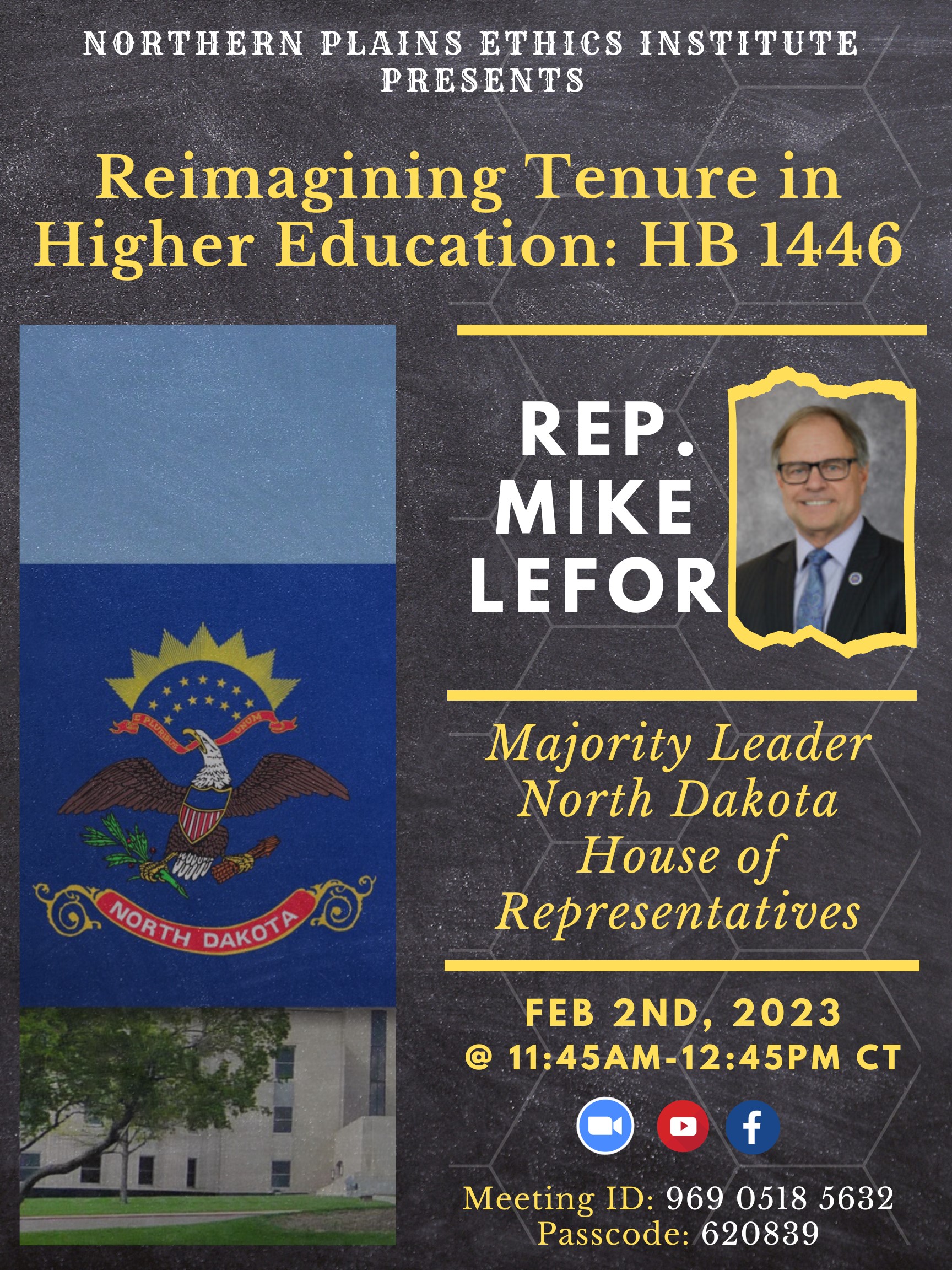
Representative Mike Lefor is President of Blackridge Enterprises, LLC and has served in the ND House of Representatives since 2015. Among his service to the community, Rep Lefor has been President of the Dickinson Park Board, Chairman of the CHI St. Joseph Hospital and was on City Commission in 2016. Lefor is a graduate of Dickinson State University During the forum, Rep. Lefor will explain the evolution of the bill, the bill itself, and why it is important and what it means for North Dakotans, as well as discussing amendments he is proposing to the committee hearing the HB 1446 on Friday morning, 3 February 2023. After his presentation, Rep. Lefor will answer questions from the audience.
Tim Flakoll, Provost of Tri-College University and NPEI Advisor Board Chair, served as host and moderator.
Open to the public and free of charge.
For more information about HB, please visit: https://ndlegis.gov/assembly/68-2023/regular/documents/23-0083-04000.pdf
Knowing Your Rights and Wrongs: How to Engage Politically as a State Employee
Chris Wilson, Chief of Staff, President’s Office, NDSU
Watch the video of the event on the NPEIs YouTube Channel here.
Each citizen has a right to be part of the political process, but many state employees worry about violating laws or policies. The unfortunate result is that some unintentionally transgress, whereas others stand on the sidelines when there is no reason to do so. With a little caution and care, state employees can engage in political participation without problems. Please come to learn more about current guidelines and to check with NDSU’s expert on the subject.
The forum was open to the public, although question priority will go to North Dakota state employees.
The Northern Plains Ethics Institute’s mission is to promote democratic participation in social and ethical issues affecting the Northern Plains and beyond. The NPEI fulfills its charge by engaging citizens in various discussions focusing on what kind of society they want to live in and how they go about creating it.
Please note that state employees may be subject to institution specific requirements that do not reflect those of NDSU.

“Winter Amid War: Ukraine’s Current Challenges”
Mark J. Lindquist, Motivational Speaker Watch the presentation on the NPEIs YouTube Channel here
Hidatsa, Memorial Union, North Dakota State University
Mark J. Lindquist, a Fargo based Air Force Afghanistan War Veteran, has been volunteering as a humanitarian aid worker in Ukraine for the past 6 months. He and his team have delivered millions of dollars of medical supplies and humanitarian aid into the war zone and out to the frontlines.
During the forum, Lindquist shared stories about the real-life situation on the ground and offered a perspective from 10 miles away from the Russian army, as well as talking about the battlefield conditions and strategy we see playing out. The audience gained insight about what the media doesn’t show you, the incredible perseverance of the Ukrainian people, and the simple ways Americans can help those fighting for their freedom this winter. Q&A followed the program.
The event was open to the public and free of charge.
Donations of winter weather gear were accepted at the door and will be hand delivered to Ukraine by Christmas.
For more information about Mark, please visit: www.MarkJLindquist.com
Sponsored by the Northern Plains Ethics Institute and the Department of Political Science.

“Police Use of Force and Public Safety” Watch the presentation on the NPEIs YouTube Channel here
Abstract: What American police regard as routine and necessary procedures can sometimes be traumatizing for American citizens. These clashes are persistent in spite of advancing technologies in de-escalation and evolving training in cultural understanding. Two nationally recognized experts in the area will have a conversation, and then answer audience questions about this socially and ethically relevant topic to the functioning of our democracy.
Experts:
Dr. Carol A. Archbold: Chair of the Department of Criminal Justice
Walter F. & Verna Gehrts Endowed Professor
Carol Archbold is a Walter F. and Verna Gehrts Endowed Professor and Chair of the Department of Criminal Justice at North Dakota State University in Fargo, ND. She teaches graduate and undergraduate courses focused on policing and research methods. Her research interests include police accountability, liability and misconduct, risk management in policing, and women and policing. Dr. Archbold has published her research in a variety of criminal justice and policing journals and has authored or co-authored five books centered on policing issues. She was Deputy Editor for Social Problems journal from 2002-2005, and currently serves on the Editorial Boards for Police Quarterly and Policing: An International Journal of Police Strategies and Management. Dr. Archbold also served as a Senior Research Scientist/Subject Matter Expert for the Collaborative Reform Initiative (Department of Justice – Community Oriented Policing Services) in the Milwaukee Police Department from 2015-2017.
Dr. Joel Powell: Professor & Director of Law Enforcement
Joel Powell is the Peace Officer Education Coordinator at Minnesota State University Moorhead and a former member of the Minnesota Board of Peace Officer Standards and Training. His research interests include examining how police officers and civilians view compliance and other police and civilian interactions differently, as well as how people who have been convicted of crimes tell convincing stories of innocence and wrongful conviction. Dr. Powell teaches Social Psychology and Sociology of Law Enforcement classes at MSUM.
Sponsored by the Northern Plains Ethics Institute at NDSU.
Additional information can be provided by Dennis Cooley, NPEI Director, at NDSU.NPEI@ndsu.edu or 701-231-7038.

“Police Use of Force and the Puzzle of Public Safety”
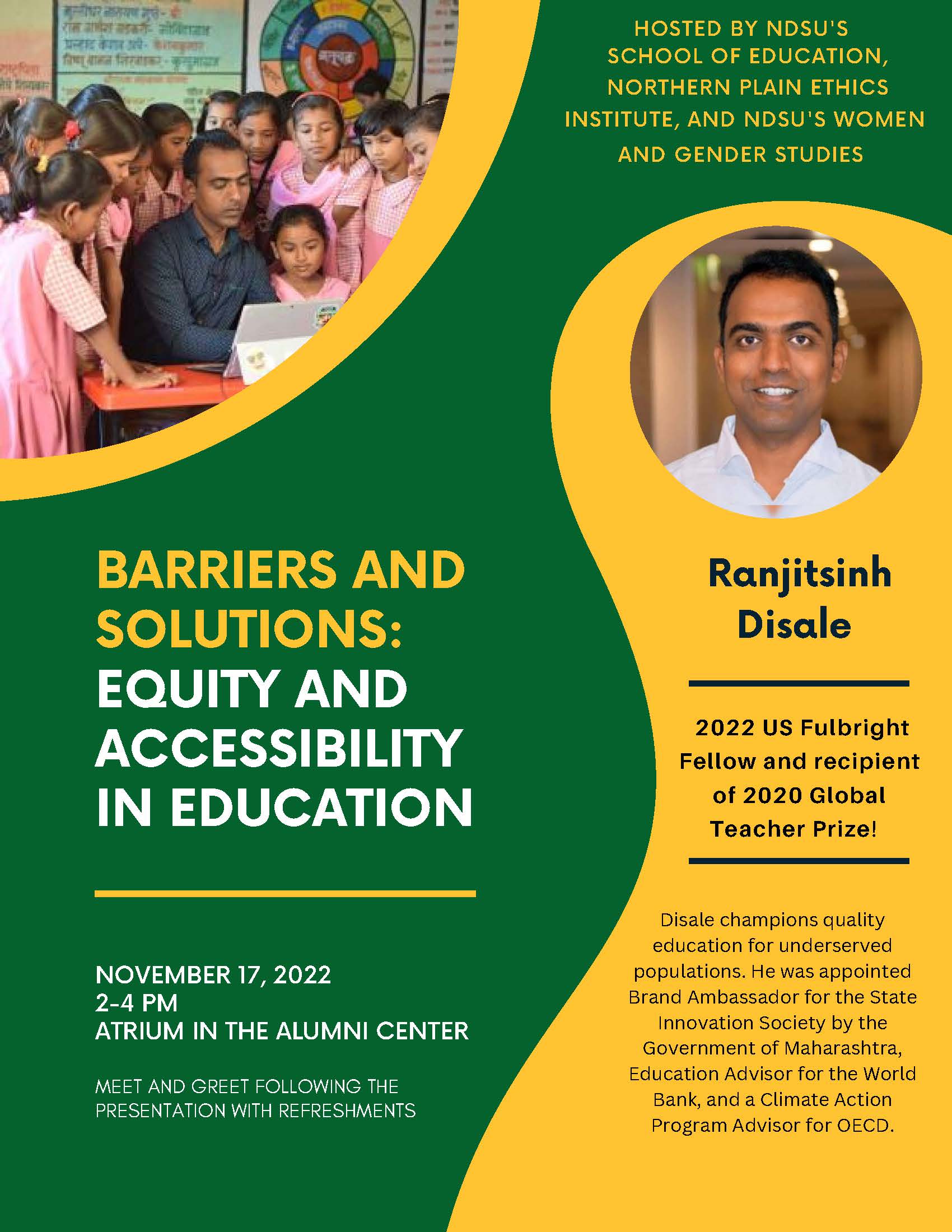
The Northern Plains Ethics Institute hosted a public forum featuring Joel O. Powell and Rylan E. Fitzpatrick of Minnesota State University Moorhead and Moorhead Police Captain Deric Swenson.
The forum, titled “Police Use of Force and the Puzzle of Public Safety,” was Thursday, Nov. 17, at noon in Barry Hall’s Louise Auditorium. The event was also available on Zoom. Watch the presentation on the NPEIs YouTube Channel here.
Powell is the peace officer education coordinator at MSUM and a former member of the Minnesota Board of Peace Officer Standards and Training. He will discuss how actions that American police regard as routine and necessary procedures can sometimes be traumatizing for citizens. Using video recordings of encounters between police and civilians, he investigates how police procedures can clash with civilian habits and ways of thinking. According to Powell, the clashes are persistent in spite of advances in de-escalation technologies and evolving training in cultural understanding.
Swenson will provide counterpoints to Powell’s research and provide guidance on understanding police-community relations. Fitzpatrick is a sociology student.
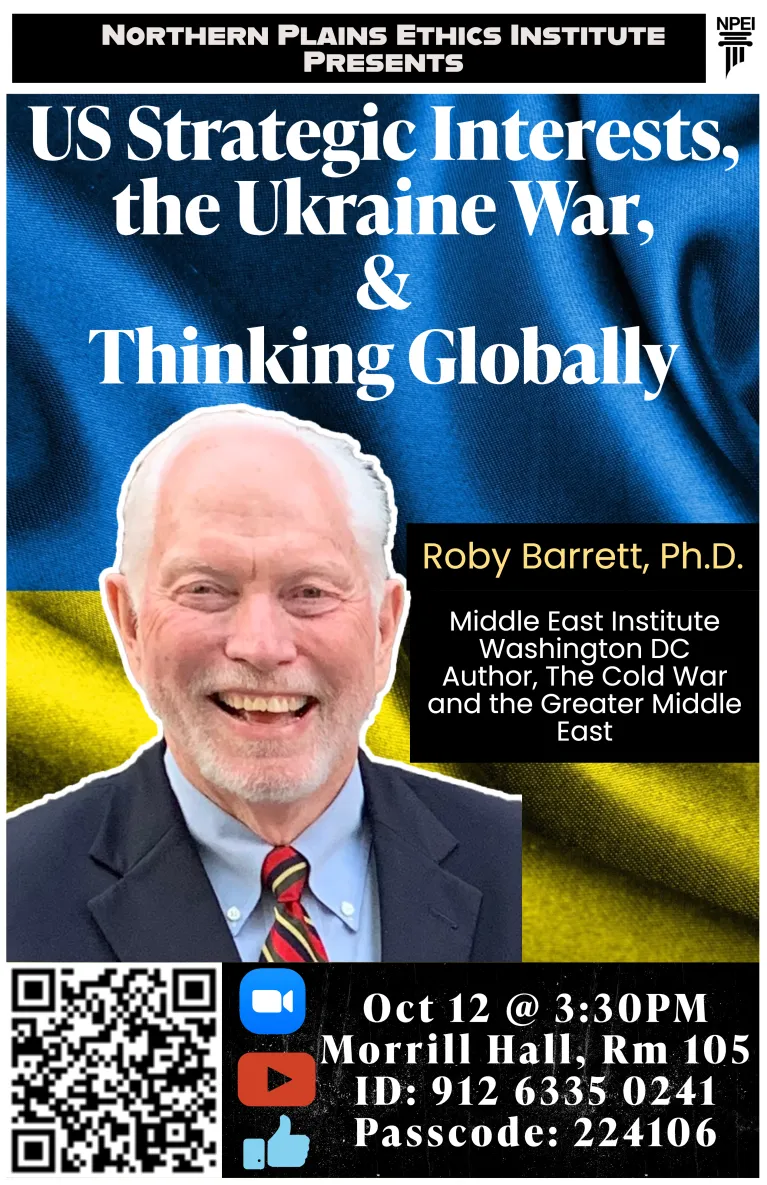
“US Strategic Interests, the Ukraine War, and Thinking Global”
Presented by: Roby Barrett, Ph.D., Middle East Institute, Washington, DC
“US Strategic Interests, the Ukraine War, and Thinking Global” Click here for the presentation on the NPEIs YouTube Channel
Abstract: Understanding the present within the context of the past is the key to projecting future developments. For example, the following excerpts are taken from a 2017 Special Operations Command briefing given by Dr. Roby C. Barrett:
“Russia without the Ukraine and the Baltics is a Regional Power; with them it’s an empire. A new “Nomenklatura” presiding over increased defense spending, a failed economy, and declining population with little option to expand territory or decline further.”
Over the last three decades, the challenge in US foreign policy has been to focus on strategic interests and dealing with tactical challenges that perpetually face a ‘Great Power.’ This is an exercise in evaluating existential threats and those tactical threats with the potential to morph into strategic problems. Given the current environment Geopolitically speaking, the US has two existential threats — China and Russia. China is driven by a rediscovered, or perhaps a reimagined, nationalism that emphasizes economic and commercial penetration followed by political and military influence. That said, China has societal imbalances that have the potential to threaten its fundamental stability. For Russia, the situation is far direr. The would-be emperor and the empire have no clothes. Seven months of war in the Ukraine has revealed that militarily it has only its nuclear arsenal and the economy only its raw materials — a hollowed-out state coupled to a colossal failure in leadership. Then, there are tactical threats that have the potential to become strategic problems. The US identifying the second-tier threats has been problematic. This presentation will touch on all these issues with a focus on U.S. priorities for next two years.
Biography: Dr. Roby C. Barrett is a Fellow at the Middle East and North Africa Forum at Cambridge University and a scholar with the Middle East Institute, Washington, D.C. Author of The Greater Middle East and the Cold War: U.S. Foreign Policy under Eisenhower and Kennedy, 1958–1963, Dr. Barrett is recognized for his expertise, experience, and publications on the Middle East. Secondarily, his expertise focuses on Russia, the Soviet Union, Eastern Europe, and arms development. Originally trained as a Russian and Soviet expert during the Cold War, he served as an intelligence analyst in the Eastern European intelligence branch of the US government where his writing was published in the Presidential Daily Brief (PDB). Later he worked on intelligence collection issues related to Soviet weapons develop and proliferation. He is an expert on Soviet and Russian relations in the Middle East. In a 2016 National Intelligence Office (NIO) exercise on Russian operations and goals in the Middle East, he served as the combined intelligence team leader on the Persian Gulf. As Corporate Vice President for Special Programs at Science Applications International, he did extensive work on U.S. strategic and nuclear issues related to the Soviet Union including the Strategic Defense Initiative “Star Wars” and nuclear issues.
A recipient of the Guittard Graduate Fellowship at Baylor University, Dr. Barrett studied Russian history focusing on messianic ideas inherent in Russian Orthodox theology and their relationship to Soviet/Russian exceptionalist self-imaging as detailed in his work, A Historiographical Study of Nicholas Zernov. He received a Scottish Rite Graduate Fellowship for expanded studies and research in Soviet and East European political science. Dr. Barrett was awarded the Rotary International Graduate Fellowship for study at the Institute for Eastern European and Soviet studies at the Ludwig-Maximilian University of Munich. He was awarded a second Scottish Rite Fellowship for study and research at Oxford University in Russian history. In addition, he received a scholarship for Russian language study at the Dolmetscher Institut, Munich, Germany. Subsequently, Dr. Barrett graduated from the two-year Middle East Studies and Arabic Language program at the Foreign Service Institute, Washington, D.C. and Tunis, Tunisia, and holds a Ph.D. in Middle Eastern and South Asian history from the University of Texas at Austin, an M.A. in Russian history from Baylor University, and an M.A. in political science focusing on Eastern European politics.
Sponsored by the Northern Plains Ethics Institute and NDSU’s Department of Political Science.
The Ethics of Job Hiring/Seeking: A Conversation
See the full presentation on the NPEIs YouTube channel here.
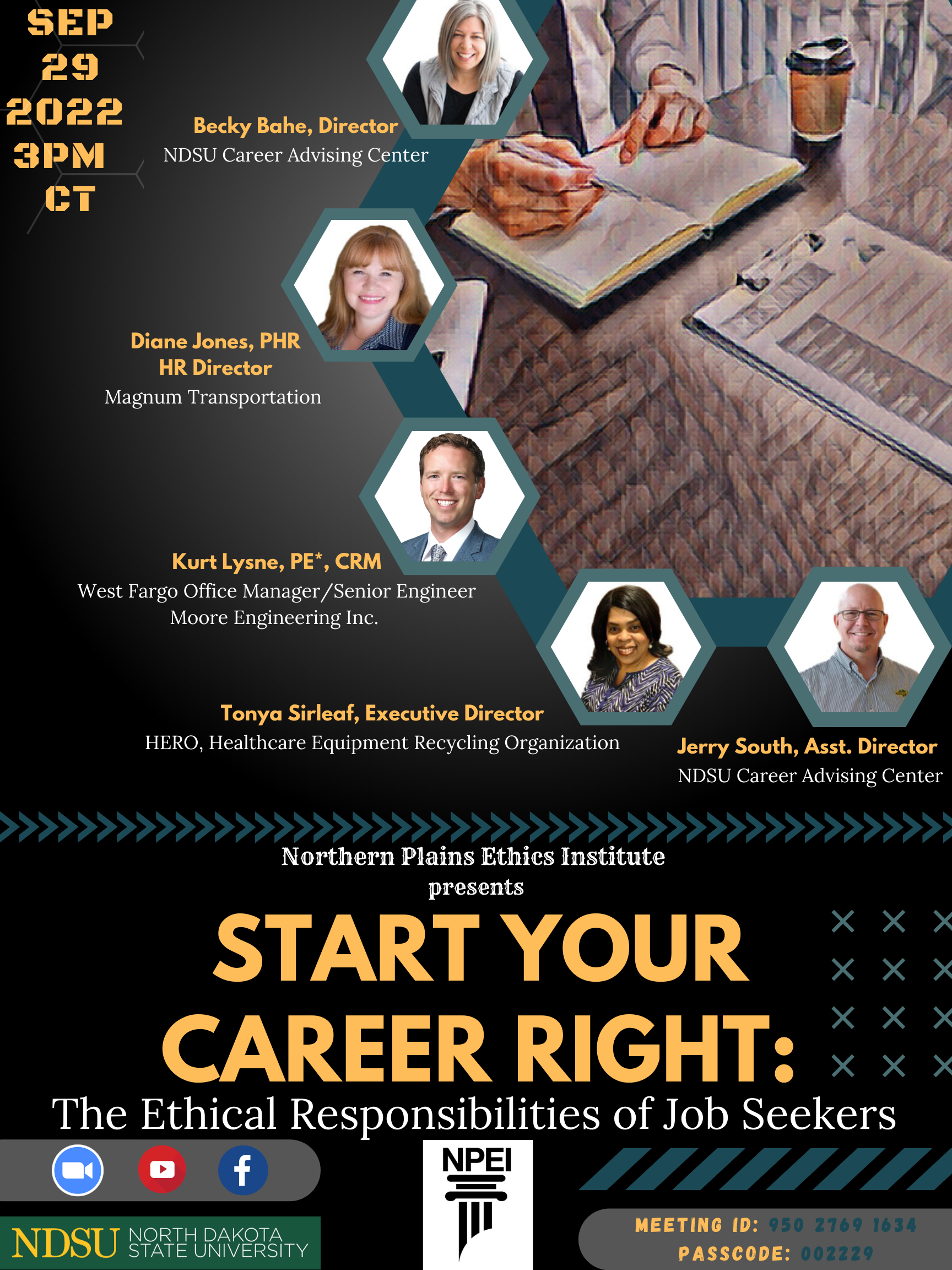
Academic Freedom and Free Speech: A Student Panel
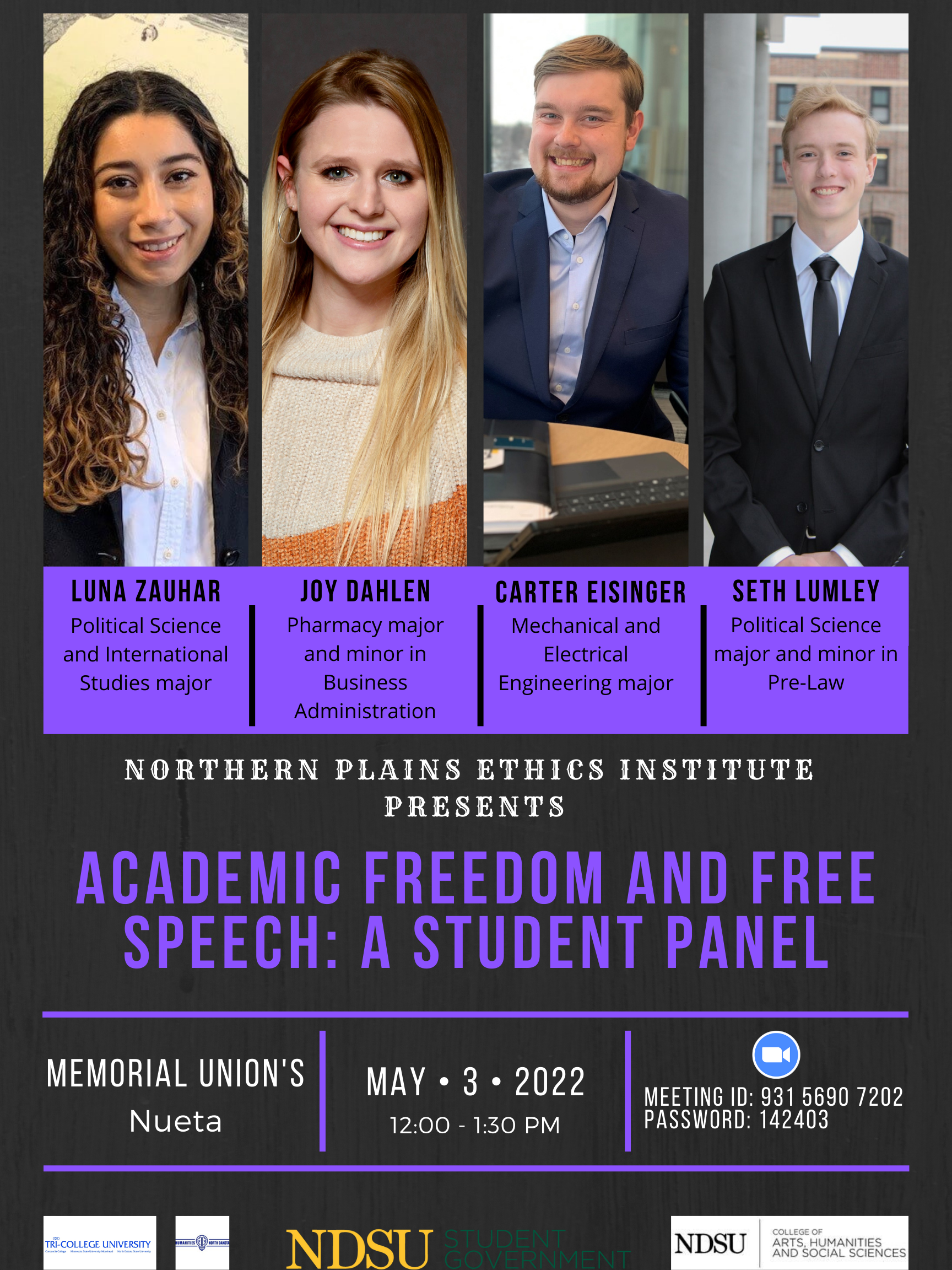
The Northern Plains Ethics Institute at NDSU hosted a student panel on free speech and academic freedom. The event was Tuesday, May 3, at noon in the Memorial Union Nueta room. The discussion was also available on Zoom. Click here to view the presentation on the NPEIs YouTube channel.
Panel members included Luna Zauhar, Seth Lumley, Carter Eisinger and Joy Dahlen.
Zauhar is a senior at NDSU double majoring in political science and international studies with an emphasis in pre-law.
Lumley is a junior majoring in political science and minoring in pre-law.
Eisinger is a mechanical and electrical engineering student at NDSU, and will graduate in fall 2022.
A fourth-year student, Dahlen is a pharmacy major with a minor in business administration.
The public forum was the final segment of the “Exploring Academic Freedom/Freedom of Speech” project of the Northern Plains Ethics Institute at NDSU, Tri-College University, Humanities ND, NDSU Student Government, and the NDSU College of Arts, Humanities, and Social Sciences.
Zauher, Lumley, Eisinger and Dahlen led the conversation and engaged with audience questions.
The event was provided free of charge to all NDSU stakeholders and the public.
As a student-focused, land-grant, research university, we serve our citizens.
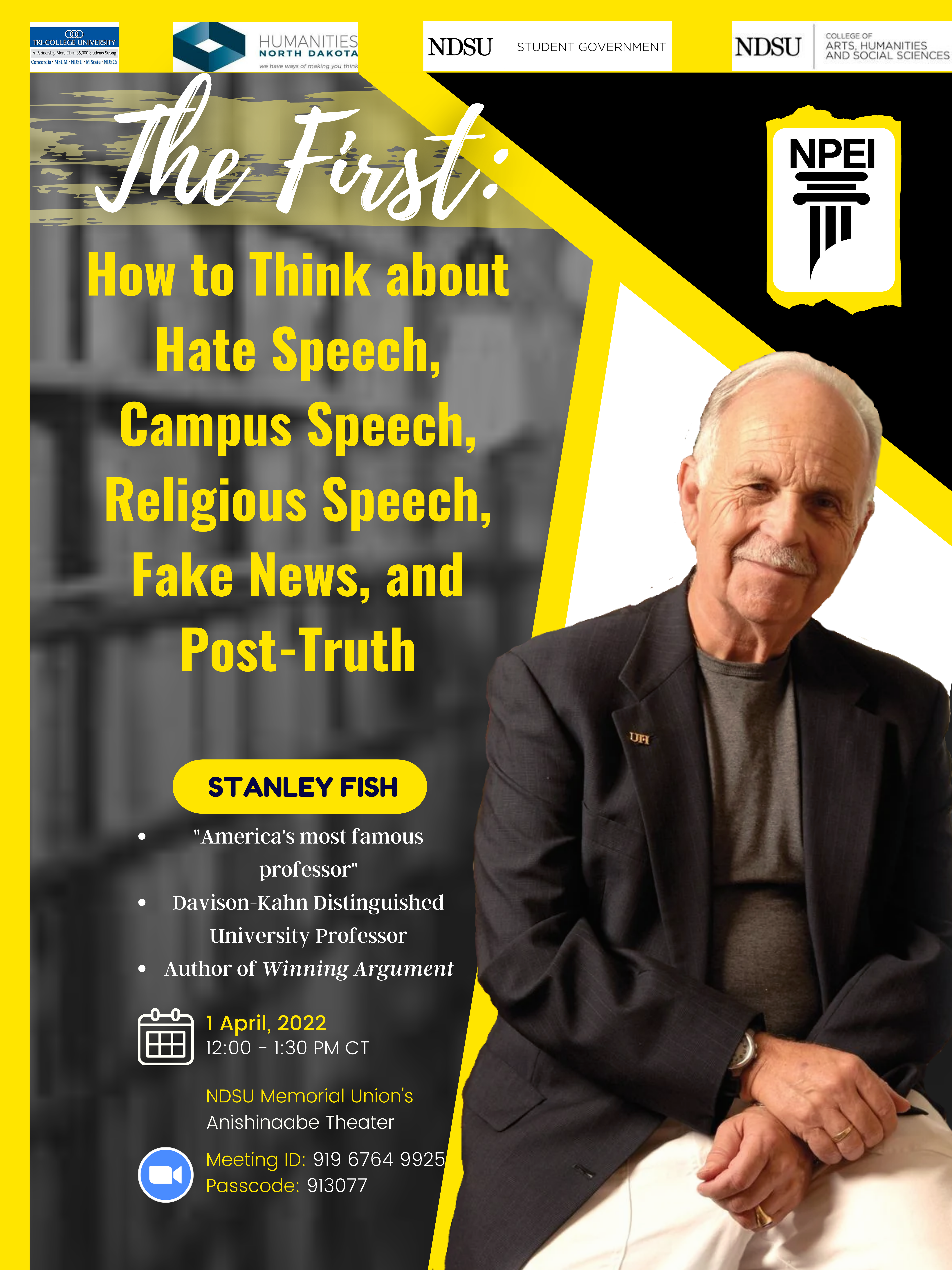
How to Think about Hate Speech, Campus Speech, Religious Speech, Fake News, and Post-Truth
Click the link above for the presentation on the NPEIs YouTube Channel
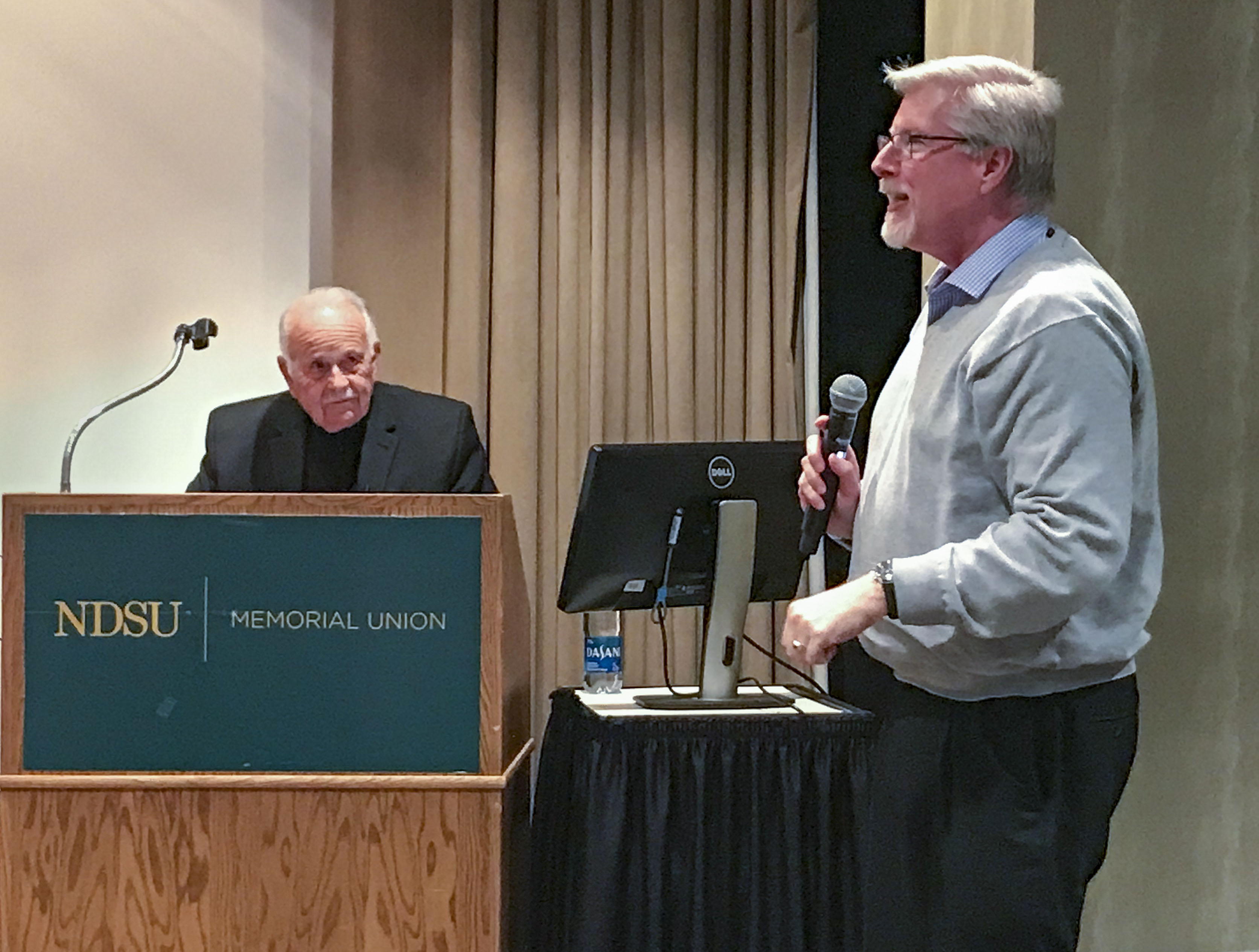
(photo courtesy of www.rossfcollins.com/photography)
The First Amendment to the U.S. Constitution was examined during “The First: How to Think about Hate Speech, Campus Speech, Religious Speech, Fake News, and Post-Truth,” an event Friday, April 1, at noon in the NDSU Memorial Union’s Anishinaabe Theater in the Memorial Union and on Zoom.
Stanley Fish, Davidson-Kahn Distinguished University Professor of Humanities and Law at Florida International University, discussed such questions as:
• How does the First Amendment really work?
• Is it a principle or a value?
• What is hate speech and should it always be banned?
• Are we free to declare our religious beliefs in the public square?
• What role, if any, should companies like Facebook play in policing the exchange of thoughts, ideas, and opinions?
Fish argued that freedom of speech is a double-edged concept – it frees us from constraints, but it also frees us to say and do terrible things.
Fish previously taught at the University of California, Berkeley; Johns Hopkins University; Duke University; and the University of Illinois at Chicago, where he was the dean of the College of Liberal Arts and Sciences. He has received many honors and awards, including being named the Chicagoan of the Year for Culture. He is the author of several renowned books, including “Winning Argument,” “How Milton Works,” “There’s No Such Thing as Free Speech: And It’s a Good Thing, Too” and “How to Write a Sentence: And How to Read One.” He is a former columnist for the New York Times and his articles have appeared in the Chronicle of Higher Education, Harper’s, Esquire and the Atlantic.
Fish signed copies of his book both before and after his presentation outside the NDSU Bookstore in the Memorial Union.
The event was sponsored by Tri-College University, Humanities ND, NDSU Student Government, the Northern Plains Ethics Institute and the College of Arts, Humanities, and Social Sciences.
Free Speech: A Community Conversation
Click the link above to view the panel on the NPEIs YouTube Channel
Issues and questions about free speech was the topic of “Free Speech: A Community Conversation,” a panel held on Tuesday, March 22, at noon in NDSU’s Memorial Union’s Room of Nations and via Zoom.
Howard A. Dahl of Amity Technology and Jack Zaleski, retired editorial page editor, will discuss what free speech is, what it contributes to a democratic society, and some of the justifiable and unjustifiable limitations on it.
The public forum is part of the “Exploring Academic Freedom/Freedom of Speech” project of the Northern Plains Ethics Institute at NDSU, Tri-College University, Humanities ND, NDSU Student Government, and the NDSU College of Arts, Humanities, and Social Sciences.
Howard A. Dahl is president and CEO of Amity Technology, LLC in Fargo, ND. He holds degrees from the University of North Dakota and Trinity Evangelical Divinity School, and has done graduate work in Philosophy at the University of Florida. Dahl sits on a number of boards including the Russian American Institute’s Board of Regents, The Trinity Forum’s Board of Trustees, the Ethics and Public Policy Center’s Board of Directors, and the U.S. Global Leadership Coalition. Mr. Dahl has also served as Director and Audit Chair for the Federal Reserve Bank of Minneapolis and as a board member of the North Dakota Trade.
Jack Zaleski is an award-winning journalist who retired in 2017 after 30 years as editorial page editor of The Forum of Fargo-Moorhead. He is the author of 2020’s Forum Communications Company: A Narrative History 1980-2018. A native of New Britain, Connecticut, Zaleski was educated in New Britain public schools and the University of Connecticut at Storrs, where he worked for a short time at the university’s Office of Public Information. Zaleski is a member of the North Dakota Newspaper Association “50-Year Club,” and a former member of the National Conference of Editorial Writers and the NCEW Foundation’s board of directors. His honors for editorials and opinion columns include two first place Herman Roe Editorial Writing Awards (2012, 2018) from the Minnesota Newspaper Association. He serves on the advisory board of the Northern Plains Ethics Institute at North Dakota State University.

Academic Freedom and Why It Matters
Click the link above for the recorded presentation on the NPEI's YouTube Channel.

Free Speech and Why It Matters
Click the link above for the Forum article on this event
Click here for the recorded presentation on the NPEIs YouTube Channel.
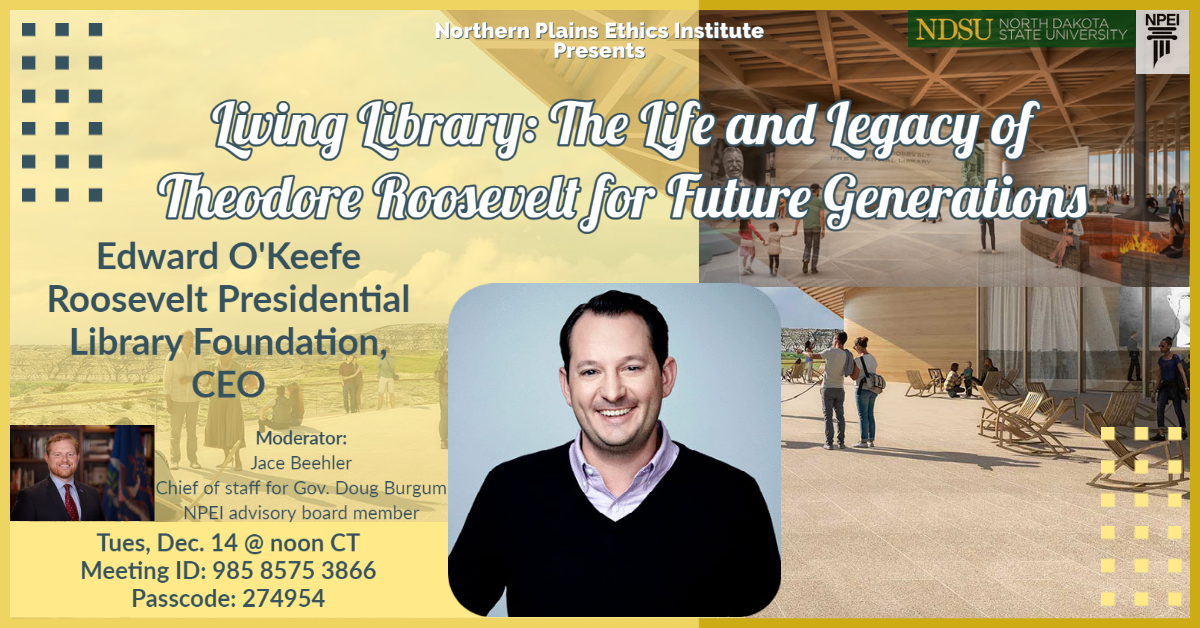
Theodore Roosevelt Presidential Library Foundation CEO to participate in NDSU ethics conversation
See the presentation on the NPEI's YouTube channel here
The Northern Plains Ethics Institute at NDSU has announced Edward (Ed) O'Keefe presented on December 14th. He delved into the historical importance of the United States' 26th president and his legacy's impact on present and future generations. O’Keefe provided project updates, as well as discussed the schematic and experiential design processes, building in the North Dakotan Badlands, and ethical considerations of the project.
O’Keefe participated in the NPEI’s long running Public Fora series on Tuesday, Dec. 14, at noon via Zoom. His presentation - Living Library: The Life and Legacy of Theodore Roosevelt for Future Generations – began the program, followed by a moderated conversation, and then audience questions until around 1:30pm.
Jace Beehler, Chief of Staff to Governor Burgum and NPEI Advisory Board member, served as moderator for the forum.
Edward O'Keefe, Chief Executive Officer of the Theodore Roosevelt Presidential Library Foundation, is a Grand Forks native who spent nearly twenty years in journalism as an EP at ABC, Editor-in-Chief at NowThis, and SVP at CNN. Ed lives in New York City with his wife Allison and their two children.
As a Harvard Kennedy School Fellow, O’Keefe delved into TR's papers and began laying the groundwork for his forthcoming book, The Loves of Theodore Roosevelt.
The event was provided free of charge by the Northern Plains Ethics Institute and Theodore Roosevelt Presidential Library Foundation to all NDSU stakeholders and the public.
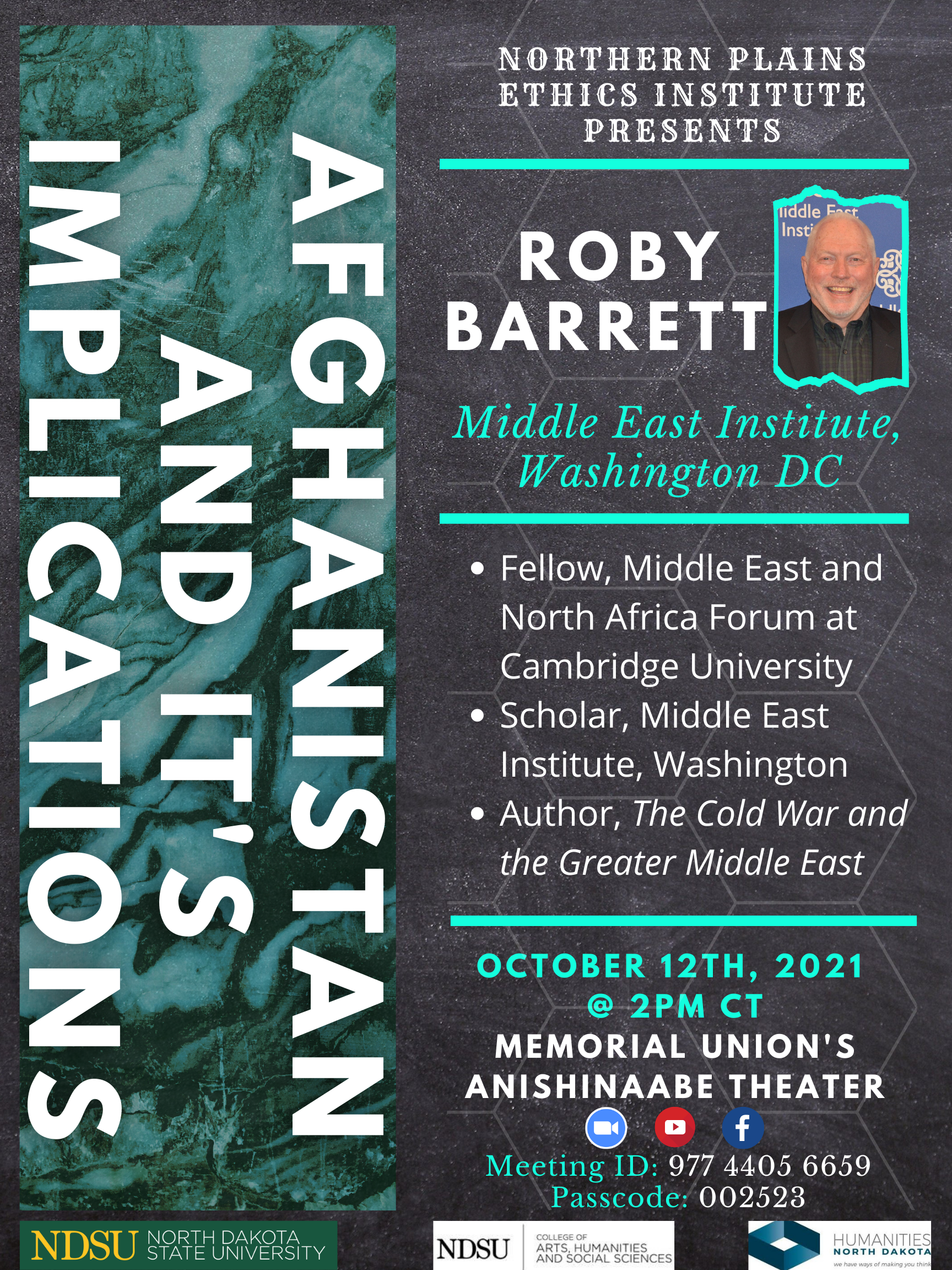
Afghanistan and its Implications
Presented by Roby Barrett, Ph.D., Middle East Institute, Washington, DC
2:00 p.m., October 12, 2021 at the NDSU Memorial Union, Anishinaabe Theater[1]
Abstract: This presentation places Afghanistan and the “Endless War” in a broader more strategic framework. For 20 years, the events of 9/11 mesmerized U.S. foreign policy and drove a failed effort to transform Afghanistan into a “sovereign” state – something that it never was and never could be. The understandable obsession with “The Global War on Terror” obscured broader strategic interests and undermined other more important priorities as U.S. poured untold treasure and thousands of lives into the failed efforts to “stabilize”, “democratize”, and “liberalize” Afghanistan and Iraq as well. This is an effort to think about the future by understanding a present that is informed by the past – past as present, present as future – and answer critical questions about the strategic interests of the United States.
[1] All in-person attendees are required to wear masks and maintain social distancing according to NDSU directives.
For more information see the Forum article here and the NDSU news item here
 Click here to see the full presentation.
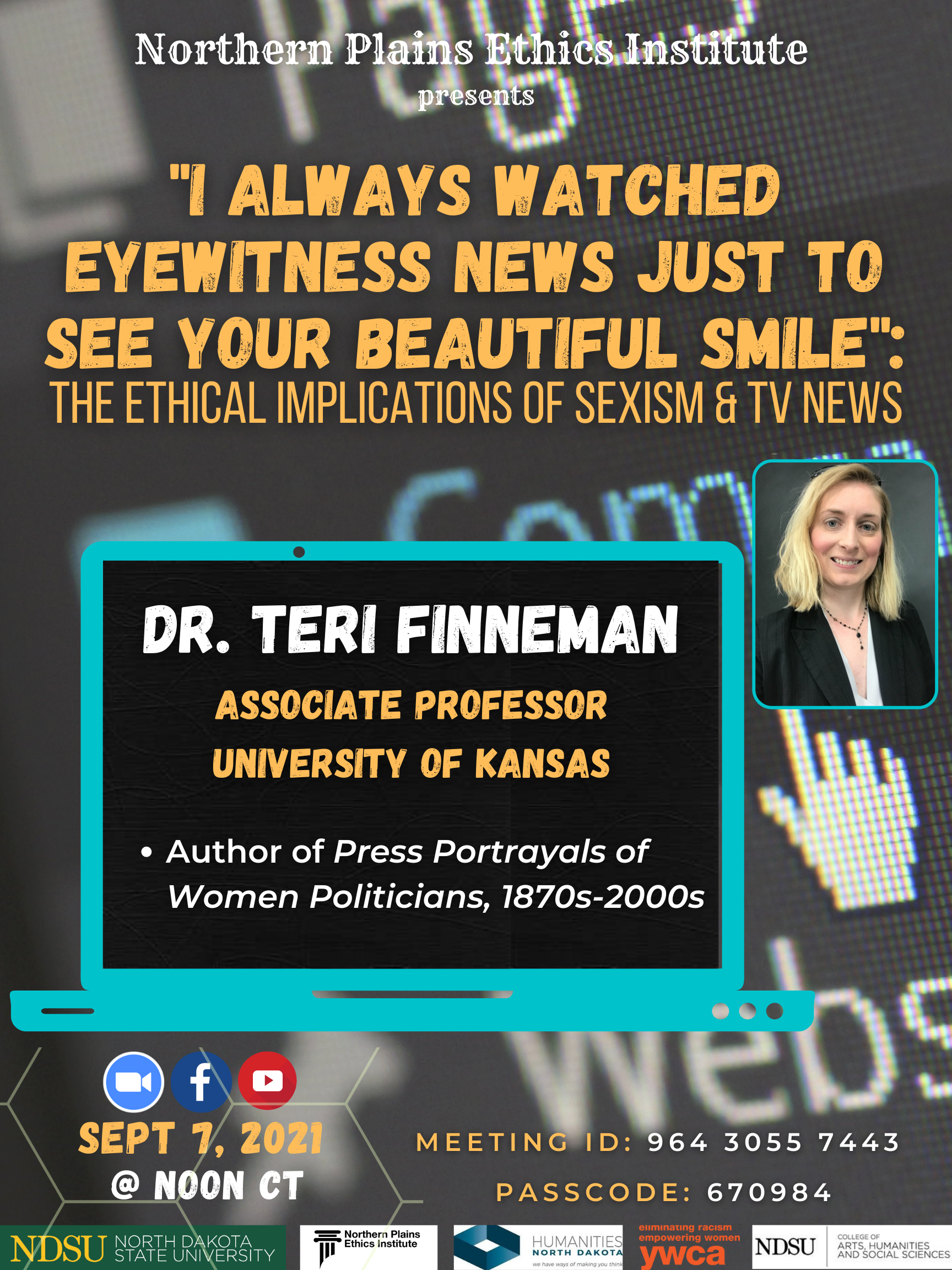
The Ethical Implications of Sexism & TV News
The Northern Plains Ethics Institute at NDSU and the YWCA Cass Clay announced Teri A. Finneman was the Learning the Language of Diversity and Meaningful Inclusion program’s September speaker.
Dr. Finneman participated in the conversation series on Tuesday, September 7, at noon Central Time via Zoom. Her presentation - "I Always Watched Eyewitness News Just to See Your Beautiful Smile": The Ethical Implications of Sexism & TV News – began the program, which was followed by moderated conversation and audience questions.
In this talk, Finneman argued that the rise of social media in recent years has created increasingly concerning problems for women who work in television as they receive sexist and downright sleazy comments from viewers on their social media accounts. Through a national survey and analysis of journalists' Facebook pages, it's become clear that employers are not doing enough to protect their employees with supportive social media policies. This session included an open discussion of sexism and how to shift cultural attitudes toward women in the workplace.
Teri Finneman, Ph.D. Teri Finneman is a journalism professor in the School of Journalism and Mass Communications at the University of Kansas. Finneman is also the author of Press Portrayals of Women Politicians, 1870s-2000s. She is a former reporter for The Fargo Forum and WDAY and is Past Chair of the AEJMC History Division.
The event was provided free of charge by Leann Wolff of Great Outcomes Consulting, the Northern Plains Ethics Institute, the YWCA Cass Clay, and Humanities ND, and to all NDSU stakeholders and the public.
 Click here to see the full presentation
Politics of Sex Education in North Dakota
Molly Secor-Turner, PhD, RN, FSAHM
Professor, School of Nursing and Department of Public Health, NDSU
Decision making about sexuality education for youth in the United States has long been influenced politics, religion, parental rights and discussions of morality. Although sexual development and sexuality are part of the basic experience of being human, open discussion about sexuality is often limited, especially in socially conservative areas. Protecting the health of youth in North Dakota depends on access to accurate sexual health information and access to reproductive health services.
Despite strong evidence for comprehensive sexuality education’s effectiveness and abstinence-until-marriage education’s demonstrated ineffectiveness in reducing risk for unintended pregnancy and sexually transmitted infection among youth, North Dakota continues to have laws that require an abstinence-based education.
The purpose of this presentation is to describe the state of sexuality education in North Dakota, provide an overview of the politics associated with sexuality education, and discuss the implications of politicizing sexuality education on the health of youth in North Dakota.
Bio: Using both qualitative and quantitative approaches to her research, Molly Secor-Turner explores methods to improve adolescent health through reducing risk and building protection in the lives of youth. Her work focuses on how social context shapes adolescent sexual health, access to youth-friendly health services, and global health. For nearly a decade, she has led the implementation and evaluation evidence-based comprehensive sexuality education in community settings across North Dakota. She is particularly interested in understanding how tailoring evidence-based strategies to context can help improve health outcomes for at-risk populations of youth.
Secor-Turner received her Ph.D. in nursing from the University of Minnesota in 2008 and she is currently a Professor in the NDSU School of Nursing and Department of Public Health Community Health Sciences specialization. She is a fellow in the Society for Adolescent Health and Medicine. She currently serves as the NDSU Faculty Senate Past-President.
You can see the recording of this presenstation on the NPEI’s YouTube page here
UPDATE: We followed up with the NDSU administration on the cancelled class mentioned near the end of this recording (52:35). From our understanding, the involved parties met to discuss the issue, determined there was a miscommunication, and resolved the issue. NDSU's administration reaffirmed their commitment to protecting and supporting academic freedom.
Unpacking and Confronting Linguistic Racism
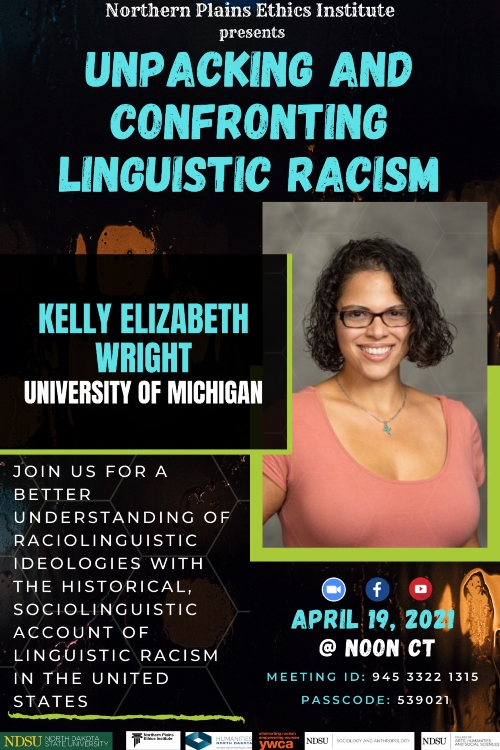
University of Michigan Experimental Sociolinguist participated in NDSU diversity conversation on confronting linguistic racism
See the full presentation here on the NPEI's YouTube channel.
The Northern Plains Ethics Institute at NDSU and the YWCA Cass Clay have announced Kelly Elizabeth Wright will be the Learning the Language of Diversity and Meaningful Inclusion program’s April speaker.
Wright participated in the conversation series on Monday, April 19, at noon Central Time via Zoom. Her presentation began the program, and was followed by moderated conversation and audience questions.
In this talk, Wright provided a historical, sociolinguistic account of Linguistic Racism in the United States by cataloguing how it manifests in the founding documents of this nation, which equate Whiteness with Standard Language use. Attendees learned about the ramifications of the defaulting of White Mainstream English by considering the process of naturalization, US educational histories, and failures of our legal system. Wright shared contemporary examples of Linguistic Racism from her research on media representations of Black athletes and voice-based discrimination in the housing market. This talk ended with a discussion of inclusive language, focusing on action steps we can take every day as educators, administrators, and citizens to create equitable and representative spaces.
Kelly Wright's research focuses on the link between Linguistic Production and Perception. She applies mixed methodologies including machine learning; massive corpora studies; perceptual and cognitive experimentation; and quantitative phonetic and qualitative sociolinguistic analyses. She upholds the civic responsibility of higher education through the creation and distribution of public-facing scholarship. Currently, Wright is developing a dissertation on Raciolinguistic Ideologies and Black Professional Speech. Her previous research has examined Language Planning and Policy; Reification of ideology through popular print media; Linguistic Profiling in the housing market; and Sociosemantic Field development and change over time.
The event was provided free of charge by the Northern Plains Ethics Institute, NDSU Office of the President, the College of Arts, Humanities, and Social Sciences, the YWCA Cass Clay, Humanities ND, and the Department of Anthropology and Sociology to all NDSU stakeholders and the public.
Attending to Racial Violence and Anti-Racism
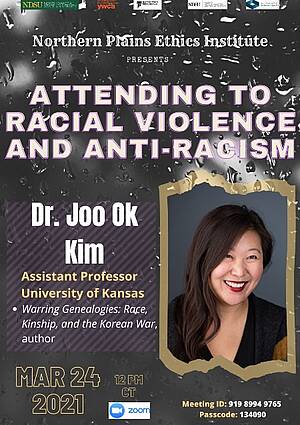
The Northern Plains Ethics Institute at NDSU and the YWCA Cass Clay have announced Professor Joo Ok Kim will be the Learning the Language of Diversity and Meaningful Inclusion program’s March speaker.
Kim participatee in the conversation series on Wednesday, March 24, at noon Central Time via Zoom. Her presentation - Attending to Racial Violence and Anti-Racism– began the program, followed by moderated conversation and audience questions.
The presentation is organized around the question of how might we attend to histories of racial violence and contemporary anti-racist movements? Kim’s presentation reviews some ongoing dialogues on race and racism; foregrounds historical and current anti-racist work converging across racial justice movements; and offers community-based, activist, and academic tools and methods as resources for dismantling racist structures.
Joo Ok Kim is Assistant Professor of American Studies at the University of Kansas. Her book, Warring Genealogies: Race, Kinship, and the Korean War (Temple University Press, 2022), examines the racial legacies of the Korean War through Chicano cultural production and U.S. archives of white supremacy.
The event is provided free of charge by the Northern Plains Ethics Institute, NDSU Office of the President, the College of Arts, Humanities, and Social Sciences, the YWCA Cass Clay, Humanities ND, and the Department of Anthropology and Sociology to all NDSU stakeholders and the public.
Watch the full presentation on the NPEI's YouTube channel here.
Canada Research Chair in Indigenous Peoples, Technoscience & Environment to participate in NDSU diversity conversation
Dr. Kim TallBear was the Learning the Language of Diversity and Meaningful Inclusion program’s February speaker.
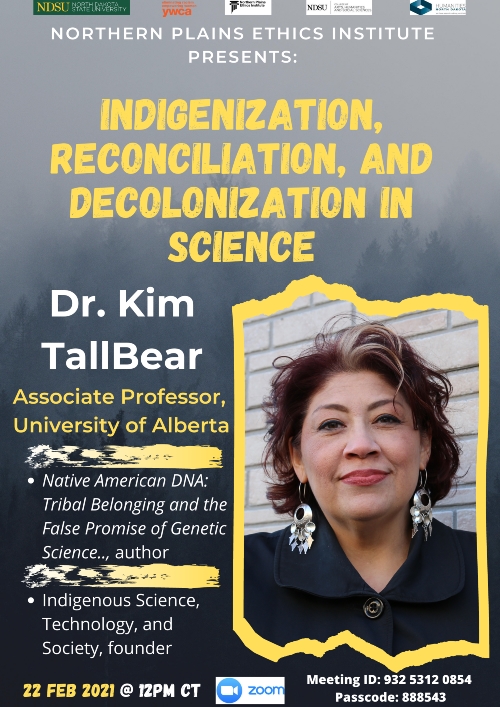
TallBear participated in the conversation series on Monday, February 21, at noon Central Time via Zoom. Her presentation - Indigenization, Reconciliation, and Decolonization in Science – will begin the program, followed by moderated conversation and audience questions.
Scientific research, technology, and related policy are performed within our society that is foundationally structured by hierarchical, Eurocentric, and colonial narratives and worldviews. No one is exempt from such influence, including scientists, engineers, and other disciplinarians. In this talk, Dr. TallBear highlights colonial assumptions and practices, and resistance to those ideas in several research case studies drawn from the genome and health sciences and from green building. She also highlights a program that helps train Indigenous genome scientists in order to increase the benefit of genome research for Indigenous peoples. Finally, Dr. TallBear provides those within and beyond the university an analytical framework to understand the relationships between “inclusion,” "Indigenization," "reconciliation," and "decolonization," in order to help us envision possibilities and concrete steps for science and technology to aid decolonization.
Kim TallBear is Associate Professor, Faculty of Native Studies, University of Alberta, and Canada Research Chair in Indigenous Peoples, Technoscience & Environment. She is the author of Native American DNA: Tribal Belonging and the False Promise of Genetic Science. Dr. TallBear founded a research group at the University of Alberta, Indigenous Science, Technology, and Society (IndigenousSTS.com). She is a co-founder of the Summer internship for Indigenous Peoples in Genomics (SING) Canada and a faculty member of SING USA (www.singconsortium.org). Dr. TallBear is a regular commentator in US, Canadian, and UK media outlets on issues related to Indigenous peoples, science, technology, and environment. She is a regular panelist on the Canadian-based weekly podcast, Media Indigena. She is a citizen of the Sisseton-Wahpeton Oyate and is also descended from the Cheyenne & Arapaho Tribes of Oklahoma.
The event is provided free of charge by the Northern Plains Ethics Institute, NDSU Office of the President, the College of Arts, Humanities, and Social Sciences, the YWCA Cass Clay, Humanities ND, and the Department of Anthropology and Sociology to all NDSU stakeholders and the public.
Watch the full presentation on the NPEI's YouTube channel here.
North Dakota Ethics Commission - How we got here and what's the future
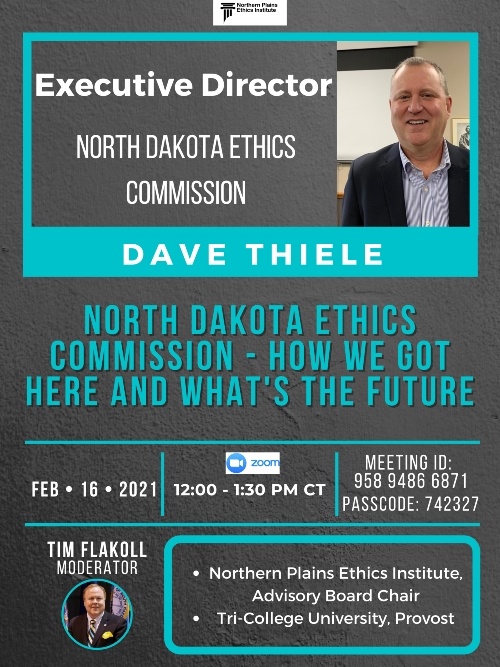
Watch the recording on our YouTube Channel here
What it is like to be black? – Toward a naming, genealogy, and epistemology of (the intractable) anti-black racism
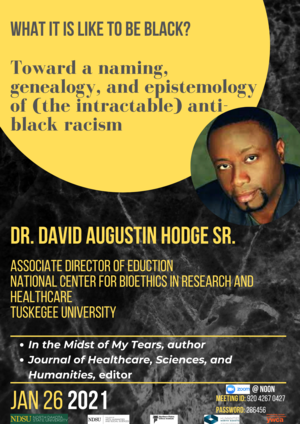
Thomas Nagel’s famous essay on “What it is like to be a bat?” demonstrates the intractability of cognitive closure, and the (often unethical) chauvinism of persons and groups. To be sure, this chauvinism doesn’t guarantee the discard of others (or difference), but it most often operationalizes either a self-priority or “us vs them” mentality. A major ethical problem, in my opinion, is that this way of thinking perpetuates artificial and unimportant variables that makes naming intractable. “What is it like to be black?” is a different question from “what it is like to be African American?” (or American African or African American living in a non-American society). Chauvinistic perpetuation of unimportant variables pushes questions of identity/genealogy and epistemology/ontology when one tries to be discursive about race, racism, and anti-black racism. Ultimately, an-other may be able to understand what it is like to be black (through empathic considerations derived from beliefs, pain, desires, aspirations, etc.), but knowing what it is like to be black is impossible. Thus, people of good will should put in the energy and the effort to achieve good will, embrace inclusion and diversity, and eradicate anti-black racism (and all other discriminatory practices).
Dr. Hodge currently serves as Associate Director of Education for the National Center for Bioethics in Research and Healthcare at Tuskegee University. In this role, which he began in October 2017, he coordinates the center’s Bioethics Honors program and bioethics minor, its annual Public Health Ethics Intensive Course, and various outreach programs designed to engage the center’s target audiences, as well as teaches bioethics and public health ethics courses.
Watch the presentation on our YouTube Channel here
Knowing Your Rights and Wrongs: North Dakota Employees and Being Politically Engaged
Chris Wilson, Chief of Staff, President’s Office, North Dakota State University
Knowing Your Rights and Wrongs: How to Engage Politically as an NDSU Employee
It is a right to be part of the political process, but many NDSU employees worry about violating laws or policies. However, with a little caution and care, employees can engage in political participation without problems. Please come to learn more about current guidelines and to check with the university’s expert on the subject.
NDUS Policy 308.3 Political Activities
NDSU Policy 160 Political Activities and Voting Rights of University Employees
NDCC 16.1-10 Corrupt Practices
AAUP 1940 Statement on Principles on Academic Freedom and Tenure
The Northern Plains Ethics Institute’s mission is to promote democratic participation in social and ethical issues affecting the Northern Plains and beyond. The NPEI fulfills its charge by engaging citizens in various discussions focusing on what kind of society they want to live in and how they go about creating it.
See the full video here on the NPEI's YouTube Channel.
The Development of Prejudice and Stereotyping from a Psychological Perspective
NY Times’ “The Ethicist” to participate in NDSU diversity conversation
The Northern Plains Ethics Institute at NDSU and the YWCA Cass Clay have announced May Ling Halim will be the Learning the Language of Diversity and Meaningful Inclusion program’s December speaker. See the full presentation here
Halim is scheduled to participate in the conversation series on Wednesday, Dec. 2, at noon Central Time via Zoom. Her presentation - The Development of Prejudice and Stereotyping from a Psychological Perspective: Challenges and Potential Solutions – will begin the program, followed by moderated conversation and audience questions.
Present-day injustices experienced by people of color have sparked outrage and a demand for change. Halim argues that we have gained a large body of psychological research that can inform us about the challenges human nature presents in facilitating prejudice and stereotyping and about possible solutions to reduce it.
Halim’s talk will have three broad sections. In the first, Halim discusses how prejudice has been defined within the field of psychology and shares research showing how racial/ethnic discrimination can affect children’s health, academic achievement and motivation, and well-being. In the second, she talks about a number of human tendencies psychology has identified that facilitates us to form stereotypes about groups and show bias. Finally, Halim presents possible solutions to reduce prejudice based on psychological research. I will focus on how adults can monitor language use that inadvertently emphasizes race/ethnicity as an all-encompassing category, such as the use of generics, labels, and contrasts. I will also discuss why striving to shape colorblind children is not realistic and can, in fact, be harmful to efforts to dismantle racism. Relatedly, I will discuss ways that parents and teachers can be proactive in their efforts to talk about race/ethnicity with their children and students. Finally, I will highlight work that stems from intergroup contact theory showing how encouraging friendships and cooperation among children from different racial/ethnic groups can be effective in reducing prejudice.
Dr. May Ling Halim is an Associate Professor of Psychology at California State University, Long Beach (CSULB). Dr. Halim completed her MA and PhD in Social Psychology with a Developmental Focus and Quantitative Minor at New York University and her BA in Psychology at Stanford University. Dr. Halim has won numerous awards and grants, such as from the National Science Foundation and the American Psychological Foundation Kenneth B. and Mamie P. Clark Fund. She has been invited to speak at several events and universities, such as at the Society for Research on Child Development Biennial Meeting, and the Society of Experimental Social Psychology Meeting. Her research spans two broad areas. The first is gender and racial/ethnic identity development in children of different cultures. The second is the effects of group discrimination on health and well-being. Her research papers have been published in national academic journals such as Child Development, Developmental Psychology, and Health Psychology. Her work has also been featured in the popular media, such as on NBC Think, NPR and in Psychology Today.
The event is provided free of charge by the Northern Plains Ethics Institute, the College of Arts, Humanities, and Social Sciences, the YWCA Cass Clay, Humanities ND, and the NDSU Department of Anthropology and Sociology to all NDSU stakeholders and the public.

Understanding "Racisms" and Racialism - Kwame Anthony Appiah
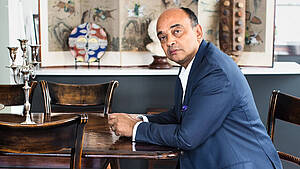
The Northern Plains Ethics Institute at NDSU and the YWCA Cass Clay announced Kwame Anthony Appiah was the Learning the Language of Diversity and Meaningful Inclusion program’s October speaker.
Appiah participated in the conversation series on Tuesday, Oct. 27, at noon via Zoom. His presentation - Understanding "Racisms" and Racialism – began the program, followed by a moderated conversation, and then audience questions until around 2pm.
Exciting and erudite, Kwame Anthony Appiah challenges us to look beyond the boundaries—real and imagined—that divide us, and to celebrate our common humanity. Named one of Foreign Policy’s Top 100 public intellectuals, one of the Carnegie Corporation’s “Great Immigrants,” and awarded a National Humanities Medal by The White House, Appiah currently teaches at NYU, though he’s previously taught at Princeton, Harvard, Yale, Cornell, Duke, and the University of Ghana. He considers readers’ ethical quandries in a weekly column as “The Ethicist” for The New York Times Magazine. From 2009 to 2012 he served as President of the PEN American Center, the world’s oldest human rights organization. He is currently chair of The Man Booker Prize.
Anthony Appiah’s book Cosmopolitanism is a manifesto for a world where identity has become a weapon and where difference has become a cause of pain and suffering. Cosmopolitanism won the Arthur Ross Book Award, the most significant prize given to a book on international affairs. In The Honor Code: How Moral Revolutions Happen, Appiah lays out how honor propelled moral revolutions in the past—and could do so in the future. Walter Isaacson calls it “an indispensible book for both moral philosophers and honorable citizens.” Among his most recent books are As If: Idealization and Ideals, an exploration of the way ideals facilitate human progress; Mistaken Identities, further explores subjects of his popular BBC series; and the brand new The Lies That Bind, an incandescent exploration of the nature and history of the identities that define us.
Kwame Anthony Appiah was born in London to a Ghanaian father and a white mother. He was raised in Ghana, and educated in England, at Cambridge University, where he received a Ph.D. in philosophy. As a scholar of African and African-American studies, he established himself as an intellectual with a broad reach. His book In My Father's House and his collaborations with Henry Louis Gates, Jr.—including The Dictionary of Global Culture and Africana—are major works of African struggles for self-determination. In 2009, he was featured in Astra Taylor’s documentary Examined Life, alongside Martha Nussbaum, Slavoj Zizek, and other leading contemporary philosophers.
The event was provided free of charge by the Northern Plains Ethics Institute, the YWCA Cass Clay, Humanities ND, and the NDSU College of Arts, Humanities, and Social Sciences to all NDSU stakeholders and the public. However, registration was required.
YWCA Event
YWCA’s Racial Justice Committee presented their first ever virtual circle dialogue on race, on October 8, 2020 leading up to Indigenous Peoples’ Day. This event is a virtual adaptation of dialogues we’ve hosted in the past in connection with the exhibit RACE: Are We So Different? co-owned by YWCA and the Science Museum of Minnesota. Due to the pandemic, the RACE Exhibit is currently closed to the public, but we look forward to working with organizations and groups to safely view and host events around the exhibit in the future at our new Administrative Offices (4650 38th Ave. S, Suite 110 in Fargo). We hope this will be a catalyst for a continued series of conversations about race and equity in our community and will continue to be in touch about further opportunities and events. 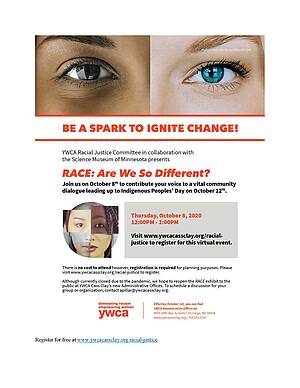
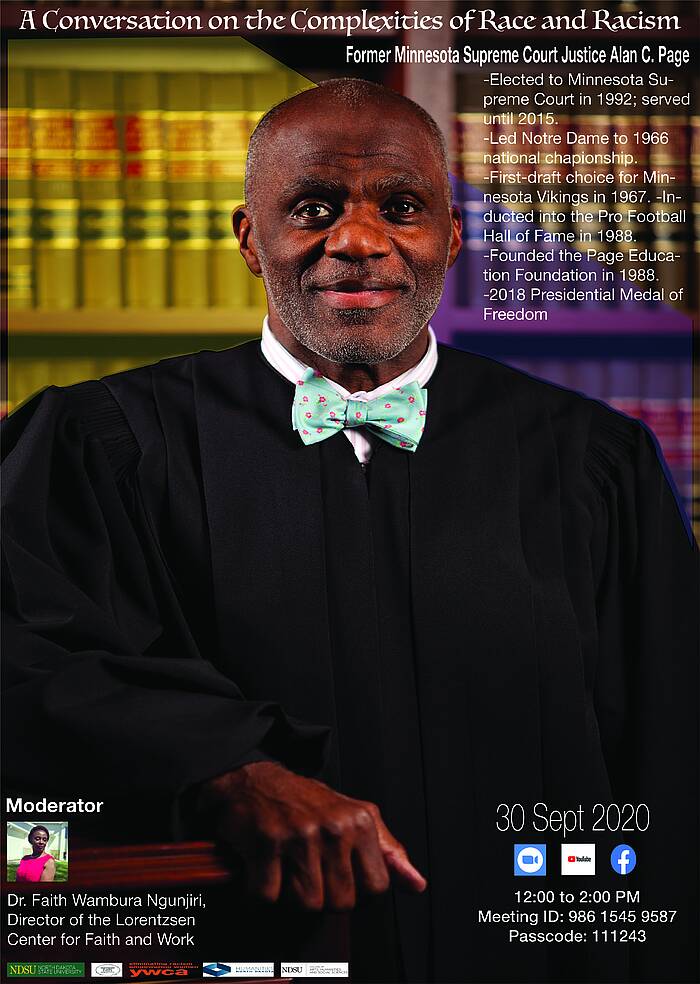
A Conversation on the Complexities of Race and Racism
To watch the presentation on our Facebook page, click here.
Native Conversation about Work and Community
A conversation with community members on Indigenous persons in the workplace. Featured guests are Lyndon Pease, Anne LaFrinier-Rithcie, and Whitney Fear. Sponsored by the Northern Plains Ethics Institute.
For the YouTube Video of this even, click here
Meeting NDSU’s Enrollment Challenges MU Century Theater 19 February 2020
Abstract: Across the country, fewer traditionally aged high school graduates are choosing to attend colleges and universities and in the coming years there is a predicted decline in high school graduates This presentation will discuss these phenomena and how NDSU’s is working to meet the challenge.
Presenters: Chris Wilson, Chief of Staff, and Laura Oster-Aaland, Vice-Provost for Student Affairs & Enrollment Management
PowerPoint presentation click here
Video on the NPEI YouTube channel click here
1st Think and Drink sponsored by NPEI and Humanities North Dakota a success.
KVRR news story click here
Science, Religion, and Lunch Seminar presented by Larry Reynolds
NDSU Budget Process 101 MU Century Theater 12:00pm-1:00pm 29 January 2020
Abstract: The University’s budget is large and extremely complicated because of numerous internal and external factors. This presentation will provide a basic overview of (1) the University biennial budget process; and (2) the role of the Division of Finance and Administration in that process.
Presenters: Bruce Bollinger, Vice President of Finance and Administration, and Cynthia Rott, Budget Director
For the PowerPoint, click here
Northern Plains Ethics Institute (NPEI) Public Forum:
Chris Wilson, Chief of Staff, NDSU
Separating Fact from Fiction: NDSU Employees’ Rights and Responsibilities in a Political Season
January 23, 2020
Being part of the political process is a right, but many NDSU employees worry about violating university, SBHE, or state policies and laws. Many of those concerns are unjustified, but it is always good to learn more about current guidelines and to check with the university’s expert on the subject.
Science Religion and Lunch Seminar
Charles Sawicki
Retired Professor of Physics, NDSU
Topic: Religion and the Formation of Empires
MU's Meadow Lark, North Dakota State University
SRLS by Chancellor of the NDUS
Mark Hagerott
Chancellor of the North Dakota University System
Topic: Can Humans Flourish in the Age of Robots, Cyberspace, and Artificial Intelligence: Suggesting a Theoretical Framework...and What This Might Mean for the University of the Future
MU's Century Theater, North Dakota State University
Watch the presentation on the NPEI's YouTube channel
Swami Atmarupananda Presentations in Fargo
Swami Atmarupananda spoke at the SRLS on October 22.
He delivered another community lecture in the evening of October 22. The title of his talk is: "The Art of Inner Joy". This was at 6.15-7.15PM in the Spirit Room in downtown Fargo. Please see the Spirit Room’s Facebook page for more info, https://www.facebook.com/events/500729747395702/
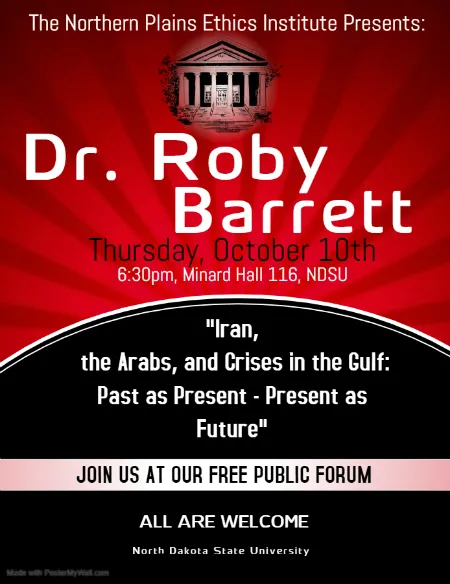
Dr. Roby Barrett, Public Forum

Ethical Issues Affecting Indigenous Communities in North Dakota
Video Link for Health and Poverty: Stress and Food Deserts, A Public Conversation
Link to the North Dakota food desert map:
Link to the PPB podcast series:
The Center for Bioethics at Cedarville University, the Northern Plains Ethics Institute at NDSU, and the International Academy of Medical Ethics and Public Health's conference Clinical Ethics and Conscience Rights
Ethical Issues Affecting ND’s Indigenous Communities
18-April-2019
View Panel Discussion here
Personhood and Science in the 21st Century
January 7-8-9, 2019
Amphithéâtre Lavoisier A (3rd floor)
Centre Universitaire des Saints Pères 75006 Paris
Productive Civic Engagement in the 2019 Legislative Session
15 November 2018 in the Memorial Union’s Room of Nations
Panel with Chris Wilson, Chief of Staff the NDSU’s President
Fake News III: Opining versus Reporting – practitioners, roles reporters play.
October 25, 2018 Century Theater, NDSU Campus
The questions for this presentation were:
1. What do you think is the difference between opinion and reporting? Please ground your answer in your experience.
2. What is the value of good opinion? What is the value in good reporting?
3. How do you develop a story? What does a week look for you?
4. If it happens, what do you do when you get a story (opinion) wrong?
5. In the current climate, what challenges are there?
6. How do you know that your communication was effective?
Fake News II
View Panel Discussion here
Keeping It Clean: How to be Politically Active without Violating the State’s Corruption Statutes
Chris Wilson
Chief of Staff the NDSU’s President
13 September 2018 in the Memorial Union’s Room of Nations
Project to Address Good Government in North Dakota at Valley City State University Campus
March 28, 2018, 7-9 p.m., Skoal Room, VCSU’s Student Center, Valley City State University, Valley City, ND
Free and Open to the Public, Refreshments Provided, Students Welcome
NDSU’s Northern Plains Ethics Institute and ThinkND hostrf a conversation about “What is Good Government in North Dakota?” on Wednesday, March 28th, from 7 p.m. until 9 p.m. in the Skoal Room in the VCSU Student Center on the Valley City State University campus. The Bush Foundation and the North Dakota Humanities Council awarded ThinkND grants for this project. The discussion featured moderators Luis Da Vinha, assistant professor of political science in the Geography and Political Science Department at Valley City State University, and Scott Hennen, radio talk show host broadcasting from The Flag, KFYR Bismarck, KTGO Williston, Tioga, Watford City, and KLTC Dickinson, and author of Grass Roots, A Commonsense Action Plan for America.
The moderators gave opening remarks and engaged in audience conversations about: What makes good government? What makes a good legislator or governor? What makes a good citizen?
According to institute director Dennis Cooley, North Dakotans have reported that trust in government has eroded. “They feel that rapid changes in everyday life and government at every level have left many disconnected, if not reeling,” Cooley said. “Facts seem often to contradict one another. Legislators are not as accessible as they used to be. Concerned citizens attending government hearings often feel dismissed, as if decisions have already been made. There are concerns about out-of-state money influencing government decisions. This comes at a time when trust is needed to pursue success for each citizen and the state.”
The discussion was part of a multi-faceted initiative to engage North Dakota citizens and academic experts in a discussion about ethics and trust in government. The elements of the initiative include:
· Five gatherings of academics and citizens around the state
· A culminating event at the Heritage Center in Bismarck
· Participation in statewide conference programs and radio talk shows
· A series of Dakota Datebook programs on Prairie Public Radio
The project focused on academic collaboration, participant engagement and preserving or creating content for re-use. Scholars addressed such topics as the role of ethical behavior in the history of North Dakota government, how ethical government affects a state’s economy, the cost of mistrust and other matters related the requirements of good government.
The gatherings focused on local thought leaders; teachers; students; people involved with township, city and county government; rural residents and the Native community.
“By providing an opportunity to engage in conversations with each other and experts from the academic community, a grass works-based framework for possibly rethinking government can be sketched out,” Cooley said.
Community Conversation: How Does Education Address Healthy Environments and Behavioral Health?
The panel included:
Dr. Anne Blackhurst (President of Minnesota State University Moorhead)
Dr. Lynne A. Kovash (Superintendent, Moorhead Area Public Schools)
Arlette Preston (owner of Home Instead Senior Care) served as the moderator.
Thursday, December 1, 2016
Rourke Art Gallery and Museum
The panel discussed the following questions:
1. How do educational opportunities help people think differently in regard to the values underlying health and their place in the world?
a. How are recidivism and education linked?
2. Where is the educational system failing our community?
3. Where is the educational system being successful?
4. What changes would you recommend?
5. What can we do in the community to help?
Untangling Quality of Life and Oil Development: The Case of Western North Dakota
Dr. Felix Fernando, North Dakota State University
18 November, 2015
View PowerPoint Presentation here
Diplomacy and War: Prospects for U.S.- Iran Relations and the Nuclear Issue in the Coming Year
NDSU’s Northern Plains Ethics Institute hosted its Spring 2013 panel Discussion on 4 April 2013.
Two internationally known policy specialists on the Middle East and security issues in the region conducted a panel discussion and question and answer session on U.S.-Iran relations and the ongoing nuclear crisis with Iran. The panel members were Allen Keiswetter, former Deputy Assistant Secretary of State for Middle East Affairs and now Senior Consultant at the international law firm SNR Denton, and Dr. Roby C. Barrett, a former Foreign Service Officer and a Senior Fellow for Strategic Studies and Applied Intelligence at the Joint Special Operations University of U.S. Special Operations Command. Both Mr. Keiswetter and Dr. Barrett are Scholars at the Public Policy Center of the Middle East Institute in Washington, D.C.
The panel discussion focused on the questions of Iran and its nuclear program as well as addressed broader regional security issues including Syria, Lebanon, Yemen, Iraq, Gulf and Israel within the context of the current crisis between Iran, its Arab neighbors, the European Union and the United States. The topics of war and diplomacy were central to the discussion.
Spring Lecture: The Nature of Evil
The 20th century witnessed the Holocaust, an unparalleled evil in the eyes of most people, as well as attempted genocide in Rwanda. The beginning of the 21st century saw the launching of a so-called “war” against terrorism, proclaimed to be a struggle of good against evil. BUT WHAT IS EVIL? If we don’t know what we’re struggling against, we’re unlikely to be successful. We can kill plenty of people, but we won’t know that we’re killing evil people. Nonviolence provides a perspective from which to answer this question and points the way to a more constructive response to violence than mere condemnation and force.
Professor Robert Holmes distinguished career in ethics and peace studies has taken him around the world. He is Professor Emeritus at the University of Rochester. He is the first recipient of the Rajiv Gandhi Professor of Peace and Disarmament, Jawaharlal Nehru University, New Delhi, and is a former Fulbright Lecturer, Moscow State University. Most recently, he held the McCullough Distinguished Visiting Professor of Political Philosophy, Hamilton College. He has also served as president of the international group, Concerned Philosophers for Peace.
Land Grant Traditions Panel Discussion
A panel-led discussion that examined the Morrill Act of 1862 and considered what it means to be a land grant university, both historically and for the future. The forum was led by Thomas Isern, University Distinguished Professor, and moderated by John Helgeland, NDSU professor of religious studies and director of the Northern Plains Ethics Institute. Featured panelists included:
· James Carlson, Founder of PRACS Institute
· Richard Hanson, Interm President NDSU
· Mark Meister, Assoc. Prof. of Communications, President NDSU University Senate