The Story That Made NDSU Known in Bangladesh
Read the original article featured in The Spectrum: The Story That Made NDSU Known in Bangladesh
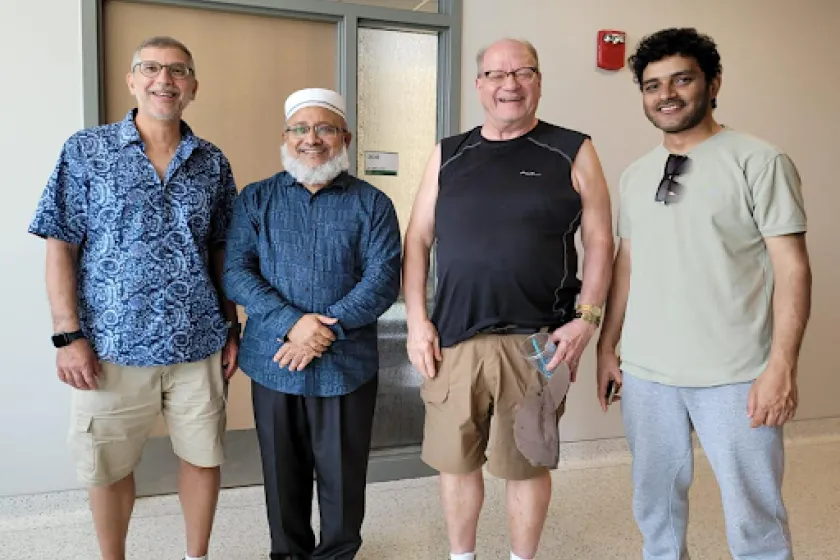
Does NDSU know that it once enrolled a student who would go on to become one of the greatest writers in Bengali literature, so beloved in his country that, through his writing, he carried this campus across continents and into the imagination of people who had never seen it? He arrived here not as a literary icon, but as a young doctoral student in chemistry. His name was Humayun Ahmed. When I was preparing to leave my country for NDSU, I began to understand this more clearly. A friend reminded me just before I left that the writer we grew up reading had studied here. For many in Bangladesh, NDSU is not just a university in North Dakota. It exists in memory and in literature long before it is ever seen. When I finally arrived here, I realized that I was stepping into a place I had already known. That realization stayed with me, but I did not fully grasp its depth until one particular visit in 2024.
In that year, a Bangladeshi physician named Tariqul Islam came to Fargo with a purpose that was simple and profound. He did not come for a conference or a professional obligation. He came to see this campus because Humayun Ahmed had once lived and studied here. He stayed with me in my apartment, and from the moment he arrived, it was clear that this was not an ordinary visit. He asked me to walk with him through the campus and take him to Dunbar Hall, where the chemistry department had been located during Humayun Ahmed’s time at NDSU. It was a request that sounded straightforward, yet it carried something deeper. He was not simply looking for a building; he was searching for a place that existed in his memory long before it existed in his experience.
Together, we began to walk. We stood near the stone Bison at the center of campus. Around us, everything was orderly and precise. The buildings and paths stood exactly where they were meant to. And yet, we were not walking only through the campus that exists. We were also walking through another one, quieter and less visible, carried in memory and shaped by language. We passed Minard Hall, Morrill Hall and Ladd Hall, making our way toward Sugihara Hall. But Tariqul’s attention kept returning to an earlier map, one that did not appear on any official directory. It was the map preserved in Hotel Graver Inn, the memoir where Humayun Ahmed wrote about his student life in Fargo, drawn not with architecture but with experience.
He wanted to see Dunbar Hall. We searched, asked and looked again. Slowly, it became clear that the building he wanted to find no longer existed. There was no dramatic disappointment. Instead, there was a quiet recognition. The place he was searching for had not disappeared. It had moved into memory. At that moment, I understood something I had not fully understood before. Universities preserve what can be measured. Buildings, departments and archives are maintained with care, but there is another kind of presence that institutions do not always know how to hold. It lives in stories.
Humayun Ahmed did not simply study at NDSU. As a doctoral student in the Department of Chemistry, he experienced what countless international students experience: distance, loneliness and the slow work of adjustment. But he did something rare with that experience: He wrote it. In Hotel Graver Inn, he transformed Fargo into an emotional geography. The city appears not through grand description, but through moments: the cold wind at the airport, the bitterness of unfamiliar coffee, sleepless nights in an old hotel, anxiety in the classroom, cheap meals repeated out of habit and unexpected acts of kindness that make survival possible. Through such details, he made distance human.
That is why Tariqul’s journey mattered. He had come because that writer had made this place meaningful. For readers in Bangladesh, Fargo is not abstract. It is already inhabited. As we walked, we also met people. Inside the chemistry department, we spoke with faculty members who could recall the name faintly, aware that someone by that name had once studied here, though they belonged to a different time. Their response was not dismissive. It was simply distant, shaped by the natural turnover of institutions.
Later, in Memorial Union, Tariqul noticed some Bangladeshi students. He spoke with them. He looked carefully at the displays and lists on the walls. He searched for a trace of the name he had carried across continents. He did not find it. He had hoped, perhaps, for something small. A mention. A corner. A book on a shelf. But this is not a criticism of NDSU. It is a reflection on how institutions remember. Universities are built to preserve structure. They document programs, buildings and official histories with precision. Stories move differently. They travel through readers, through families, through conversations and through language. They cross borders without permission and endure without institutional support. And sometimes, they last longer than the structures themselves.
What struck me most during Tariqul’s visit was not what we found, but what we felt. He had traveled a long distance not for a monument, but for an atmosphere. Not for confirmation, but for connection. He wanted to stand, however approximately, where memory and literature once met. That kind of journey tells us something important about transnational identity. International students do not arrive as blank individuals who simply absorb a place. They arrive already inhabited by other journeys. They carry languages, memories, histories and stories that shape how they see what is in front of them. Sometimes, they also carry places they have never physically visited but already deeply know.
Humayun Ahmed once came here as a student. Decades later, another Bangladeshi came here because that journey had been written down. Between them lies a bridge not built by institutions, but sustained quietly through literature. This is also a story about invisible intellectual and emotional labor. We often measure international education through numbers: enrollment, diversity and economic contribution. But we rarely account for the interior work of being here. The work of translation, adaptation, longing and self-reconstruction. Humayun Ahmed did that work. And then he transformed it into something others could feel. He turned a place into memory. That is no small contribution. And that is why the contrast between story and structure matters. NDSU’s structures are visible, organized and carefully maintained. They tell us what the university is. But Humayun Ahmed’s story tells us what the university means beyond itself. It lives in readers’ minds, in distant homes, in another language and in visits like Tariqul’s.
A truly global university is not only one that hosts international students. It is one that recognizes how its meaning travels through them, long after they leave. A small gesture would be enough. A plaque. A corner. A recognition that this campus exists not only here but elsewhere too. In the Memorial Union there is an inscription: “All gave some, some gave all.” Standing there with Tariqul, that line felt different. Some give knowledge. Some give labor. Some give years. And some give something far less visible but far more enduring. A story that carries a place across continents and across generations. Humayun Ahmed gave NDSU that story. The question is whether we are ready to see it. Because somewhere, even now, there may be a reader who knows this campus not by its map, but by a sentence.