Powering Lunar and Martian Exploration
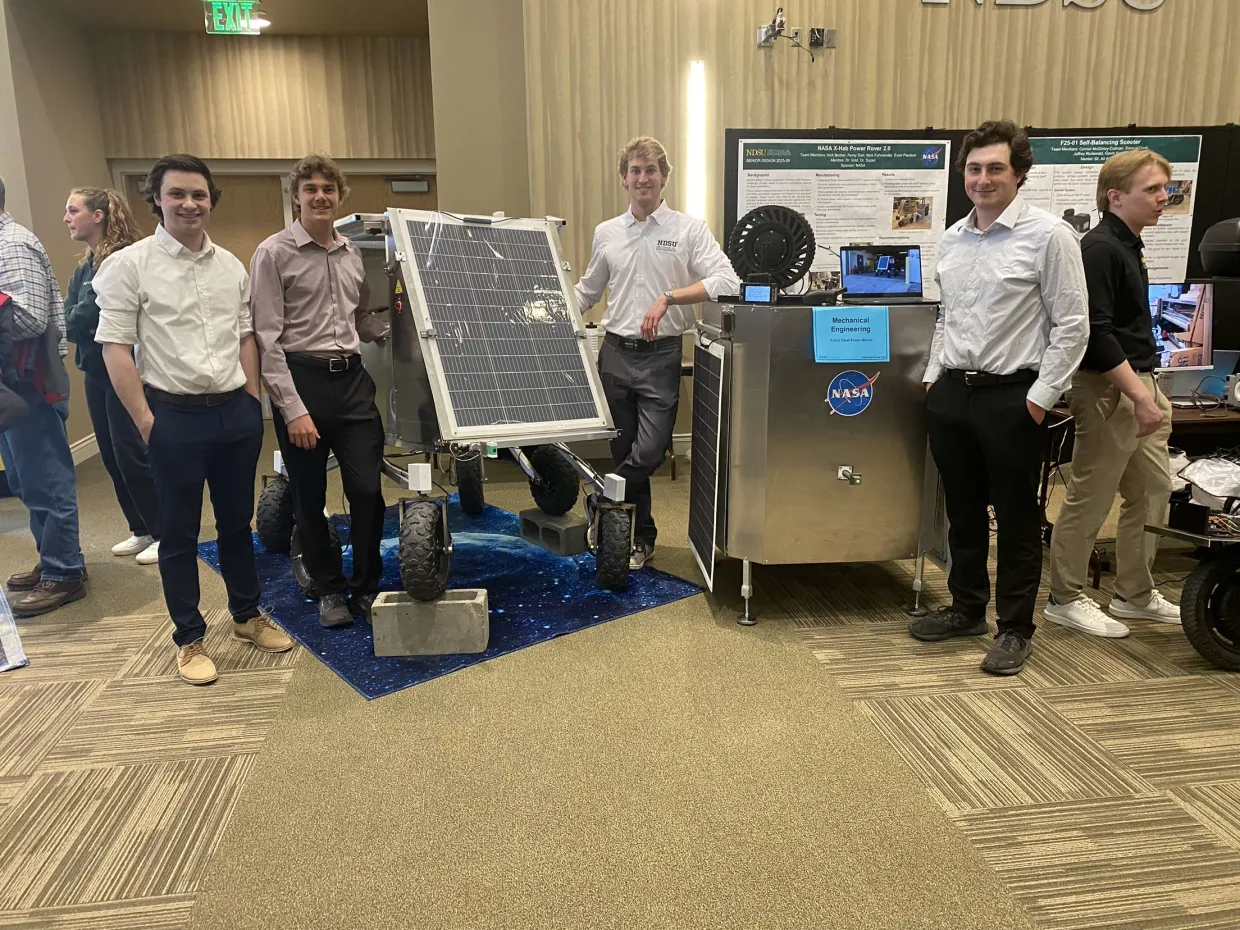
Over the 2025-2026 academic year, seniors Nicolas Becker, Remy Darr, Nicolas Fahnlander, and Evan Paulson designed, built, and tested a power generation and storage rover for NASA as part of the Moon to Mars eXploration Habitat (M2M X-Hab) Academic Innovation Challenge. The team’s goal was to develop a rover and a fixed charging station to charge and revive mission-critical rovers that have entered critically low-power states. The primary objective was to ensure mission continuity and rover recovery in remote or power-limited environments where solar energy is unavailable or insufficient. By enabling mobile energy delivery, the system increases the operational lifespan of field-deployed rovers and prevents the permanent loss of valuable equipment.
The rescue rover is engineered to travel long distances, navigate challenging terrain, and deliver power directly to disabled rovers. Its charging capabilities are designed to be efficient, reliable, and flexible enough to support a variety of rover platforms. Complementing this is an immobile charging station that can recharge the rescue rover and provide additional charging for future expansion as more rovers are deployed.
The power generation and storage rover was designed to be powered by a multi-mission radioisotope thermoelectric generator and three solar panels. The rover's motion is controlled by six hub motors mounted to the six-wheeled rocker-arm suspension system. To enable charging of other rovers, the team designed a charging connection system with internal contact points to help eliminate the impact of regolith, the abrasive dust on the surface of the Moon and Mars.
As the team progressed through the design, build, and testing phases, they met regularly with NASA engineers at Kennedy Space Center and Stennis Space Center to ensure their designs met NASA’s needs. The NDSU M2M X-Hab team successfully demonstrated their rover and station design at the 2026 Senior Design Expo. Prior to the expo, the team drove the rover across campus from their workspace to the Memorial Union, demonstrating its ability to navigate diverse terrain and travel significant distances. The team was mentored by ME faculty members Dr. Bora Suzen and Dr. Jessica Vold. The rover will be on display in the Richard Offerdahl ’65 Engineering Complex when it opens in fall 2026.
The M2M X-Hab Challenge is an annual program run by NASA that provides funding for design projects at ABET-accredited institutions. Each year, NASA issues a request for proposals for projects that NASA personnel have approved for funding. Projects range from $15,000 to $50,000 and must be completed by undergraduate or graduate students enrolled in design courses. The goal of the M2M X-Hab program is to bring together the next generation of engineers and current NASA engineers to close the knowledge gap and reduce the risk of new technology that advances NASA's mission. To facilitate this connection, each M2M X-Hab team is paired with a team of NASA engineers who regularly meet with the students to discuss their design, build, and testing progress. NDSU has been awarded four X-Hab grants over the last five years to develop a wide variety of rovers and life support systems.