
Since 3D printing was developed in the early 1980s, people have used the technology to print all kinds of items ranging from surgical equipment to plant pots to game pieces. But what about replacement parts for musical instruments?
That’s the question the NDSU Challey School of Music and its registered piano technician Christian Heaford asked when essential parts for the school’s harpsichord – a piano-like instrument from the Baroque era – were no longer being produced by the manufacturer.
As NDSU’s go-to harpsichord expert, Heaford was willing to explore any solution that would replace its worn-out springs, plectra and tongues in time for NDSU’s performance of Handel’s Messiah in December. “Even though it’s a finnicky instrument, the harpsichord has allowed NDSU to pursue a more realistic experience when performing Baroque music, as the modern piano did not yet exist in the Baroque era,” Heaford says.
He connected with Zachary Drechsel, an Interlibrary Loan Associate at NDSU Libraries who helps run the Digital Fabrication Lab, a student-centered and accessible workspace that allows students to design and produce prototypes and projects for personal, academic and professional purposes.
Was it possible to 3D print parts for an instrument that was designed as early as the 14th century? Intrigued by this unique opportunity, Drechsel agreed to help Heaford find out.
A High-Strung Project
Although harpsichords were revived in the 20th century thanks to builders like Frank Hubbard and William Dowd, the instrument is rare. Music written for harpsichord is now primarily played on piano, a more accessible and robust instrument that requires less maintenance.
Despite the harpsichord being higher maintenance, the NDSU Challey School of Music knew it was worth saving. The department acquired the instrument through a generous donation from engineer Roger Laskey in the early 2000s. Laskey built the harpsichord from scratch using one of Hubbard’s “do it yourself” kits that were sold in the 60s and 70s.
Heaford has maintained the harpsichord for many years, but as with any equipment that’s used repeatedly over time, the tongues – or the small pieces that enable the plectra to pluck the strings when a key is pressed – began to wear out, reducing the sound quality. He was alarmed when parts were out of stock, but appreciated that Drechsel was willing to experiment with 3D printing the parts in the Digital Fabrication Lab.
“I enjoyed the problem-solving aspect [of the project], but I was concerned about the scale,” says Drechsel, who would need to print over 200 small parts that could withstand long-term, repetitive use. “There are a lot of one-off projects in the 3D printing world. It comes from a space of rapid prototypes – check the fit, check the function, then send them to the manufacturer to be reproduced. [Heaford] needed something that could be manipulated over and over.”
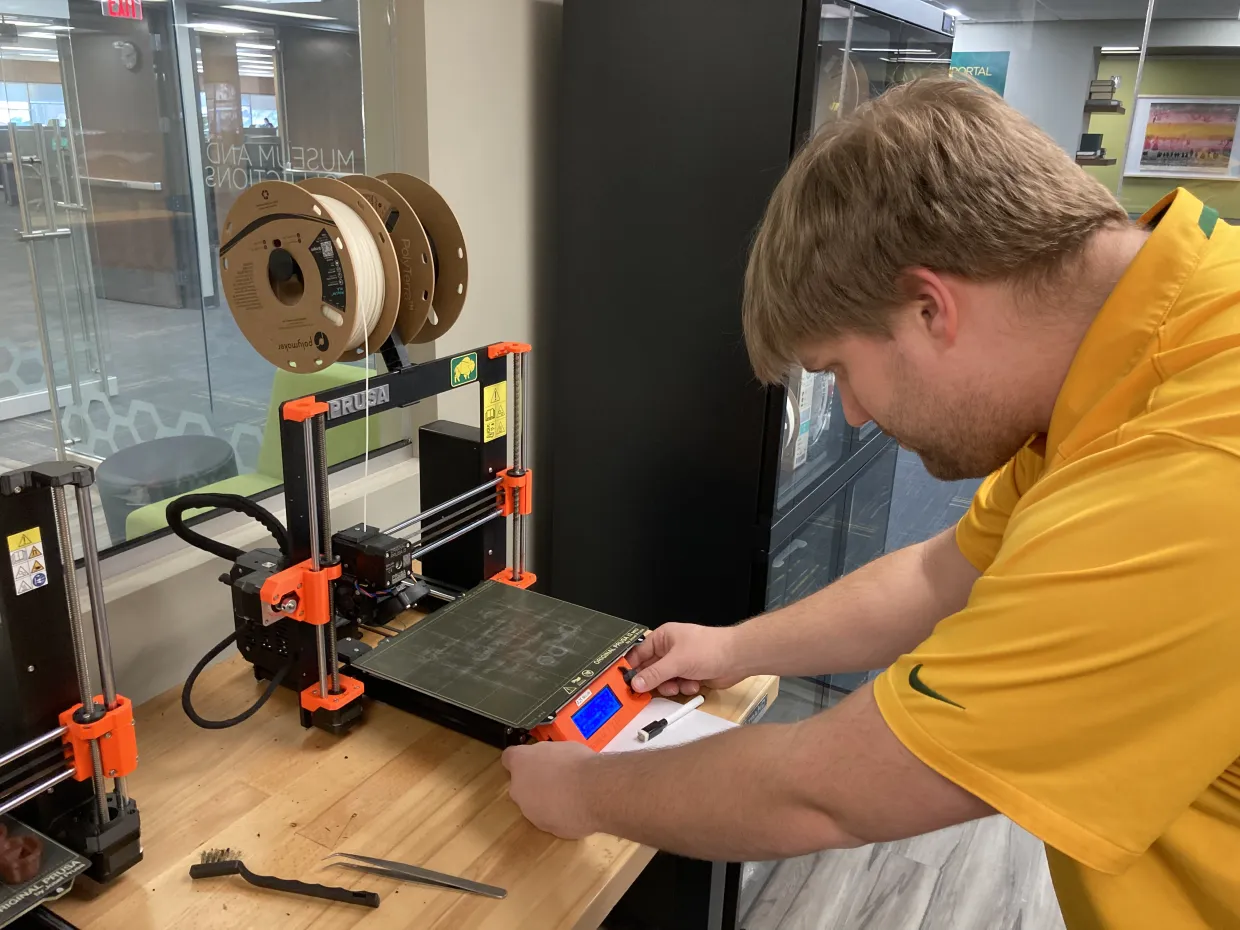
“The original parts were made of plastic but molded in one solid piece,” Heaford adds. “3D printing builds layer upon layer, which creates stress points that are weaker and more prone to breaking. You don’t want that happening in the middle of a show.”
Fortunately, after five rounds of experimentation over the course of several months, Drechsel printed a tongue using a filament called Polyethylene Terephthalate Glycol, or PETG. Most 3D printed projects use Polylactic Acid (PLA), but PETG provided the flexibility and functionality that the harpsichord tongues required. To print over 200 tongues, Drechsel created a template that fit 25 tongues per sheet. Each sheet took up to five hours to print. Heaford had the parts he needed within a week.
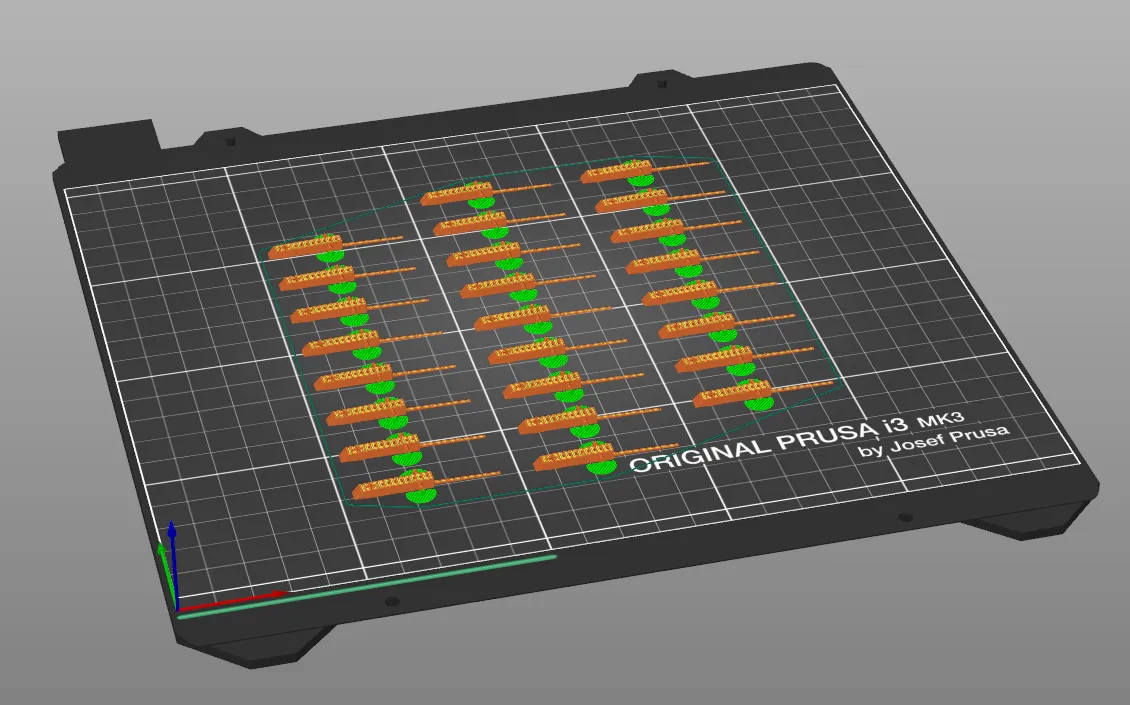
Now, it was a matter of installing the tongues into the harpsichord.
Old Meets New
With Handel’s Messiah quickly approaching, Heaford brought in NDSU piano student Zakk Volk to assist him with installing the new tongues and restring the harpsichord. Volk, who taught himself how to tune pianos when he was a teenager, was interested in Heaford’s line of work.
“Working on pianos is the perfect intersection of my music interests and repair skills,” says Volk.
“He saved me countless hours,” Heaford says. “Once he got the process down, he offered to come in between classes to keep things moving. He worked into the wee hours of the night. He had 80% of the 200 strings done – and done right – a week later.”
“By the end I was wrapping [the strings] faster and cleaner than Christian,” Volk says with a smile. “It felt good to gain the trust and respect of a master in his field."
After everything was installed, the final step was “regulation” – or the fine tuning to make sure everything was working correctly. “As soon as we changed the strings and added the new parts, there was at least twice the volume,” Heaford says. With only three days to spare, the harpsichord was ready to shine not only at Handel’s Messiah, but any other performances featuring Baroque music for years to come.
To learn more about upcoming music performances, visit the NDSU Performing Arts calendar. More information about the Digital Fabrication Lab is available on the NDSU Library website.