Pine wilt disease confirmed in North Dakota
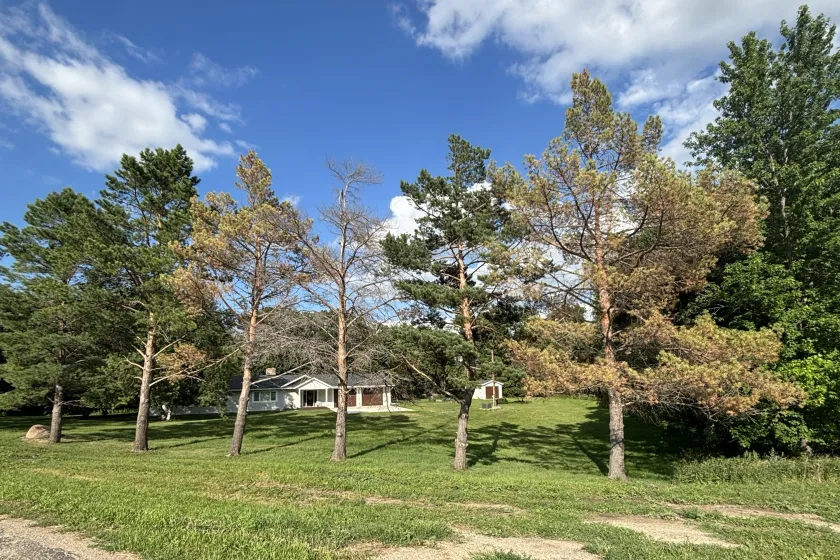
Forest Health staff from the North Dakota Forest Service have discovered a new threat to North Dakota’s conifers this week. While investigating mortality in Scotch pine trees, pine wilt disease was tentatively identified in Ransom County at Sheyenne River State Forest and in Sargent County near Forman, ND. The finding was confirmed on August 11, 2026, by the South Dakota State University plant pathology lab.
Pine wilt disease is caused by a nematode (Bursaphelenchus xylophilus) and kills non-native pine trees, including Scotch Pine (Pinus sylvestris), Austrian Pine (Pinus nigra), and Mugo Pine (Pinus mugo). The nematodes spread from tree to tree by hitching a ride on native sawyer beetles. The nematodes cause water-conducting pores to collapse within the tree, essentially starving the afflicted tree. Symptoms begin with needles turning grayish green, then progressing to yellow to reddish-brown. The tree declines rapidly, often retaining the dried needles on the tree. Scotch pine trees will generally die within one season of contracting the disease, while Austrian pine may take two seasons to succumb.
There is currently no effective treatment for pine wilt, according to NDFS Forest Health Manager, Martin Shervey. Removal and destruction of the wood is the best treatment to slow the spread of the disease. When planting new trees, it is advised to plant native conifers, such as Ponderosa pine, instead of non-native species like Scotch or Austrian pine.
As North Dakota summer temperatures increase, pine wilt is expected to move north through the state. It took several years for pine wilt to move northward through South Dakota, and similar trend to the spread is expected here.
Non-native pine species like Scotch and Austrian pine are commonly used in windbreak plantings, on farmsteads, and in communities across North Dakota. The confirmation of this disease speaks to the necessity of diversifying tree species across our forest resources.
Concerned your tree has pine wilt disease?
The North Dakota Forest Service collects data on tree pests and disease issues through the Sick Tree Assistance form. Consider submitting your tree or contact your local extension agent. Pine wilt disease can only be confirmed from samples taken when the nematode is active in late July, August, and early September.