NDSU assistant professor receives NSF-MRI award to acquire laser scanning vibrometer
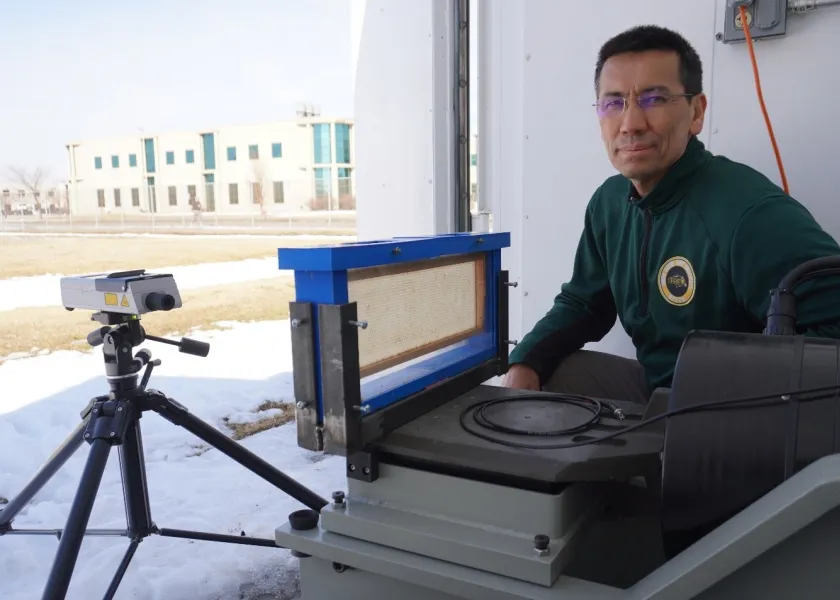
Sulaymon Eshkabilov, NDSU assistant professor of ag machinery engineering, has received an award of $625,244 from the National Science Foundation (NSF) Major Research Instrumentation program to acquire a PSV QTEC 3D Laser Scanning Vibrometer.
The 3D Laser Doppler Vibrometer (PSV QTEC 3D-H) provides unique capabilities that will substantially enhance NDSU’s research across several key areas. The vibrometer supports high-resolution vibroacoustic scanning across a broad range of applications, and its flexibility enables researchers to study dynamic responses in biological systems, structural components and engineered materials, advancing both technological innovation and scientific knowledge.
Eshkabilov, the principal investigator on the project, said the pursuit of the grant was a collaborative effort with several professors from three different colleges at NDSU — the College of Engineering, NDSU College of Agriculture, Food Systems and Natural Resources, and the College of Arts and Sciences.
“This instrument positions NDSU as a R1 research university in a very competitive position to perform advanced research on a few domains, such as engineering, material science, instrumentation, entomology and biology,” Eshkabilov said. “Using this instrument, researchers will be able to solve some of the challenging issues in honey bee health issues, crop monitoring and insects, which are directly linked with the advancement of farming practices for North Dakota farmers and beekeepers. This instrument will help to improve quality and services, better monitoring structures and advance new engineering materials, not only used for civilian purposes but also for national defense purposes.”
The laser vibrometer will serve as a valuable tool for Eshkabilov’s honey bee research, which focuses on monitoring their responses to external stimuli.
“Adding a laser Doppler vibrometer to a bee research lab doesn’t just add an instrument — it adds an entirely new sensory dimension, allowing researchers to quantify behaviors that define pollinator health, communication and resilience, an important task for NDSU researchers serving beekeepers in North Dakota,” said NDSU interim vice president for research Heidi Grunwald.
Eshkabilov’s research work comes at a time when honey bees are facing survival challenges, as commercial beekeepers lost 62 percent of their colonies from June 2024 to February 2025, according to a survey by Project Apis m, which conducted honey bee health research. USDA statistics state that 2.6 million honey bees pollinate more than $15 billion in annual crops in the United States and have a direct impact locally, given that North Dakota is the nation’s leading honey-producing state.
Eshkabilov said the laser vibrometer will be used to measure the vibroacoustic frequencies of honey bee body parts in a non-invasive way without interrupting their natural behaviors. With the use of data from the instrument, 3D response characteristics of bees, which will help NDSU researchers decode bees' vibroacoustic behaviors and patterns, including how they are feeling.
“To measure the body motions of bees accurately is not an easy research task, and the measurement needs to be done in a non-invasive way. To measure non-contact vibratory motions of bees, a special tool is necessary, and one of such tools is a laser vibrometer,” Eshkabilov said.
"This research integrates laser vibrometry technology with vibroacoustic and electric field sensing for non-invasive monitoring of honey bee colonies,” said NDSU graduate student Ibne Md. Joha, who is working on Eshkabilov’s research team. “It enables accurate, real-time assessment of colony health and swarming behavior using advanced signal processing and machine learning. I am highly motivated to contribute to this work, as it directly supports my PhD research by strengthening my expertise in data-driven modeling and intelligent sensing systems. The proposed framework translates biological signals into measurable data for automated diagnostics, supporting both my dissertation objectives and the advancement of precision beekeeping.”
"I am proud to be part of Dr. Eshkabilov's Agri-Mechatronics lab here at NDSU,” said NDSU graduate student Brady Lindsey, who is also working with Eshkabilov. “This new technology will allow us to capture the honey bees' and larvae's true 3-D vibration (X, Y and Z), which enables deeper analysis and understanding of what these honey bee vibration responses mean, such as whether the bees are calm or stressed. This understanding could help fight the annual colony loss problem beekeepers face every year, and it's an honor to be part of this research.”
The vibrometer will enhance Eshkabilov’s honey bee monitoring but, on a larger scale, will benefit several areas of NDSU research.
Eshkabilov noted how the instrument’s impact will extend well beyond a few disciplines.
“It will support research aimed at boosting agricultural productivity by improving honey bee health monitoring, help enhance transportation safety by enabling more accurate evaluation of roads, bridges, and pipelines, and assist researchers in designing more reliable machinery, electronics and new materials. By enabling breakthroughs that benefit industry, agriculture, infrastructure and public well‑being, this NSF‑funded acquisition represents a major achievement for me and reinforces NDSU’s commitment to scientific progress and national research priorities.”
Eshkabilov’s research is supported by NSF award #2510004.