NDSU School of Education featured at premier education conference
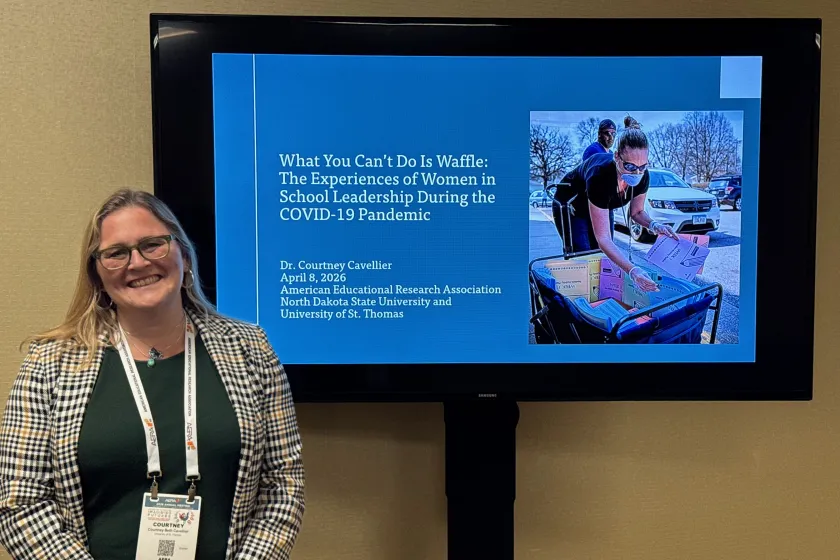
Several NDSU education leaders, faculty and doctoral students presented their accepted papers at the 2026 American Educational Research Association annual meeting.
This annual meeting is a highly selective event and is considered the premier global venue for educational research. The NDSU presenters were: Elizabeth C. Reilly, head of the school of education; Cailen O’Shea, associate professor; Courtney Cavellier, visiting assistant professor of practice; Md Mahmudul Haque, doctoral degree candidate in education; and Elizabeth Harney, doctoral degree candidate in education.
The papers were selected through a double-blind peer review of papers on educational topics that demonstrate methodological rigor and relevance.
Reilly presented with Jill A. Perry from University of Pittsburgh and Kathleen Wallace from Sacred Heart University. Their paper, titled “Practitioner Pathways to Justice-Oriented Leadership: Exploring Collaboration and Community in Three CPED-Influenced EdD Programs,” focused on a qualitative investigation examined the preparation and professional practice of thirty graduates from three Carnegie Project on the Education Doctorate influenced EdD programs, with a focus on the principles of collaboration and community, hallmarks of civic engagement and equity-centered leadership.
O’Shea presented a paper with Amber M. O'Shea, University of Nebraska – Omaha; Sashay Schettler; Bismarck Public Schools; and Hollie Mackey, North Dakota State University. Titled, “Culturally Sustaining and Decolonial Pedagogies: Transforming Indigenous Education Through Community-Driven Research and Educational Reform,” the paper described how rural schools face unique pressures to balance local expectations with urban-centric mandates, often marginalizing Indigenous students through axiological differences and inadequate funding for culturally responsive practices.
Cavellier presented a paper titled, “What You Can't Do Is Waffle: Women in School Leadership During COVID-19.” This phenomenological study investigated the experiences of women in school leadership during the COVID-19 pandemic. It explored the multifaceted challenges these leaders faced and the professional choices they made after the pandemic. Fourteen women participated in in-depth and photo elicitation interviews and shared personal and professional artifacts. Six major themes emerged: multilayered complexity and widespread disruption; defining moments; crisis and continuity leadership; responsibility to and for others; well-being and self-care; and personal and professional journeys.
Harney, a PhD candidate in the School of Education presented a paper titled, "From Anxiety to Agency: Reimagining the Composition Classroom through Feminist Praxis." The paper examined the lived experiences of first-year college students in a composition course at NDSU, exploring how feminist pedagogy shaped their lived experiences in the writing classroom.
Finally, Md Mahmudul Haque, a PhD candidate in the School of Education, co-presented a paper titled 'AI-Driven Pedagogies in MSI Classrooms: How Students Negotiate AI in Academic Writing' with Shahin Hossain of the University of Maryland, Baltimore County. The paper was part of a symposium titled 'AI for Equity, Access, and Innovation in Postsecondary Writing and Learning Contexts,' which featured five presentations. Their paper introduced the Reliance Negotiation Framework, developed by Hossain, the framework is a new theoretical model examining how undergraduate students at a minority-serving institution (MSI) navigate generative AI in academic writing. The study centered on questions of equity, ethics, and student agency.