Bison Spotlight: Lisa Montplaisir, biological sciences professor
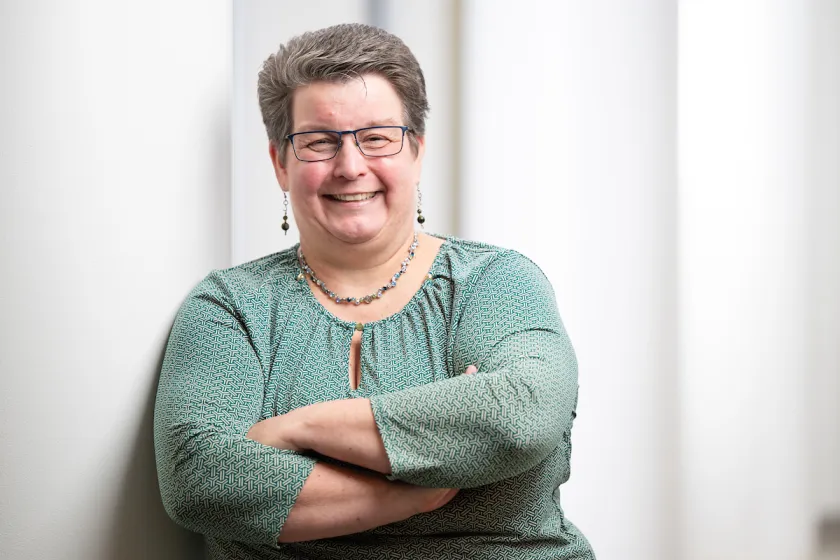
NDSU biological sciences professor Lisa Montplaisir balances a full slate of responsibilities. In addition to teaching biology classes, she also completed both her second term as Faculty Senate president and a four-year stretch as faculty advisor to the State Board of Higher Education in 2026. For Montplaisir, working to help others comes naturally.
“We’re here to serve,” explained Montplaisir, who has been with NDSU for over 35 years. “That’s a mentality, belief system or ethos that I was raised with. Both of my parents were big into volunteering: my father at the VFW and my mother with both veterans’ organizations and the church.”
To serve her biology students, Montplaisir meets them where they’re at using the interactive classrooms in NDSU’s A. Glenn Hill Center, which can scale in size to accommodate between 24 and 300 students.
“I’ve been teaching introductory biology in Hill’s scale-up classrooms since the building opened. I used to joke, but now I’m quite serious: I won’t teach it anywhere else,” noted Montplaisir with a smile. “The ability to get around and meet the students where they’re at is made possible by the scale-up classrooms. It’s been transformational. I love to interact with students, and I couldn’t imagine going back to a stand-and-deliver classroom.”
The Learning Assistant Program is another NDSU tool Montplaisir uses to support her students. The program employs undergraduate students who have successfully completed the course to work alongside instructors to support the learning experiences of their peers.
“These Learning Assistants may have taken the course from myself or another instructor the previous year, so they’re near-peers for the current class,” Montplaisir said. “These assistants give us, as professors, direct access to the students and help identify pinch points in the curriculum. That’s another thing I say I will never teach large lecture courses without again.”
Montplaisir also supports NDSU faculty, serving back-to-back terms as president of the Faculty Senate, one of the university’s three shared governance groups alongside the Student and Staff senates.
Her time as leader of the Faculty Senate coincided with the most recent state legislative session, one which passed new laws and regulations affecting the University System. Navigating the new legislation on things like post-tenure review and workload policies is a point of pride for Montplaisir.
“I’m most proud of the things we did during the 2025 legislative cycle. A lot was coming at the faculty out of the legislature and NDSU was responsive and led the way among the 11 NDUS institutions,” said Montplaisir. “We were able to help guide some of the processes because of the things we had done on campus. We were able to say ‘here is what NDSU is already doing,’ and then have discussions with legislators to get amendments to things that more closely mirrored our existing policies.”
That state-level work also shines through with Montplaisir’s time as faculty advisor to the State Board of Higher Education. The ND Council of College Faculty, a statewide equivalent of the Faculty Senate representing the 11 NDUS institutions, appointed her as their representative on the board from 2022 to 2026.
Being a member of the State Board put Monplaisir in a position to keep faculty at the table for important issues.
“There are board meetings every month, but there are also ongoing discussions on policies,” said Montplaisir. “So, if in the course of these discussions, we saw how conversations were going in a direction that wouldn’t be beneficial to faculty, we would ask for a pause. We’d go back to the 11 institutions, get their feedback and start a negotiation with the voting members of the board.
“In that way, faculty were able to have a solid voice with the board.”
As someone who has volunteered at the highest levels available at the university, Montplaisir encourages her fellow faculty and staff members to get involved on campus themselves.
“Shared governance is just one of the ways to become involved. Every college, every department and NDSU as a whole all have committees that are there to improve university life. Committees work on things like recruiting and retaining students, first-year experiences, curriculum development and a whole spectrum of other topics. There’s something out there for everyone who wants to get involved and serve the university community.”