NDSU associate professor receives NSF CAREER Award to study how heart cells sense danger signals
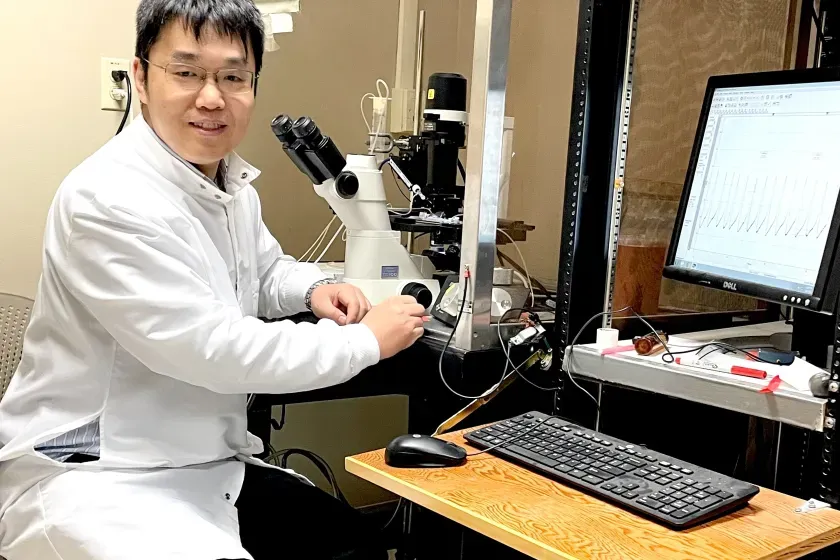
NDSU associate professor of pharmaceutical sciences, Ang Guo, has received a National Science Foundation (NSF) CAREER Award of $702,662 for his project, “Electrically Encoded Innate Immune Sensing in Cardiomyocytes,” which focuses on how heart cells sense danger signals.
Guo joined NDSU in 2019, and his primary research focuses on how heart cells respond to stress and disease.
“Cardiomyocytes (heart cell muscles) are some of the hardest-working cells in the body,” Guo said. “They never rest, and each cell has to last a lifetime. Because of that, they have been equipped with very delicate and efficient systems to handle the different challenges they encounter over time. I’ve been particularly interested in how heart cells sense danger signals, such as those that come from infection or internal damage, and I have been studying multifunctional proteins that are involved in these processes.”
The NSF CAREER Award will focus on a fundamental question, Guo said. Can electrically active cells, such as heart cells, use changes in their electrical signals as part of an early immune response to threats such as infection or internal damage?
To address this, the research examines how danger signals, such as immunogenic nucleic acids, alter the electrical activity of heart cells and how these changes, in turn, influence the innate immune response.
“We will use a combination of approaches, including electrophysiology with patch-clamp techniques to measure electrical activity, along with molecular biology, biochemistry, and novel protein design to understand the underlying mechanisms,” Guo said. “Our goal is to uncover a new connection between electrical activity and innate immune signaling in heart cells.”
This research has the potential to impact heart health while also influencing education and training across North Dakota.
“This research is focused on fundamental science, but it has important long-term implications for human health. It may help us better understand conditions like abnormal heart rhythms and inflammation-related heart problems,” Guo said.
“Dr. Guo's project is a great example of the National Science Foundation funding a basic science project with broader human health impacts,” said NDSU interim vice president of research and creative activity Heidi Grunwald. “His work introduces the idea that the same electrical signals that allow the heart to beat might also act as a language of immune sensing, allowing heart cells to detect stress or injury, which could lead to non-drug therapeutic interventions. NSF CAREER awards are so important for young scientists to become international leaders in the integration of research and education in their field. We are immensely proud of Dr. Guo.”
The Faculty Early Career Development (CAREER) Program represents the NSF’s most prestigious support for early-career faculty. It is intended for those who show strong potential to serve as role models in both research and education and to drive progress within their departments or organizations. The program supports activities that establish a solid foundation for a lifetime of leadership in integrating research and education.
“Receiving the NSF CAREER award means a lot to me. It’s a great honor,” Guo said. “It’s recognition of the direction I’ve been building, and it gives me the support to continue developing this research over the long term and build a stronger research team moving forward. It also helps create more opportunities for students to get involved in STEM training and research.”
“Dr. Guo’s award is transformational for his field of study and the Department of Pharmaceutical Sciences. His research will provide significant opportunities for our graduate students,” said Teresa Conner, NDSU Dean of the College of Health and Human Sciences.
“Working in Dr. Guo’s lab has been a very valuable experience for me as a graduate student,” said NDSU graduate student Seyedsaber Mirabdali. “He is very supportive and takes the time to explain not just what we are doing, but why it matters. The CAREER award is especially exciting because it explores a new idea about how heart cells respond to stress and disease. Being involved in this work has helped me think more broadly about science and develop both technical skills and independent thinking.”
“This project will create more opportunities for students to get involved in research, gain hands-on experience and prepare for careers in science and healthcare. It also helps strengthen the research environment at NDSU and contributes to building a stronger workforce in the region,” Guo added.
Guo said the NSF CAREER award provides an opportunity to take the next step in his heart-cell research and to develop and strengthen his research team.
“Over the next few years, this award will allow me to develop this research into a more complete understanding of how heart cells sense and respond to danger signals and stress,” Guo said. “I expect we will identify new mechanisms that connect electrical activity with immune responses in the heart, which could change how we think about heart disease and open up new research directions. It will also support building a strong research team and training the next generation of scientists.”
Guo’s research is supported by NSF Award #2541292.