The future of farming: NDSU’s 4-year agricultural technology degree
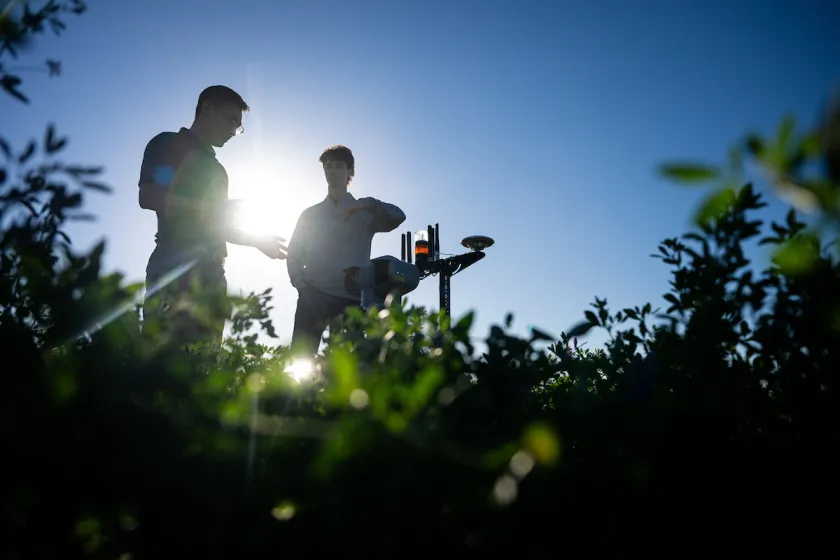
NDSU’s agricultural technology degree program prepares graduates to lead the farms of the future through hands-on education in agriculture, biology and physical sciences, economics and advanced tools.
The program provides an extensive hands-on learning, according to Matthew Olhoft, Endowed Professor of Practice for Advancement in Agricultural Technology. Much of the hands-on learning is done through advanced technology, including: the latest tractors from John Deere and Case IH; flying drones; precision planters; and robots the students build themselves.
The amount of hands-on learning is unique to NDSU’s program. When senior Isaac Mauch was touring colleges, there were few universities with cutting-edge agricultural programs and none stood out like NDSU.
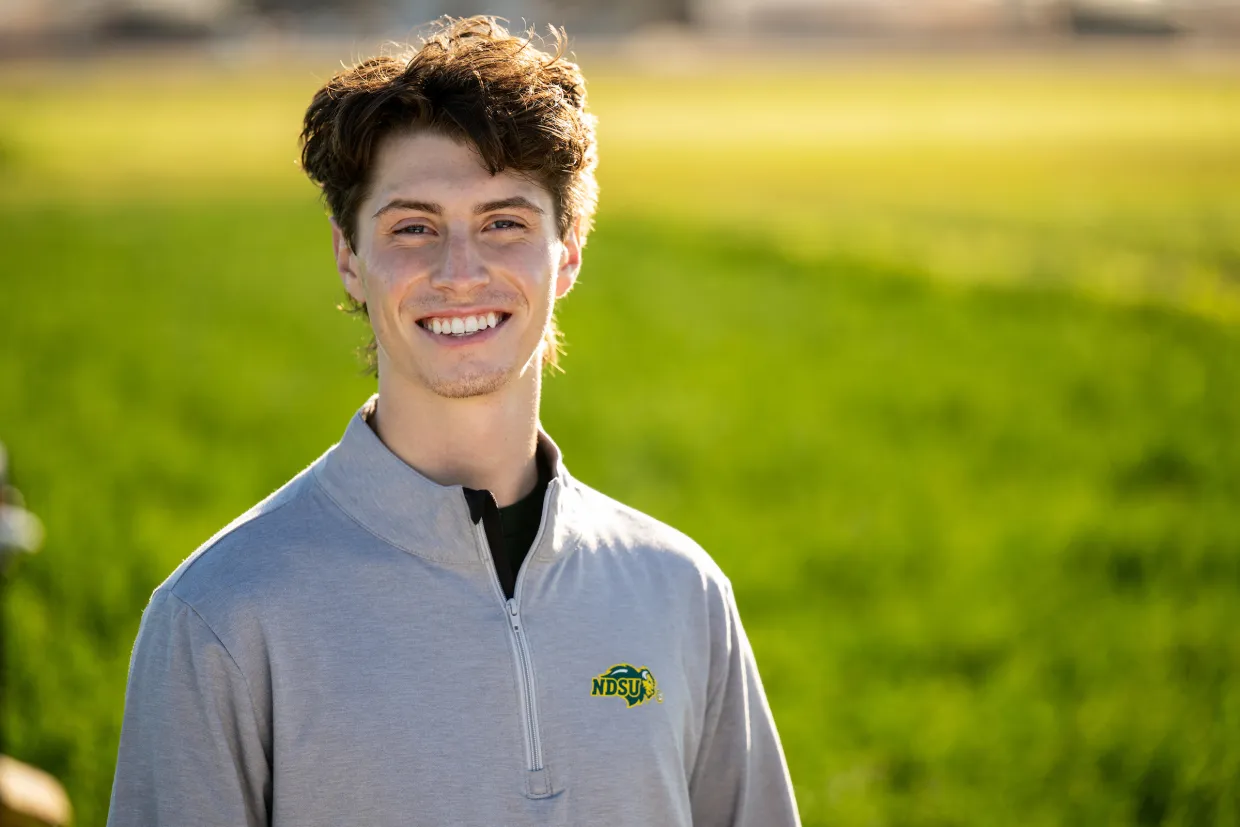
“This isn’t a textbook program,” said Mauch, an agricultural technology and biotechnology double major from Thief River Falls, Minnesota. “You learn it, you apply it and you understand why it works, whether that’s in the cab of a tractor, analyzing data on a computer or making real financial decisions that affect the farm operation.”
Mauch appreciates how passionate the faculty are and their dedication to ensuring students don’t just understand the content but can apply it as well.
Most farms already collect vast amounts of data through modern equipment; however, many underutilize it, missing opportunities to make better-informed decisions that can impact outcomes. Students enrolled in ag tech learn how to turn the data collected into cost savings, efficiency and sustainability.
“An example is see and spray systems,” Olhoft said. “They’re seeing a 40-60% decline in the use of farm chemicals. That's a huge cost savings.”
See and spray systems detect weeds so producers can treat the weeds without treating the entire field. Other advancements, such as drones, electronic ear tags, sensors, robotic feeders and virtual fencing, enable farmers to monitor fields and livestock without sending a person out, saving time and labor, Olhoft added.
But this four-year degree program is much broader and deeper than just using technology and analyzing data. Students develop a foundation in precision agriculture, livestock technology, data analysis and prescription writing, agronomy, animal science, chemistry, physics and soils. Students also learn about the business management side of farming, an unexpected but appreciated aspect of the program for Mauch.
“I was ready for the hands-on work with tractors, sensors and combines, but I never thought I’d get the business side of it too,” he said. “And I feel good about learning that business management side.”
Mauch has been able to apply what he’s learned in the classroom in several other areas of his life.
He’s given advice to his uncles, who are farmers, encouraging them to adopt newer technologies like sensors and variable-rate applications. And his uncles, both skeptical and curious about the technology, have expressed interest in using drones for imaging and decision-making on the farm.
For the past four summers, Mauch has interned with Bayer Crop Sciences, assisting with various crop trials for testing new seeds in the tri-state area, giving him the opportunity to apply classroom knowledge to his internship. His first summer, he struggled to identify weeds and didn’t even know what weed pressure was. After taking a weed science class, he returned able to identify the weeds and determine weed pressure.
Mauch did not grow up on a farm, so his ability to apply what he’s learned at NDSU to his internship has shown him he belongs. “It’s helped me feel confident in being an ag student.”
In addition to his internship with Bayer Monsanto, Mauch immediately took advantage of the opportunity to participate in undergraduate research. Inspired by his grandpa, who bought and sold dry bean seed, Mauch has been conducting research with Dr. Juan Osorno, the dry bean breeder on campus, since his freshman year.
He started off assisting with harvest by cleaning seed and checking the yields, ultimately expanding to conduct his own research through a grant.
“I am currently studying the effects of temperature and moisture on the dry bean Phaseolus vulgaris,” he said.
He conducts his trials in the Dalrymple Greenhouse and also uses a growth chamber in the basement, where he can control the temperature and moisture. In addition to planting, monitoring and harvesting, he’s had the chance to learn lab techniques such as RNA analysis. Mauch appreciates the opportunity to think through the scientific process and apply what he’s learning in ag tech and bio tech.
After graduating, Mauch is interested in pursuing a career in genetics in agriculture, while continuing to help his uncles and cousins farm.
Ag technology is a flexible program that also allows students to customize the degree through elective credits to tailor it toward interests and future career goals, such as agronomy, machine learning or livestock. This program prepares students for a variety of career pathways, from running family farms and ranches to working in industry through equipment dealerships, agronomy and crop consulting, research and emerging ag tech companies.