NDSU economist discusses U.S. Trade Integration Outlook at Global Business Connections Conference
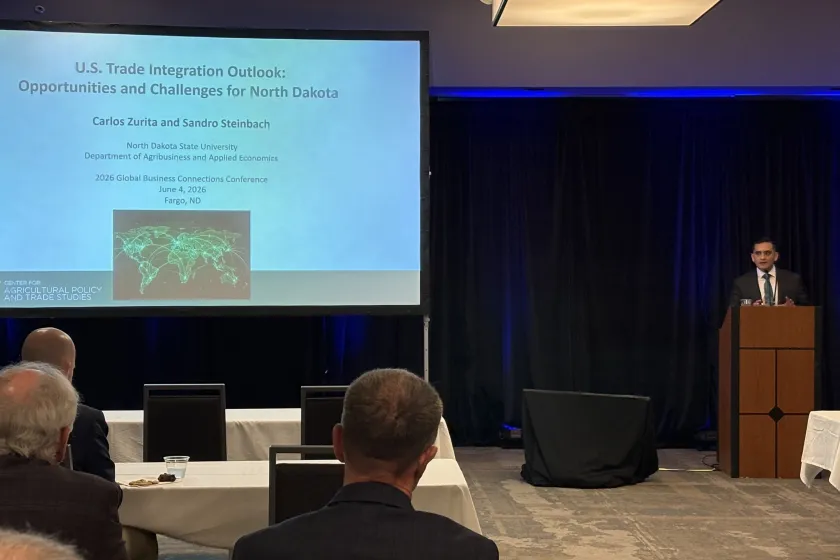
On June 4, 2026, business leaders, policymakers, and trade stakeholders gathered in Fargo, North Dakota, for the 2026 Global Business Connections Conference, held at the Holiday Inn Fargo and hosted by the North Dakota Trade Office. The event brought together regional and international perspectives on trade, investment, market access, and the changing global business environment.
Carlos Zurita, from North Dakota State University’s Department of Agribusiness and Applied Economics, presented “U.S. Trade Integration Outlook: Opportunities and Challenges for North Dakota.” The presentation, co-authored with Dr. Sandro Steinbach, assessed the current and future landscape of U.S. trade agreement integration and highlighted the implications of these developments for American and North Dakota exporters and importers.
Zurita discussed the growing importance of deep trade agreements, which extend beyond traditional tariff reductions to include areas such as investment, intellectual property, services, regulatory standards, competition policy, and environmental provisions. He explained how these agreements can help reduce non-tariff barriers, improve regulatory coordination, and support participation in global value chains.
“Trade agreements today are no longer just about tariffs. They increasingly shape how businesses navigate standards, investment decisions, supply chains, and long-term market access,” Zurita said.
The presentation also examined the upcoming 2026 USMCA review, U.S.–EU trade opportunities, and recent developments in U.S.–China trade relations, while addressing broader trade policy questions facing the United States. It considered whether the United States should pursue additional trade agreements, which countries to prioritize, and which provisions to include in future negotiations. Dr. Zurita emphasized that the answers to these questions depend on the country’s strategic objectives, such as expanding market access, enhancing competitiveness, or shaping the rules governing international trade.
For North Dakota, these developments are especially important as agricultural producers and exporters navigate shifting market conditions, evolving regulations, and changing demand from global partners. The presentation underscored the need for adaptable trade strategies and continued attention to how international agreements affect regional export opportunities.
The session contributed to broader conference discussions on global market access, trade policy uncertainty, and future opportunities for North Dakota businesses.