Tokach receives ND Department of Agriculture Award to help beekeepers manage Varroa mites
Rogan Tokach, NDSU assistant professor of applied honey bee entomology, has received a North Dakota Department of Agriculture (NDDA) award to study Varroa mites, a main cause of honey bee colony losses in the United States. Varroa mites feed on the circulatory fluid of developing bee pupae and the fat body tissues of adult bees. Additionally, the mites vector a range of virulent honey bee pathogens.
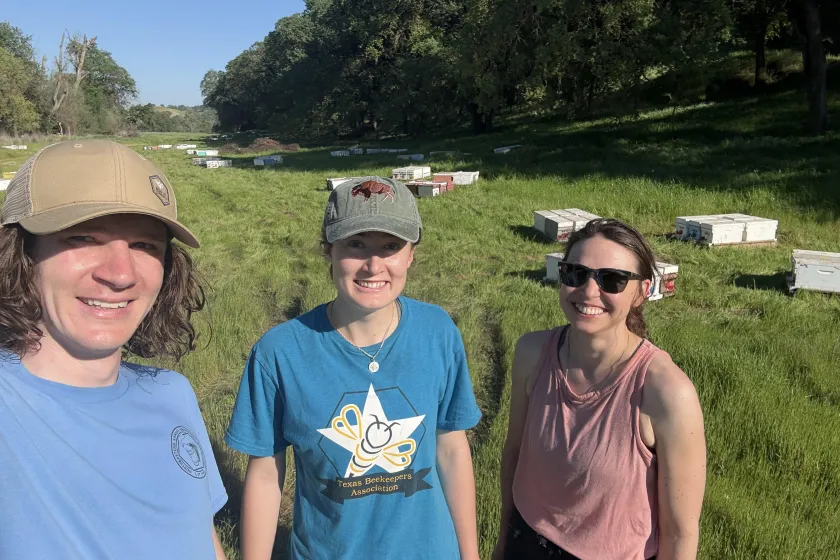
Rogan Tokach, NDSU assistant professor of applied honey bee entomology, has received an award of $115,000 from the North Dakota Department of Agriculture (NDDA) for his project, “Strategies for Varroa mite management in commercial beekeeping operations.”
The Varroa mite has been a main cause of honey bee colony losses in the United States since its detection in the country in the 1980s, and Tokach, along with University of Minnesota extension educator in apiculture Katie Lee and Michigan State assistant professor of Apiculture Meghan Milbrath, is collaborating on research to help manage those mites.
Varroa mites feed on the hemolymph (which is the circulatory fluid in bees that functions similar to blood) of developing pupae and the fat body tissues of adult bees. Additionally, the mites vector a range of virulent honey bee pathogens, facilitating their spread within colonies. These combined effects can lead to severe colony declines and mortality, even when mite populations are low.
“As Varroa mite pressure increases, colonies continue to weaken from a combination of mite feeding and virus transmission until they eventually ‘crash’ due to high mite infestations,” Tokach said. “Almost all colonies die from Varroa mites within two years if some form of Varroa mite management strategy is not performed.”
One management strategy used is a synthetic miticide, but mites have become increasingly resistant to it in recent years. Tokach said there is no “silver bullet” for Varroa mite control, and that developing multiple treatment strategies to help commercial beekeepers reduce colony losses is the aim of his research.
“The goal is to provide beekeepers with knowledge and understanding of how effective different treatment regimens are to assist them in making informed decisions within their operations,” Tokach said. “I hope to reduce the reliance on any singular treatments and increase the use of integrated pest management strategies. Furthermore, I see this work helping shape future Varroa mite treatment plans, hopefully allowing beekeepers to control mite infestation better and limit their colony losses.”
Honey bees are very important pollinators across the United States, not only for many food crops but also for different varieties of various wildflowers. More than 90 crops in the United States are dependent on insect pollination, much of which comes from honey bees. In addition, 85 percent of all flowering plants require pollinators, and honey bees play a role in that.
Tokach’s honey bee research is vital for the state. North Dakota is the No. 1 honey producer in the nation and had more than 800,000 bee colonies were brought into the state in the summer of 2025, a year when the state produced 36 million pounds of honey. His research focus is clear – helping beekeepers mitigate colony losses.
“I design research projects targeted at providing solutions to those problems that they face,” Tokach said. “I am hoping to provide beekeepers with sustainable management practices that allow them to maintain healthier colonies throughout the year while mitigating colony losses and increasing their profits.”
“The greatest strength of the NDDA-funded project is that it is designed to be relevant not only on a commercial scale, but specifically to North Dakota honey producers,” said NDSU graduate research assistant Catherine Crosier. “We are lucky to be in a state with such a high population of experienced, multi-generational beekeepers who continue to find ways to keep their bees alive under huge pest threats. But the pressure is high and constant, and much of the research into treatment efficacy has fallen on the beekeepers themselves. Through this project, we hope to alleviate some of that pressure by providing more information on treatment efficacy and timing that beekeepers could take into consideration when making mite control plans.”
Tokach said Varroa mite impact has increased in recent years, leading to more colony losses. Finding an effective treatment, including one that does not kill the honeybees, is difficult because of limited options available and the fact that Varroa has become more resistant to miticides.
“Varroa mites are becoming more resistant to a common synthetic miticide used by beekeepers,” Tokach said. “This Varroa mite research will provide beekeepers with valuable information regarding treatment timing and effectiveness.”
North Dakota is an effective location for honey bees to spend the summer, as it provides quality forage, allowing beekeepers to produce honey and build up strong colonies before and after the intensive pollination season.
“Honey bees are extremely valuable pollinators,” Tokach said. “Honey bees contribute billions to the U.S. economy every year through their pollination services.”
With the state’s vibrant honey production activities and the importance of pollinators for other areas of agriculture, Tokach’s research on Varroa mite mitigation is both timely and important. “The funding provided by the NDDA is imperative to conduct my research projects and will allow me to have an impact on this important part of North Dakota agriculture,” Tokach said.