NASA award to address nutrient losses in Upper Mississippi River Basin
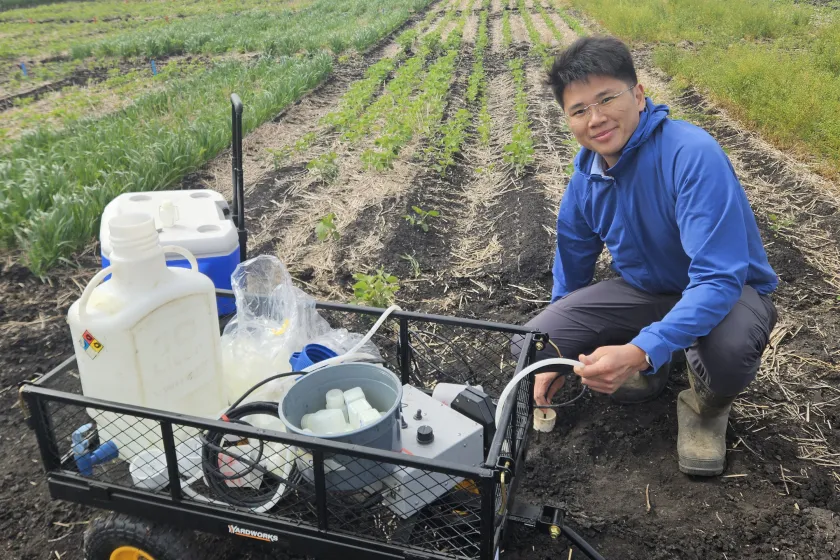
Kang Liang, NDSU assistant professor of soil physics and hydrology, has received an award of $749,995 from the National Aeronautics and Space Administration (NASA) for his research project, “Development of a Nutrient Management Decision-Support Tool to Improve Water Quality in the Mississippi River Basin and Reduce Hypoxia in the Gulf of America.”
The project seeks to co-produce an advanced Basin-wide Analysis for Stewardship and Integrated Nutrient (BASIN) decision-support platform that connects NASA Earth Science data, agricultural management, and agroecosystem modeling to regional water quality and coastal ecosystem health outcomes, to improve water quality while sustaining agricultural productivity.
“Securing a competitive NASA award demonstrates national confidence in NDSU's research capabilities. Beyond the nearly $750,000 award, the project brings expertise, jobs, student opportunities, and future research capacity to North Dakota,” said NDSU interim vice president for research and creative activity Heidi Grunwald. “Land-grant institutions have a long history of balancing agricultural productivity with responsible management of soil and water resources. This research tackles nutrient loss, water quality, and downstream environmental impacts while recognizing that farmers also need to remain economically viable. That balance reflects the land-grant mission. The emphasis on ‘co-producing’ the tool with stakeholders demonstrates engaged scholarship and increases the likelihood that the research will be adopted in practice. We are very proud of Dr. Liang’s work in this area.”
The Upper Mississippi River Basin (UMRB) is an extensive agricultural region in North America, spanning eight states and draining more than 307,000 square miles. The fertile loess soil, along with the continental climate, makes the region very productive agriculturally, as almost half of the land is devoted to crop production. However, the region's intensive agriculture makes it highly susceptible to nutrient losses. The Upper Mississippi River Basin also contributes significant nutrient pollution that impacts downstream water quality and drives hypoxia, which decreases oxygen levels in the Gulf of America. Many aquatic species cannot survive at those low oxygen levels.
“The loss of those nutrients creates both environmental and economic challenges. Excess nitrogen can degrade the water quality of streams, rivers and drinking water. The UMRB contributes almost half of the nitrogen delivered to the Gulf of America,” Liang said.
“What motivated me to pursue this NASA award was the opportunity to turn scientific research into practical solutions,” Liang added. “By combining advanced hydrologic and water quality models with NASA Earth observation data, we hope to develop a decision-support tool that helps farmers, watershed managers, and policymakers evaluate conservation practices and make more informed decisions. Ultimately, the goal is to improve water quality while maintaining agricultural productivity.”
Liang has experience with this work. His NASA-funded project at NDSU builds upon research he conducted while a postdoc at the University of Maryland as part of a USDA-funded DAWN (Dashboard for Agricultural Water and Nutrient Management). That research helped develop decision-support tools for nutrient management.
“My research has focused on how agricultural management practices affect soil nitrogen, greenhouse gas emissions, soil carbon, and water quality in the UMRB,” Liang said. “This award allows our team to take our previous research to the next level.”
Liang recently published a study in npj Sustainable Agriculture that found that no-till practices can benefit soil health and boost soil moisture, but can also increase nitrogen leaching.
“I also found a strong connection between nitrogen losses from the UMRB and summer hypoxia in the Gulf of America,” Liang said. “These findings highlight the importance of evaluating conservation practices from a whole-system perspective. The NASA project will allow me to bring together my experience in decision-support tool development and my research on agricultural water quality to create a practical tool that helps stakeholders reduce nutrient pollution while maintaining productive and sustainable agriculture.”
The project team will include project coordinator NDSU research specialist Annika Christensen and three graduate students. The team will partner with the Minnesota Pollution Control Agency and the Upper Mississippi River Basin Association (UMRBA) to identify stakeholders' needs and priorities, Liang said.
"This opportunity will allow me to gain a deeper understanding of watershed and agricultural ecosystem interactions at a broad landscape scale while working alongside water resource and pollution control experts,” said Christensen. “I am honored to be part of such a knowledgeable team and contribute to turning scientific insights into a practical tool. Knowing that our work may ultimately produce an application for agricultural and water management stakeholders is incredibly rewarding.”
The research team will integrate NASA Earth observation data, including satellite-derived soil moisture, precipitation, evapotranspiration, land use and water quality, into advanced hydrologic and water quality models.
“We will use these models to evaluate how different conservation practices and nutrient management strategies affect water quality across the UMRB,” Liang said.
Nearly half the land in the UMRB is dedicated to crop production. “That level of production requires large amounts of fertilizer, but some of those nutrients are lost through runoff and leaching,” Liang said.
“Reducing nutrient losses here can improve local water quality while also helping reduce hypoxia in the Gulf and protect coastal ecosystems,” Liang said. “Agriculture is a major part of North Dakota's economy, and producers face the same challenge of balancing high crop productivity with water quality protection and efficient nutrient management.”
Liang sees this project becoming the start of a long-term effort, and creating a decision-support tool is the initial step. He said the challenge is to ensure the decision-support tool can adequately address stakeholders' needs.
Liang also hopes to expand the platform to incorporate additional conservation practices, such as drainage water management and precision nutrient management, as well as emerging technologies like artificial intelligence. “Our long-term vision is to create a living platform that evolves with new science, new technologies, and stakeholder needs,” Liang said.