DeKeyser to help revitalize Knife River Indian Villages site
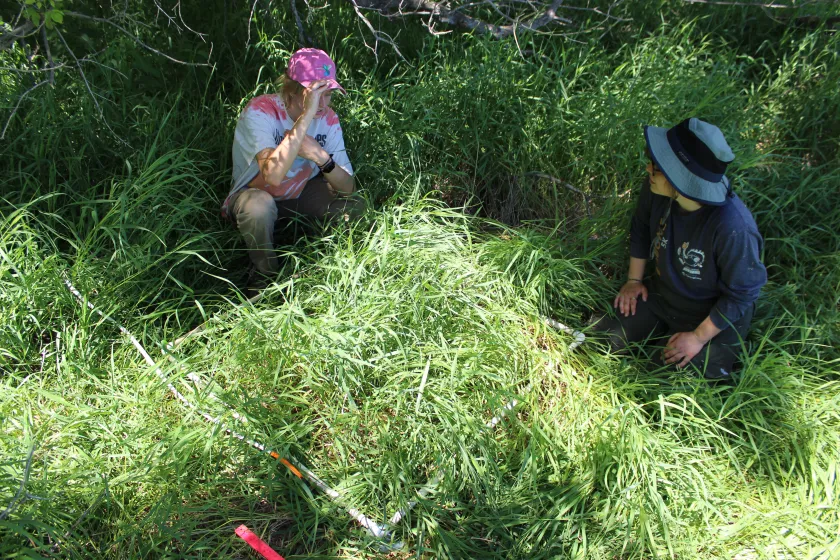
Shawn DeKeyser, NDSU professor of range and natural resource management, received an award of $146,385 from the National Park Service for his project “Rejuvenation of North Forest at Knife River Indian Villages National Historic Site.”
Knife River Indian Villages National Historic Site (KNRI) is located in central North Dakota near Stanton, at the confluence of the Knife and Missouri rivers. KNRI features a green ash-dominated forest (called the North Forest) that has been in decline for several years. DeKeyser’s team is working to find a practical way to restore the forest while also helping it become a more resilient community.
“We don’t believe we can restore the forest to an original state; however, we believe we can restore the forest canopy with trees native to North Dakota, and restore the forest understory with plants native to North Dakota,” DeKeyser said. “We are trying to increase the diversity of the understory plant community, and reestablish the canopy cover of the trees.”
In 2006, DeKeyser received funding to develop a grassland management plan for the KNRI site and the project revealed how invasive species affected the grasslands of the Northern Great Plains. During that time, many KNRI prairie sites were dominated by Kentucky bluegrass and smooth brome, and DeKeyser has focused on those species ever since, so when the chance arose to return to KNRI in 2024, he jumped at it.
“When KNRI had a request for proposals dealing with the restoration and management of their North Forest area, I was excited to write a proposal and work with KNRI again,” DeKeyser said. “It’s a beautiful site along the Missouri and Knife Rivers, with a deep history for the Indigenous peoples of the area, as well as American history.”
Several factors have contributed to the decline of the North Forest, DeKeyser said. Some are known to researchers, others are not. One suspected factor is tree-rot fungus, which weakens the inside of green ash trees, making them prone to wind damage. In addition, herbivory by several animals and invasive species prevents the germination and growth of new trees.
DeKeyser says that factors such as trunk rot, invasive species and herbivory all contribute to the decline of the North Forest natural habitat, but there could be other unknown factors at work as well, such how the Garrison Dam is impacting groundwater supply and nutrient levels or how soil biota has changed, which can potentially aid invasive species growth.
“The decline of many of our natural areas in the Northern Great Plains is a complex issue. It is never due to one reason, and there are always multiple attributes that need to be considered,” DeKeyser said. “The North Forest decline isn’t due to just a single attribute. but could be a result of many contributing to, and, to some degree, impacting the area. There are also attributes that we don’t know about or even understand how they are impacting the health of the forest.”
“One of the main things we have learned is what we don’t know,” DeKeyser said.
The team has learned about the current composition of the North Forest. The presence of the invasive species smooth brome -- a perennial grass that negatively impacts rangelands across the Northern Great Plains -- increased with greater light penetration through the canopy.
“We took light readings at each site we sampled the understory, and where there was more light penetrating the canopy, there was more smooth brome,” DeKeyser said. “Essentially, when a tree breaks or falls due to trunk rot, it leaves an opening for smooth brome to invade.”
DeKeyser’s team is testing herbicides to help control smooth brome and other invasive species.
The team also set up six major restoration sites in 2025 to determine the most effective restoration method, spanning from leaving the areas as it is, removing all debris (downed trees and branches) on the forest floor, or clearing all the trees and removing all debris. Within the sites, there are four sub-treatments available: control; planting trees; herbicide and planting trees; and herbicide, planting trees and planning the understory species. Nearly 2,100 tree seedlings were planted, featuring a mixture of six native tree species.
“The project has come a long way since its beginning in 2024. I was involved with the collection of baseline data within the forest's understory (the vegetation growing beneath the tree canopy but above the forest floor) to help with planning and decision-making when it comes to tackling this restoration project,” said NDSU graduate student Elise Bakke. “As a result, ongoing and future restoration research is well-informed and heading in an amazing direction. I believe this project will be successful in revealing best management practices to restore a riparian woodland in our region, and I'm excited to see what they find.”
DeKeyser said it can take 40-60 years to fully restore a forest canopy. The current research aims to identify tree species that will help redevelop the forest canopy.
“We are hopeful that we can at least identify potential tree species that will grow and reshape the forest canopy of these forests. We should be able to see which of the 6 species planted will be successful in establishment, and under what treatment,” DeKeyser said. “While those are being established, we will hopefully have a methodology to impede invasive species, while promoting native understory species. Unfortunately, forest restoration can’t be seen in 4-6 years; it takes more like 40-60 years to redevelop a forest canopy. The best we can hope for is quality data and methodology that will help the next generation of managers to achieve the goals of KNRI in the reestablishment of the North Forest.”