Preserving Great Plains history through regional storytelling, folklore and lived experiences
NDSU University Distinguished Professor of history, Tom Isern, has spent his career documenting the history and folklore of the Great Plains, an expanse of prairie stretching from Alberta, Canada, to Texas.
Over the years, Isern has brought those stories to life in multiple forms. He has written more than 2,000 radio essays for Prairie Public under the title Plains Folk, in which Isern documents the history of the North American Great Plains in North Dakota.
He also shares Great Plains history through music, performing decades-old ballads that reflect the prairie experience. From his home, he livestreams monthly through his Willow Creek Folk School, offering audiences insight into the lyrics, origins and historical context behind each song.
Isern is currently in the process of writing an intellectual autobiography that doubles as a contemporary history of the Great Plains. The work will build on the book “The Great Plains,” written in 1931 by Walter Prescott Webb, bringing the region’s story into a modern context.
Isern’s connection to the Great Plains is rooted in his own upbringing. Raised on his family’s 152-year-old alfalfa farm in Kansas, Isern developed an early appreciation for the land and the people who inhabit it. For Isern, telling the story of the Great Plains is about more than preserving history; it’s about giving the region a voice.
“A part of regionalism is having a bit of your own language and culture, and it may not be explicable to just everybody,” said Isern. “I'm writing for the people of the plain, so they have a constructive history and a good story to tell about themselves.”
That idea of identity is central to his current work. One of the themes he explores is the sense of alienation many in the Great Plains feel from the rest of the country.
“We have that in spades from Texas to North Dakota right now. This is a part of the country that's deeply discontented and showing it,” Isern said. “This is a federal system in the United States. We can't afford to have 10 states smack in the middle of the country and 20 United States senators, permanently alienated from the American Republic. I'm telling history from the Great Plains with the hope that with a constructive story to tell about ourselves, we might be a little more comfortable and a little less antagonistic.”
Beyond his writing and storytelling, Isern has played a key role in preserving and promoting regional history. He is the founding director of NDSU’s Center for Heritage Renewal, which focuses on historic preservation and heritage tourism. Among its initiatives is German-Russian Country, a phrase coined by Isern while he was drafting the original charter in the Tri-County Tourism Alliance, a nonprofit dedicated to promoting Germans from Russia heritage and culture.
Other larger initiatives Isern has had a part in includes contributing to a National Park Service project to discover, document, map and interpret the Dakota War of 1862 in Dakota Territory. Through this work, Isern has made new research alliances, working with tribal scholars and archaeologists.
Along with the Center for Heritage Renewal, NDSU is also home to the Institute for Regional Studies Archives, the oldest regional studies center in the Great Plains of North America, which recently celebrated its 75th anniversary last year. Located at the NDSU Archives, the Institute documents photographs, publications and other items with a focus on the history of North Dakota.
Isern, along with his wife Suzzanne Kelley, the Editor-in-Chief of the NDSU Press, is currently working to revitalize the Institute and reaffirm its importance of regional studies.
“It causes the university to speak to the region, to speak to people on the prairies, and to listen to people on the prairies. Those are ties we need to strengthen,” Isern said.
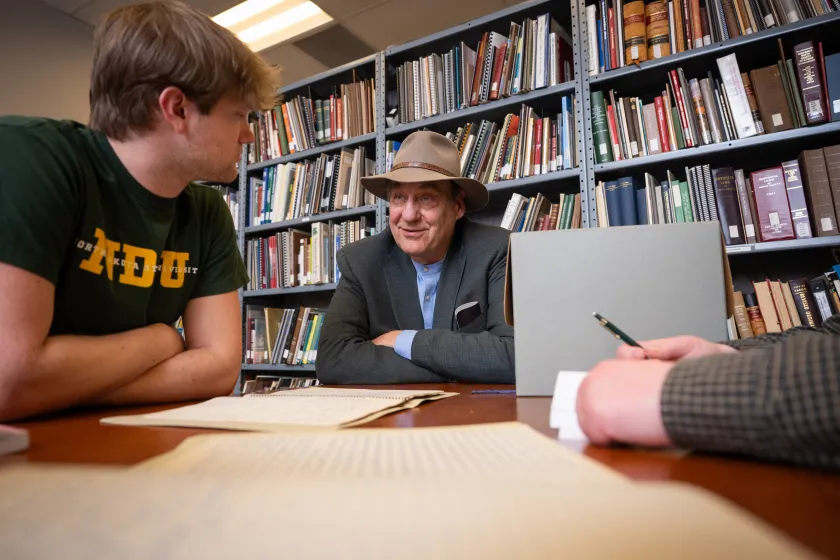
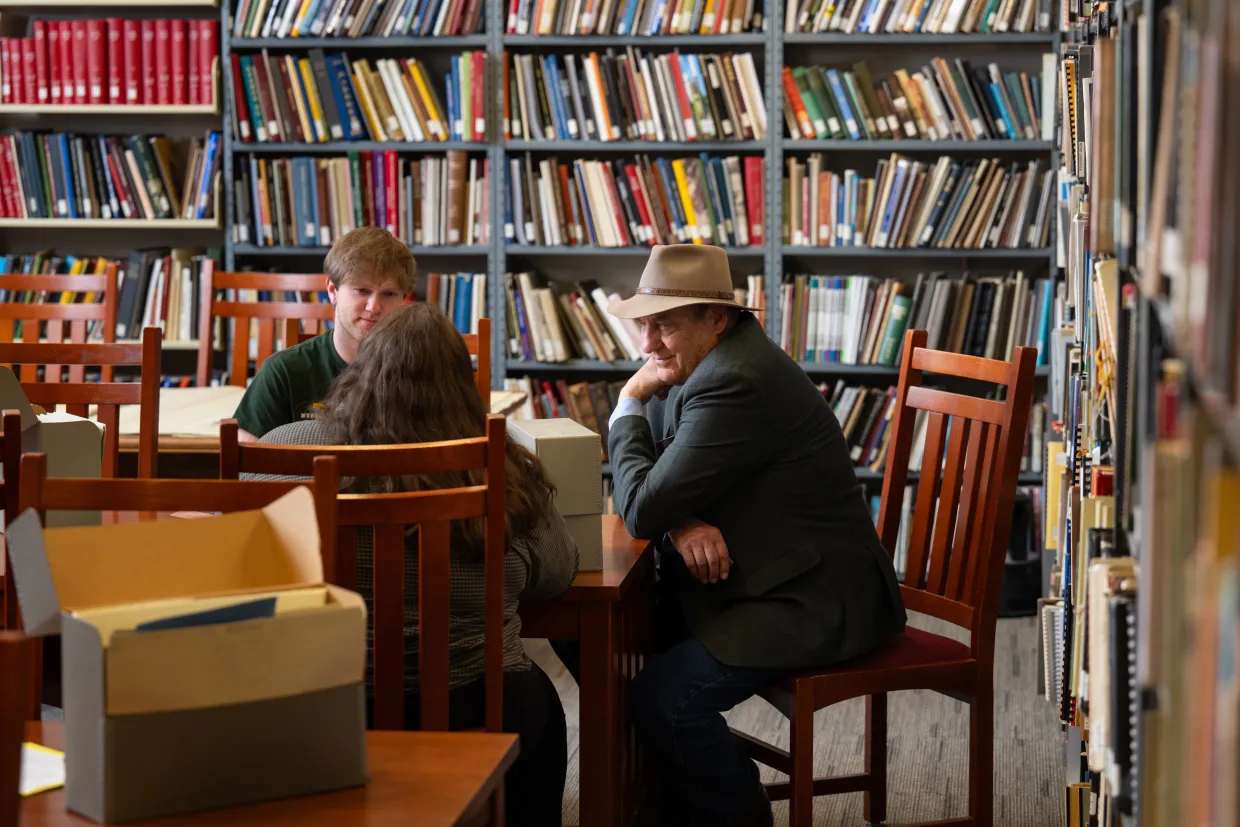
In the classroom, Isern brings that same philosophy to his teaching. Working with both undergraduate and graduate students, he emphasizes hands-on learning through archives and field experiences across the state, including sites like the McIntosh County Heritage Center in Ashley, North Dakota. For Isern, it’s been a highlight to see his students bring in new ideas and have their work published, which Isern then frequently cites in his own work.
“They teach me stuff. I'll teach them what I know, which is how to function as a research scholar in the profession and how to get along in the profession. How to succeed in an academic conference and how to make a good impression when you're interviewing for your first job,” he said. “All that stuff is important, but fundamentally we’ve got this common cause of achieving a better understanding, charting new courses and generating a constructive history of the Great Plains.”
Ultimately, Isern hopes his students carry that perspective forward.
“I'm teaching to help people with their personal aspirations. But then, I hope to teach them that they're part of a larger story and part of a larger community. Embrace it,” he said.
As he looks to the future, Isern remains committed to sharing the stories of the Great Plains. He sees that mission as closely aligned with NDSU’s land-grant purpose of serving the region through teaching, research and a deep engagement with the people and history of the prairie.
“I'm fortunate enough to have a job at a land grant university and it's on the plains. What better gig is there for me? What a good trajectory,” Isern said.