Colbert receives NIH R01 Award to further iron import cell surface signaling research
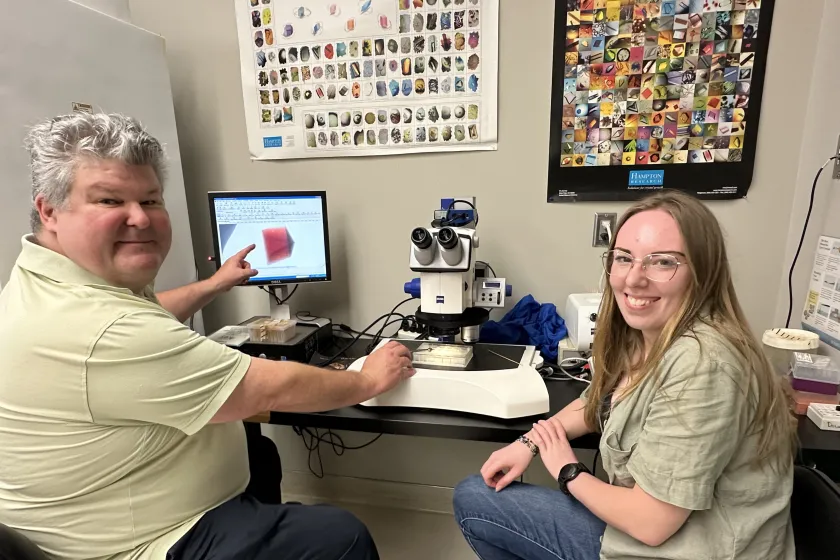
Christopher Colbert, North Dakota State University professor of chemistry and biochemistry, has received a National Institute of Health R01 Award of $1,262,771 for his project, “Structural basis of sigma-regulator recognition by a site-1 protease during cell surface signaling by Gram-negative bacteria.”
R01 awards are for established, hypothesis-driven research projects with strong preliminary data.
Colbert, who has been at NDSU since 2010, is a structural biologist and biochemist whose research aims to deepen understanding of the molecular structure and function of proteins, which are the molecules that do most of the work in living cells. This award will further the research his team has been conducting for the past several years.
Iron is essential for life, but bacteria often have a hard time finding enough of it to survive. Colbert’s team studies how certain bacteria detect and collect iron from their surroundings. His team focuses on studying the communication system that tells the bacteria when to produce more of the proteins needed to capture this vital nutrient. By understanding how the process works, researchers can gain new insights into how bacteria survive and potentially identify new ways to combat disease-causing microbes.
“Dr. Colbert’s work is vital to understanding the detailed structural insights of cell-surface signaling in order to advance the design of targeted antimicrobial drugs aimed at destroying superbugs without triggering broad resistance associated with traditional antibiotics,” said NDSU interim vice president for research and creative activity Heidi Grunwald.
Gram-negative bacteria are pathogens and examples of well-known germs, including well-known germs such as E. coli and Salmonella, which can cause serious illnesses in people. These bacteria are especially difficult to treat because they have built-in defenses that help them resist antibiotics.
“Our research focuses on the conserved critical process of iron import cell surface signaling,” Colbert said. “By understanding this mechanism, we hope to facilitate targeted efforts such as Trojan horse drug delivery or phage therapy, which have shown promise against multi-drug-resistant Gram-negative bacteria. I hope our research will ultimately lead to improved treatment.”
Colbert's research examines how these bacteria obtain iron, a nutrient they need to survive. By better understanding this process, scientists may be able to develop new ways to deliver treatments directly to harmful bacteria and improve our ability to fight antibiotic-resistant infections.
“These bacteria import iron through their outer membrane proteins using proteins called TonB-dependent transporters,” he explained. “A subset of these transporters can upregulate their own expression through cell surface signaling, a rapid and efficient mechanism for mounting an intracellular response to extracellular stimuli. We are interested in the mechanism of this iron import cell surface signaling in these systems.”
Colbert added that the research will use a broad range of biochemical, molecular, biophysical, structural, and computational techniques. Much of the work will be conducted at NDSU but will also use facilities such as the Advanced Photon Source in Chicago and the Stanford SLAC CryoEM Center.
The NIH R01 award has two interconnected benefits for North Dakotans, Colbert said. One is helping with workforce development in the state, as research training builds in-depth critical-thinking and analytical skills that can be applied across diverse regional industries. The other addresses a significant human health challenge.
“The research will provide fundamental knowledge needed to develop novel antibiotics and therapeutics targeting bacteria, addressing a critical human health challenge not only in North Dakota but globally,” Colbert said.
When it comes to future research, Colbert said his team will continue studying sigma regulator-sigma factor interactions to further their understanding of cell-surface signaling. Work is underway to investigate related iron import in E coli, which is a crucial human pathogen.
Colbert said the award also bolsters NDSU's future in biomedical research.
“A NIH R01 award is the gold standard and flagship independent research project award from the National Institutes of Health,” Colbert said. “It validates my scientific standing as an investigator and secures my lab’s sustainability. An NIH R01 elevates the investigator’s reputation, making it easier to recruit high-quality graduate students, postdoctoral fellows, and specialized staff. Receiving this renewal creates a strong track record of peer-reviewed productivity that heavily influences my subsequent grant renewals.
“It also helps position NDSU well for future biomedical research center grants that require leadership by NIH R01 investigators, such as NIH Center of Biomedical Research Excellence,” Colbert added. “I am very excited by this recognition that my research is of high scientific merit and recognition.”
This research is funded by NIH R01 Award 2R01GM126207-05A1.