Pirim receives NIFA Award to develop web-based tool for aquaculture vaccine candidate predictions
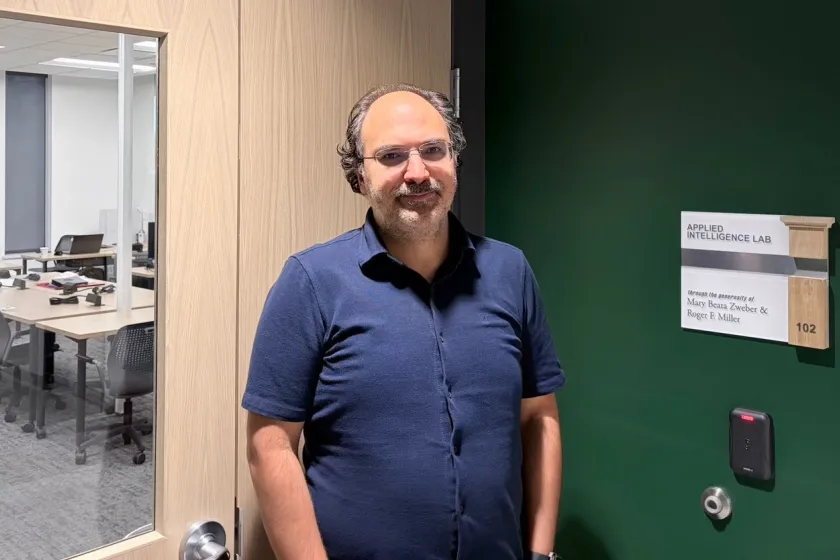
NDSU assistant professor of industrial and manufacturing engineering Harun Pirim has received a United States Department of Agriculture National Institute of Food and Agriculture award of $591,500 for his project, “A-Sysrv: Systems biology reverse vaccinology, an integrated vaccine prediction tool for aquaculture pathogens.”
The project aims to create a web-based decision-support tool that predicts hypothetical protein features and incorporates the findings into a reverse vaccinology (RV) pipeline. Reverse vaccinology is a method in which computers use fish genetic code to design vaccines without culturing the live organism in a lab. Pirim’s team is using network science and deep learning to predict promising vaccine candidates for the aquaculture industry. Vaccines can be an effective means of preventing bacterial and viral diseases in fish.
A USDA Animal and Plant Health Inspection Service report states that channel and hybrid catfish account for 50% of all food fish aquaculture in the United States. Emerging diseases contributed to an almost 50% decrease in domestic production, according to the study.
Pirim said the new project goes beyond hypothetical protein function prediction, which involves predicting protein function from a protein sequence derived from the genetic code.
“It builds a complete reverse vaccinology pipeline spanning data engineering, deep learning, and software design,” Pirim said.
Pirim has been at NDSU for four years and is the founder of CELL, the Connect, Elicit, Learn Lab. His research focuses on the relationships among individual parts of a network and how they interact and work together toward a common purpose. “Studying bioinformatics, social science, and operations through a network lens has shown me patterns that were not obvious before. Those patterns in turn have helped define the prediction tasks and the models I believe are worth building,” he said.
“This important work by Dr. Pirim and his team addresses several national priorities by using artificial intelligence to advance initiatives that harness automated decision support for food security and antimicrobial resistance, and to build scalable, pathogen-agnostic AI platforms that translate across plants and animals,” said NDSU interim vice president for research and creative activity Heidi Grunwald.
The research will be a collaboration with the Mississippi State University College of Veterinary Medicine. Pirim said NDSU researchers will use protein sequence data for Edwardsiella, Aeromonas, and Flavobacterium, the three bacteria the MSU team studies most closely and for which they generate their own datasets. They will then design the RV pipeline to rank viable vaccine candidates. Collaborators at the Mississippi State University College of Veterinary Medicine will test the vaccine candidates in fish trials to determine whether they protect fish.
“Bacterial disease is a major and recurring source of loss in catfish operations, and the three we study are behind much of it,” Pirim said. “Growing antibiotic resistance and the absence of effective vaccines against these pathogens are exactly what motivate our work. If the pipeline works, better vaccines mean fewer losses to infection.”
“What excites me most is the direct connection between our predictions and tests in live fish,” said Yusuf Akbulut, NDSU doctoral student. “We will recommend the strongest vaccine candidates, and our collaborators at Mississippi State will test how well they protect catfish. Their results will guide our next round of work. If we succeed, the tool could help researchers find vaccine candidates faster, reduce the time and cost of testing, and help producers lose fewer fish to disease while relying less on antibiotics."
Pirim said the work will run in three stages, all using Agentic AI tools: data engineering; modeling and scoring; and ranking every candidate protein for vaccine potential, with the top of that list heading to Mississippi State for wet-lab testing.
“Agentic AI tools run across all three stages,” Pirim said. “They earn their place in the unglamorous parts of research such as reconciling inconsistent annotations, converting between formats, and wiring jobs up to high-performance computing, which is exactly where bioinformatics pipelines normally lose weeks. That is what shortens our iteration cycle: not replacing the science, but cutting the overhead between one cycle and the next.”
Pirim said that while aquaculture is not an industry in North Dakota, the process used in this vaccine testing work can be applied to cattle and crops in the state.
"This is the kind of research that makes you want to come to the lab each morning,” said M Mishkatur Rahman, NDSU Ph.D. student. Catfish is the largest domestic food-fish sector in the U.S., and bacterial disease drains millions from it every year. Our collaborators at Mississippi State test our top vaccine candidates in live catfish, and we feed the results back to sharpen the model. If it succeeds, it means cheaper vaccines, fewer losses for farmers, and less reliance on antibiotics. We are building a tool that can be adopted for other fish, other pathogens, even crops. That is what keeps us going."
“The fish are not the point, but the method is,” Pirim said. “We are building machinery that turns raw sequence data into ranked, testable predictions, and that machinery does not much care whether the pathogen infects a catfish or a canola crop. North Dakota leads the nation in canola, flaxseed, dry edible beans, and durum and spring wheat, and carries roughly 1.7 million head of cattle. Every one of those systems has pathogens, and every one generates the kind of genomic data this pipeline is designed to work on.”
Pirim’s research is supported by USDA NIFA award #1034396.