Soil reclamation research helps restore damaged soil to healthy condition
The North Dakota Coat of Arms states the motto, “Strength from the Soil.”
For NDSU University Distinguished Professor of Soil Science Tom DeSutter, that underscores the importance of his team’s soil reclamation research.
“To me, it means that our cultures and economies depend on healthy, functioning, and productive soils,” DeSutter said.
DeSutter’s research team is tackling an important question: when soil is disturbed from the extraction and transportation of energy resources, how does it return to its previous state?
That process is called soil reclamation, which works to restore damaged soil to a healthy condition. DeSutter said his team has frequent discussions with the responsible parties or groups that does the actual reclamation.
“All our work involves stakeholders such as energy industries, state and/or federal agencies, reclamation specialists, and landowners,” DeSutter said. “We have primarily focused on accidental releases of oil and/or produced waters, soil management after the installation of pipelines, and coal-mine land recovery, where each of these disturbances eventually requires the re-establishment of plants.”
More than $90 billion in economic impact comes from the North Dakota ag and oil/gas industry combined, and the soil research is important for both.
“The linkages between agriculture and the energy industries are strong, and they impact one another,” DeSutter said. “Our research programs have focused on utilizing the principles of science and theory, and also empowering our stakeholders with new knowledge through Extension and classroom education so that more in-depth questions about reclamation can be asked, which will then improve the overall process of soil reclamation.”
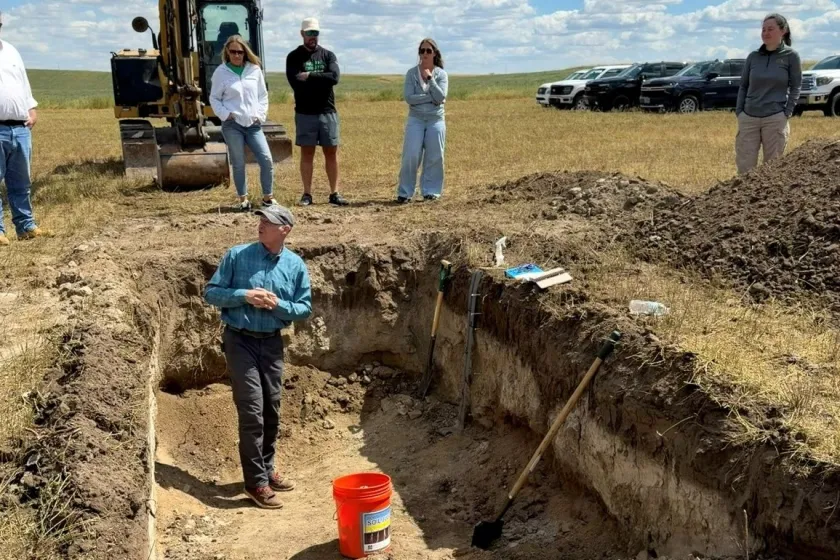
Soil research is conducted at various sites, including the Bakken and Three Forks Formations in western North Dakota. A formation is a distinctive rock unit that allows geologic mappers to identify and distinguish from surrounding rock layers. The top three oil- and gas-producing counties in North Dakota are McKenzie, Williams, and Dunn, where the majority of the field research is conducted.
“In western North Dakota, pipelines are everywhere,” said NDSU natural resources graduate student Amanda Jenkins. “If you’re a land owner or someone who enjoys public lands, ensuring that good reclamation practices are in place and that operating companies are doing what they can to put these disturbed areas back while also safely transporting products is for the benefit of all.”
A reclamation advisory group, consisting of landowners, industry and reclamation representatives and state and federal partners, helps guide the team's research, extension and education efforts, DeSutter said. “The RAG has had a significant impact on helping NDSU move reclamation strategies forward for our stakeholders,” he stated.
DeSutter said that because soil across the landscape varies, strategies should be suited for each situation. Clay mineralogy can affect how and when the reclamation process proceeds.
“Creating frameworks for our reclamation professionals that incorporate an aspect of clay mineralogy is one of our research projects,” DeSutter said. “Identifying plants that can tolerate the saline conditions after an accidental release of produced water is challenging. Produced water has a salt concentration that is about five times that of seawater.”
Another aspect of the DeSutter team’s research is determining which plants can survive in salt-affected soils and how they can desalinate the soil.
“The most important aspect is understanding soil function prior to disturbance and then outlining the goals of reclamation to again achieve pre-disturbance levels of soil productivity,” DeSutter said. “Once these have been identified, then the choice of reclamation and monitoring can be decided upon. The ‘how’ varies and depends on risks to surface- and groundwater quality, landscape position, depth of impacted soils, availability of resources, and estimated costs.”
DeSutter said the partnerships built are an important part of the research's success, which also boosts NDSU graduates and eventually helps fill workforce needs across the state.
“These relationships also help our graduate students make connections and find careers in North Dakota,” DeSutter said. “About 70% of my graduate students manage the soils of North Dakota in some way, and I am very proud to help fill the workforce needs of our state.”
DeSutter’s team is also working with NDSU Extension Livestock Environmental Stewardship Specialist Miranda Meehan to further the research’s impact through NDSU Extension.
“Advances in ideas and technology will continue to be a part of our research successes,” DeSutter said. “Doing research for the sake of doing research is fun, but conducting research is much more rewarding when you have impact.”