NDSU research team working to understand microbiome behavior
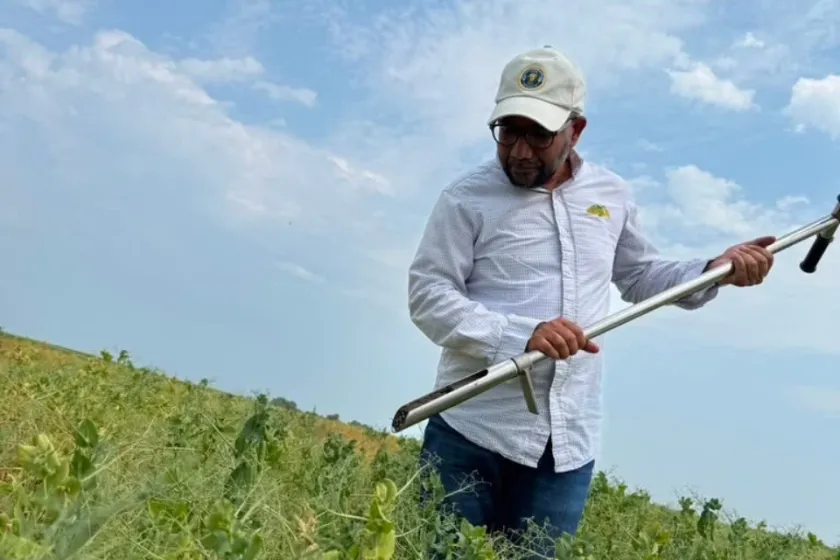
NDSU assistant professor Samiran Banerjee is researching how to better understand the fundamental principles that shape microbiomes, which are communities of microorganisms that exist in a particular agricultural environment.
Microbiomes are the centerpiece in regulating nutrient cycling, carbon dynamics and crop productivity, yet their functional properties have not been integrated into a predictive framework for use in agricultural systems.
Banerjee’s current work aims to understand how these communities assemble, how they function, and how various microbial communities interact with one another. “A major challenge in microbiome science is moving beyond simply describing which microorganisms are present and instead answering these fundamental questions,” he said. “We want to know why particular communities form, which organisms or traits are most important, and what makes some microbiomes more stable or resilient than others. We study these questions using microbial ecology, multi-omics, experimental manipulation and computational modeling. The broader goal is to identify general ecological and functional principles that can help us better predict how microbiomes behave.”
The North Dakota Agricultural Microbiome Project, a statewide effort to explore the complex communities of microorganisms that contribute to soil health, is a major research focus for Banerjee. His lab has collaborated with more than 100 North Dakota growers and Extension personnel from all seven NDSU Research Extension Centers. More than 3,000 soil, root, grain and groundwater samples have been collected to date.
“Working at this scale allows us to examine microbiomes across different soil types, crops, management practices, and climatic conditions,” Banerjee said. “We are lucky because North Dakota provides a highly diverse agricultural landscape where we can study these questions on a regional scale rather than at only one experimental site.”
Banerjee noted that the main public benefit of his work is better and more consistent information. “If we understand how management, soil properties, crops and microbes interact, we can develop better approaches for maintaining healthy and productive soils, improving fertilizer-use efficiency, and enhancing the resilience of agricultural systems.”
Banerjee’s lab has been identifying microbial keystone taxa, which are microorganisms that can have the greatest impact on the microbiome, more than their numbers alone would suggest. Using samples collected across the state, Banerjee’s team identifies these microorganisms, determines their critical positions within microbial networks, and assesses whether the same organisms occur across different crops, soils, and environmental conditions.
“Dr. Banerjee's work matters in the real world for one reason above all: it moves microbiome science from knowing which microbes are present to knowing which ones the system depends on, and that distinction is the difference between a correlation and something a grower can act on,” said NDSU interim vice president of research and creative activity Heidi Grunwald.
“The statewide survey allows us to distinguish microbes that appear important only at one location from those that may have broader ecological importance,” Banerjee said.
Field sampling is combined with DNA sequencing, multi-omics (which is a biological analysis that combines data from two or more “ome” layers), microbial culturing, molecular biology and machine learning to conduct the research, Banerjee said.
“By isolating microbes and using synthetic microbial communities and controlled experiments, we can selectively manipulate individual taxa,” Banerjee said. “We are testing what happens to a microbiome when a presumed keystone microbe is removed. This helps us move from simply predicting which microorganisms are important to directly testing their roles.”
“We can study microbiomes at different scales,” he added. “For us, the goal is not simply to use new technology. We try to combine these approaches so that patterns observed in the field can be tested experimentally for predictive modelling.”
The next phase in Banerjee’s research is to connect field research with additional mechanical experiments by leveraging microbiome datasets from agricultural systems across North Dakota.
“We are also developing computational models to examine microbiome functions across environmental and agricultural gradients,” Banerjee said. “At the same time, we are bringing candidate microbes identified from large field datasets into controlled experiments. We want to determine how microbial interactions affect microbiome stability and host (plant) resilience.”