NDSU researcher aims to make AI more trustworthy and useful
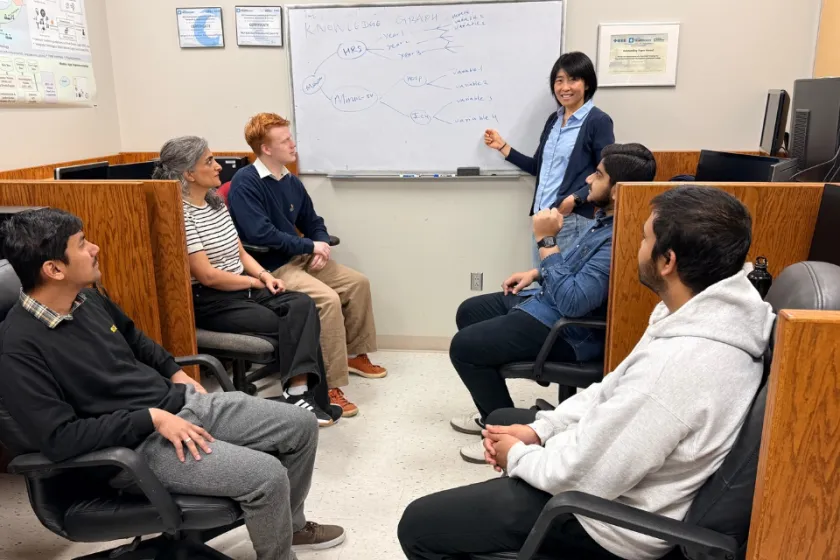
Artificial intelligence is having an impact on every aspect of society. While there are many unanswered questions surrounding its application, NDSU professor of computer science Juan (Jen) Li’s research team is seeking to answer just how reliable and useful it is.
Li leads a research group of undergraduate and graduate students at NDSU. Their focus is making AI more trustworthy and useful in people’s lives. “We combine AI with structured knowledge and verification methods so that its conclusions are supported by evidence, its limitations are clear, and it can recognize when it needs more information,” Li said. “We apply these ideas to healthcare, education and cybersecurity.”
Li joined NDSU in 2008 as an assistant professor, and has been a professor in the department of computer science since 2019. In 2026, she received the NDSU College of Engineering’s Kessler Excellence in Research Award.
In that time, AI has grown more capable, but Li notes concern about its reliability. While AI can provide a convincing answer, she said, there may not be evidence to back it up. “That raised the questions that now connects my research: How can AI use knowledge responsibly, explain the basis for its conclusions and recognize when it needs more information?”
Li’s earlier research was involved with distributed systems, information retrieval and knowledge representation. “I've always been interested in how computers can organize knowledge, connect concepts and use them to reason,” Li said. More recently, her focus has shifted from helping computers gather information to helping them interpret that data and support decisions based on it.
Li’s research team combines modern AI techniques, including large language models, with structured knowledge representations such as ontologies and knowledge graphs that organize concepts and their relationships, enabling AI systems to validate their outputs against established knowledge and rules.
“I combine reinforcement learning and knowledge graphs to develop diabetes digital twins,” said NDSU doctoral student Fatemeh Sarani Rad. “I’m proud of contributing to research that could support more personalized healthcare. I’ve learned that good AI needs reliable evidence and clear explanations, alongside accuracy. This experience is strengthening my technical skills and preparing me for future research in trustworthy AI.”
The team has used the same approach in areas such as health care, where they have developed digital twins. These computer models of a person’s changing health link their information through a personal knowledge graph to support prediction and simulation. StatWiseAI, a National Institute of Health-funded project, allowed Li’s team to build a prototype AI assistant grounded in dataset documentation, statistical methods and their assumptions. Researchers can then use it to decipher data and determine whether a further health analysis is appropriate.
Powered by AI, diabetes digital twin research focuses on building tools that both patients and clinicians can rely on. Utilizing health histories, wearables, and mobile-app data, it examines how a person’s physical condition changes over time,
“We're evaluating these new approaches with existing data and simulations, with the long-term goal of supporting earlier, better-informed care,” Li said. “We want to develop personalized tools that patients and clinicians can trust.”
StatWiseAI, developed in collaboration with UT Austin, helps guide students and researchers through public health data analysis by clarifying why statistical methods are appropriate and identifying potential errors. “Our guiding principle is that AI should strengthen people's own reasoning rather than replace it,” Li said.
Li will be collaborating with the University of Washington Tacoma on a National Science Foundation-funded project ($199,842) called CyberBridge.
"We are incredibly proud of Dr. Li and her work in multidisciplinary, use-inspired topics. Dr. Li's most recent research asks the question that matters most about artificial intelligence right now: not whether it can produce an answer, but whether we should trust it,” NDSU interim vice president for research and creative activity Heidi Grunwald said. “Her team is building AI that shows its evidence, states its limits, and knows when to ask for more, and they are doing it in fields where the stakes are real: healthcare, education, and cybersecurity. That is exactly the kind of work a land-grant university should be leading, and it puts NDSU students at the center of it."
CyberBridge will build on CyberCJ, the earlier NSF-funded initiative that brought cybersecurity education into criminal justice settings and developed an AI tutor for individual learners. The tutor was evaluated in a user study involving 123 students, educators, and law-enforcement officers.
“The key lesson is that reliability takes more than accurate predictions,” Li said. “We also have to check whether the evidence is relevant, whether assumptions hold and whether explanations make sense to the person using the system. Our current work goes further. We are teaching AI to detect conflicting evidence, revise unsupported conclusions and ask for more information so it can clearly say what the evidence it supports or remains uncertain on.”
CyberBridge focuses on the critical link of digital forensics and criminal justice. CyberBridge will bring learners from both backgrounds together to work through scenarios such as ransomware attacks and data breachers, Li said. Responding to a cyberattack on a hospital, school or local government requires more than technical expertise. It brings experts with different skills in different areas to work together, interpret digital evidence and connect the findings to legal questions. As a result of these groups training separately, gaps will prevent their ability to collaborate effectively.
A team of specialized AI agents guides the experience, offering technical and criminal-justice expertise, identifying communication breakdowns and checking the evidence behind AI-generated recommendations. By combining interdisciplinary training with AI-supported coaching, CyberBridge helps prepare future professionals to respond to cyber incidents together.
“That work showed that individual learning isn't enough,” Li said. “Two people can each know their own field well and still struggle to connect their expertise. We pursued CyberBridge to find out whether AI can help bridge that gap, and we'll measure both learning outcomes and the quality of collaboration.”
Li said the research has multiple benefits for North Dakotans, including more accessible AI training, improved tools for health research, and a stronger workforce. And it will help NDSU students as they prepare to enter the workforce.
“The most immediate benefit is for our students,” Li said. “NDSU graduate and undergraduate students help design, build and evaluate these systems. Throughout the process, they are learning advanced AI techniques along with the critical thinking needed to assess AI responsibly, and they bring those skills to employers and communities across the state.”
Future research for Li will focus on AI that ties its outputs to evidence, recognizes uncertainty and will check its own work as it tackles more complex tasks.
“The real test of these systems is whether they help people learn, collaborate and make better decisions,” she said. “My long-term goal is AI that earns trust through evidence, clear limitations and careful evaluation, and that makes people more capable.”
Funding for this project is from NSF Award #262760.