NDSU students find success at American Society of Microbiology annual meeting
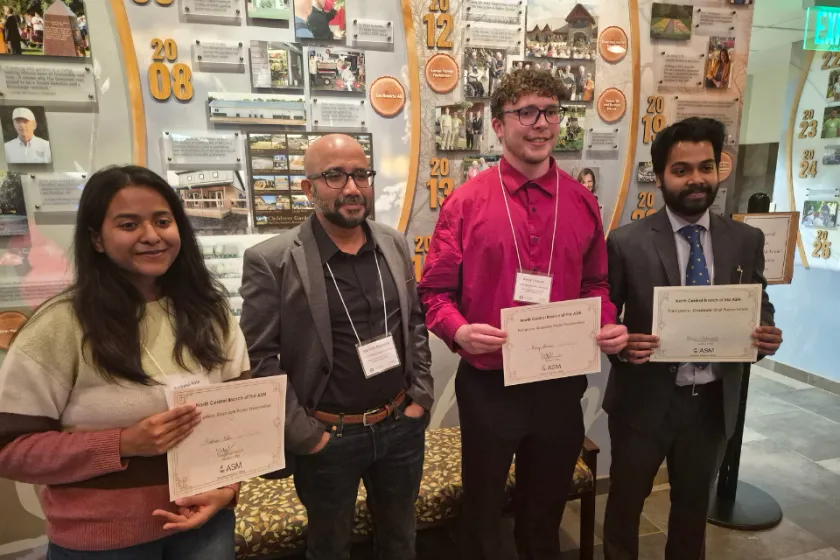
Several NDSU faculty and students attended the 86th annual meeting of the North-Central Branch of American Society for Microbiology, with three students recognized for their research and science communication.
Three students placed in competitions through posters and oral presentations. Avery Folsom earned first place for her poster presentation, and Purbasa Kole earned fourth place for her graduate poster presentation, while Ditam Chakraborty earned third place in the oral presentation competition.
“This is important for students for practicing their communications skills, building a network and possibly finding a new mentors,” said Birgit Pruess, professor of microbiological sciences, who also attended the conference. “Sometimes collaborations arise from attending.”
The three students work in the Banerjee Lab with Dr. Samiran Banerjee exploring the effect of intensive management practices on soil and plant microbiomes in agricultural systems.
After attending the International Symposium on Microbial Ecology in New Zealand this summer and receiving constructive criticism on his poster, Folsom appreciated the opportunity to apply that feedback to his work, which he credits with her success at the conference.
“Earning these awards as a lab after receiving constructive criticism at our previous conference demonstrates our resilience as a research group, which is somewhat ironic considering we study microbiome resilience,” Folsom said.
Chakraborty presented his research on microbial communities and their responses to environmental stress through an oral presentation which required him to spend time thinking about how to communicate the bigger picture of the research.
“Research involves a lot of trial and error, long hours and experiments that don’t always work out the way you expect,” Chakraborty said. “Moments like these make all that effort feel worthwhile. Being recognized by fellow scientists was both encouraging and motivating, especially as I continue working toward completing my Ph.D.”
Kole appreciated the opportunity to share her research with the broader scientific community while learning from others working in related areas.
“Sharing months of research with the scientific community is always rewarding, but having that work recognized made the experience even more meaningful, especially because I was able to celebrate alongside fellow members of our lab,” Kole said.