Bison Spotlight: Rex Sun, Peltier Institute’s endowed chair and director
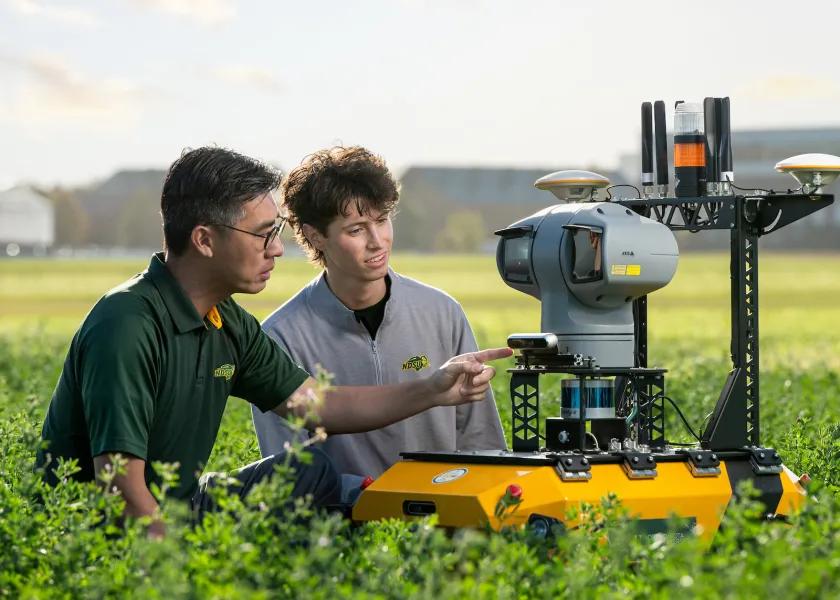
In his 15 years at NDSU, first as a graduate student, then a research scientist and now an associate professor in agriculture and biosystems engineering, Xin (Rex) Sun has built a career around his passion of using innovative technology to solve today’s most pressing challenges in agriculture.
Sun was first introduced to the agriculture and biosystem engineering discipline when he started his graduate degree at NDSU in 2010.
“I was using Artificial Intelligence and machine learning technology to identify meat quality, which gained my interest in how using applied engineering technology can solve real-world problems,” Sun said. “Something you work on can be applied to the real production of people’s daily lives.”
Sun continues to channel his passion for agriculture and biosystems engineering into the research he works on in his lab, where he focuses on integrating AI, robotics and sensing technologies to advance livestock, crop and food production.
“Currently, my team is advancing projects like robotic soil sampling for real-time soil health analysis, edge-AI for disease diagnosis in soybeans and UAV/UGV-based imaging for precision weed, crop, food and livestock management,” he said. “Each of these projects aims to provide faster, more accurate and more cost-effective solutions to pressing challenges in agriculture.”
Sun’s research team is made up of postdoctoral research assistants, graduate and undergraduate students, who all serve a crucial role in his lab.
Sun said involving students in his research helps them gain the practical, hands-on experience essential for success in their future careers.
“Students are central to everything we do. They help design and build robotic platforms, develop AI models and conduct field trials,” Sun said. “I believe research provides invaluable experience — it gives students the chance to apply their knowledge, gain technical and leadership skills, and contribute to solving real-world problems. This prepares them for successful careers in industry, academia or entrepreneurship.”
That same philosophy carries into the classroom. Sun encourages active participation and open discussion, creating a space where students feel comfortable sharing ideas and asking questions.
“The classroom serves as an open space where students can share their opinions without fear of judgment. There are no absolute right or wrong answers; instead, the focus is on fostering constructive dialogue. To enhance their career prospects, I strongly encourage them to take their thoughts and ideas to action.”
One of the most rewarding aspects of teaching, Sun said, is seeing his former students go on to build successful careers and make a positive impact in the agricultural industry. Each year, he shares their stories with his first-year students as inspiration to chase their own goals.
For Sun, teaching not only allows him to guide the future leaders of agriculture, but it also allows him to continue learning about new and evolving technologies.
“I’ve always dreamed of becoming a professor. This career allows me to explore the cutting-edge technology and ideas from around the world, while also sharing my knowledge with the next generation of students,” he said. “It’s an exciting journey of continuous learning, listening and engaging with diverse backgrounds, keeping my mind fresh and open to new possibilities.”
Sun’s impact within the field is evident far beyond the classroom and lab. Sun was recently named the inaugural endowed chair and director of the Peltier Institute for Advancement in Agricultural Technology.
The Peltier Institute will play a central role in shaping the future of agriculture by funding student scholarships, developing interdisciplinary academic programs and increasing opportunities for research and outreach.
“It’s a tremendous honor to serve as the inaugural Endowed Chair and Director of the Peltier Institute,” Sun said. “This institute represents a bold step forward in connecting cutting-edge technology with agriculture to benefit producers, industry and communities. I’m most excited about building a strong collaborative hub where researchers, students, industry partners and producers can work together to accelerate innovation. Through the Institute, we will advance robotics, AI, sensing, and digital agriculture while also training the next generation of skilled professionals. It’s an opportunity to make a lasting impact on agriculture in North Dakota and around the world.”