Engineering seniors deliver real world automation solution
A team of NDSU engineering seniors helped create an automated system that improves how ceiling panels are constructed, gaining hands-on experience with industry standards, automation and real-world problem solving.
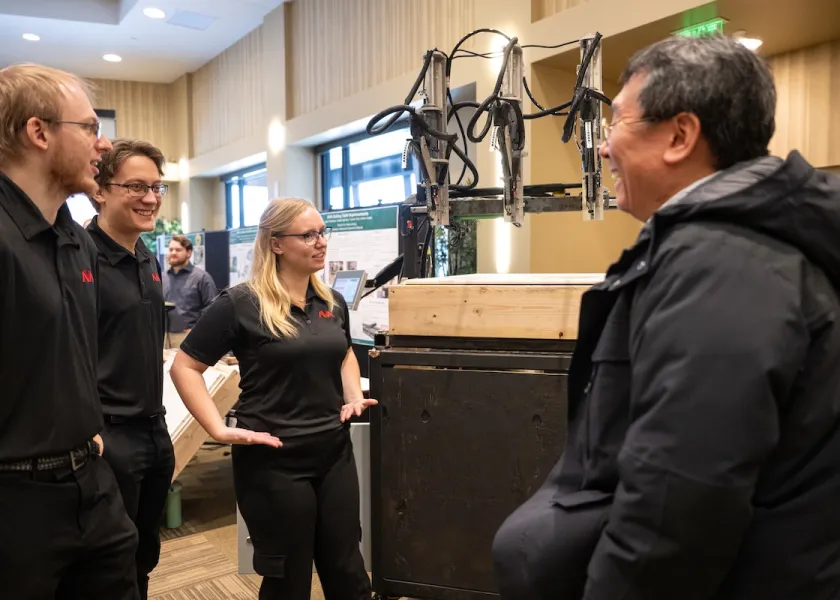
At NDSU, engineering students don’t just learn about innovation, they build it. As part of the College of Engineering’s senior design program, a team of seniors partnered with Advanced Volumetric Alliance to create an automated system that improves how ceiling panels are constructed, gaining hands-on experience with industry standards, automation and real-world problem solving.
AVA specializes in modular construction and was seeking improvements to its ceiling panel process. The student team of Hailey Highland, Tucker Kolb, Logan Carpenter and Ethan Walker responded by designing an automated screw gun system that mounts directly to the company’s current bridge frame. As the gantry moves along the length of a ceiling panel, the system lowers screw guns to secure sheetrock to wood framing, then retracts and shifts laterally to continue fastening across the panel.
“Our goal was to create a completely automatic way to build ceiling panels,” said Highland. “By attaching to their existing gantry, we were able to design a system that fits into their current workflow while significantly reducing manual labor.”
A key element of the project was automation and usability. The system is semi-autonomous and features a newly designed control panel that allows operators to easily manage screw spacing, sequencing and other functions. Developing the human-machine interface was one of the team’s biggest challenges, as none of the students had designed one before.
“Learning how to build an HMI and make it communicate with the rest of the system was a huge learning experience,” Highland said. “It pushed us outside our comfort zone in a good way.”
The team also faced mechanical constraints. AVA provided specific screw guns that could not be modified, requiring the students to develop a creative solution to control the tools without altering them. The team designed a system that clamps the trigger in place and controls power delivery at the outlet level, allowing each screw gun to be activated independently.
Working with an industry sponsor added a real-world dimension to the project.
“It gave us a much better understanding of engineering standards, professional communication and technical documentation,” Highland said. “Knowing that what we designed could actually be used in a factory made the project especially meaningful.”
The AVA sheet rock system served as a proof of concept for the company. The student-built prototype includes three screw guns on a four-foot span, with plans for AVA to scale the design into a full system next spring featuring approximately 15 screw guns across a 16-foot gantry.
For the team, seeing the system come to life was a defining moment.
“The first time we turned it on and watched it move was incredible,” Highland said. “It really made us feel like engineers. It was the culmination of everything we’ve learned at NDSU.”
Senior design is a capstone experience for all College of Engineering students, requiring them to apply years of coursework to solve real engineering problems for real clients.
“This project takes everything you’ve learned and turns it into something tangible,” Highland said. “It shows how far you’ve come and prepares you for what comes next.”
For the AVA sheet rock team, the project represents not only a potential advancement in modular construction, but also their first major step into professional engineering careers as Bison engineers.