Get to know this year’s Three Minute Thesis finalists

Six NDSU graduate students are preparing to take the spotlight as finalists in the NDSU Graduate School’s Three Minute Thesis Competition, set for Thursday, Feb. 12 at 2 p.m. in the Memorial Union’s Anishinaabe Theater. The event will showcase the power of concise communication as students distill years of research into presentations designed for a broad audience.
The finalists made it through the competition’s preliminary round and received $250. The championship round winner will receive an additional $1,000 prize. Judges will evaluate each presentation on content, comprehension, communication and engagement.
The Three Minute Thesis Competition challenges graduate students to clearly and compellingly explain the significance of their research in three minutes or less, using terminology that everyone can understand.
Below are this year’s finalists:
Julia Scully
Hometown: Madison, Wisconsin
Area of study: Master’s student in coatings and polymeric materials
Advisor: Eugene Caldona
Presentation title: “Giving Tires a Second Spin”
Overview of research:
End-of-life tires pose significant environmental and economic challenges due to their durability, large-scale disposal and slow degradation. Traditional recycling methods often downcycle tire materials, limiting their functional value and long-term impact. Ground tire rubber is uniquely suited for upcycling due to its carbon-rich composition and the formation of highly reactive surfaces during specialized grinding processes. These reactive sites enable strong interactions with surrounding matrices, allowing ground tire rubber to function as a performance-enhancing additive rather than an inert filler. Herein, we propose ground tire rubber as a low-cost, sustainable additive for coatings and advanced manufacturing applications. When incorporated at low loadings, ground tire rubber improves toughness, flexibility, thermal stability and processability, resulting in more durable and reliable materials. This work reframes tire waste as a functional resource capable of improving material performance while addressing a critical sustainability challenge.
Why did you choose NDSU?
I chose NDSU for its strong coatings and polymeric materials program, which emphasizes both fundamental understanding and real-world applications. I was drawn to NDSU because it offered the opportunity not only to learn how materials perform, but to understand why they behave the way they do at a molecular and structural level. This approach aligns with my goal of creating materials that balance long-term performance with efficiency and sustainability. NDSU’s emphasis on applied research with environmental and industrial relevance has allowed me to explore sustainability not as an afterthought, but as a core design principle embedded in material selection, processing and performance.
How has the research environment at NDSU contributed to your development as a researcher?
The research environment at NDSU has significantly contributed to my development as a researcher by fostering hands-on experimentation, interdisciplinary collaboration and close faculty mentorship. Access to specialized facilities and the freedom to pursue independent, curiosity-driven questions have strengthened my ability to design rigorous experiments, interpret complex results and connect fundamental mechanisms to practical performance, shaping my growth as a thoughtful and impactful researcher.

Maria Luiza Paiva de Oliveira
Hometown: Pouso Alegre/Minas Gerais/Brazil
Area of study: Doctoral student in plant pathology
Advisor: Richard Wade Webster
Presentation title: “Protocol Development for Sclerotial Degradation Through Biological Agents”
Overview of research:
White mold, caused by the fungus Sclerotinia sclerotiorum, is an important disease affecting a wide range of economically important crops, including soybean, dry bean, canola, sunflower and many vegetables. The pathogen is difficult to manage because it produces long-term survival structures called sclerotia, which can persist in the soil for many years and serve as a continuous source of inoculum. Current management relies mainly on chemical fungicides when the disease is already established in the field, which are not always effective. Because of this, there is a strong need for alternative control strategies, in different phases of the pathogen life cycle, which is the motivation behind this project. Our research focuses on developing and standardizing a protocol to evaluate the degradation of S. sclerotiorum sclerotia using biological control agents. By targeting the pathogen’s primary survival structure, this approach aims to reduce the inoculum and provide a more sustainable strategy for long-term disease management.
Why did you choose NDSU?
NDSU has a strong research-focused environment with a clear emphasis on agriculture and plant sciences. I was particularly drawn to the Extension and Soybean Plant Pathology Laboratory, where research is closely connected to field problems and disease management. The opportunity to work under Dr. Richard Wade Webster, who is well known for his work on soybean diseases and extension-based research, made NDSU the right place for me to pursue my doctorate in plant pathology.
How has the research environment at NDSU contributed to your development as a researcher?
At NDSU, I have had the opportunity to grow as a researcher through strong mentorship and a collaborative research environment. The university has provided access to well-equipped research facilities that have been essential for developing and testing my experiments. Working in an extension-focused plant pathology lab has also allowed me to connect research with real field problems and disease management needs. In addition, interacting with researchers from different areas has strengthened my critical thinking and experimental planning, while presenting my work at seminars and conferences has helped me improve my science communication skills.
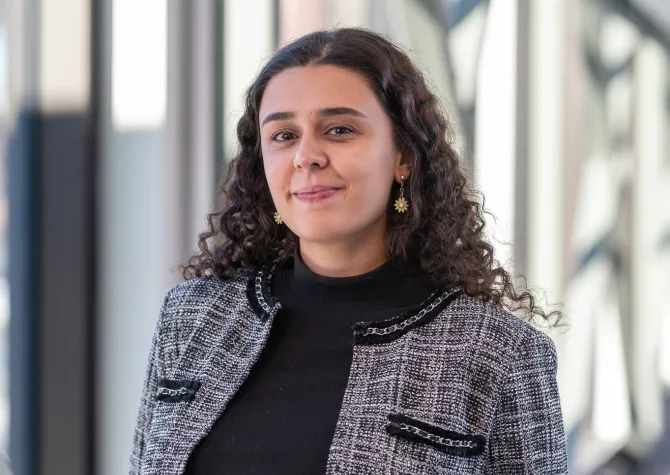
Ritah Namawejje
Hometown: Kampala, Uganda
Area of study: Doctoral student in plant pathology
Advisor: Gary Secor
Presentation title: “Understanding Rz1 Mediated Resistance to Beet Necrotic Yellow Vein Virus in Sugarbeet”
Overview of research:
Beet necrotic yellow vein virus is a destructive soil‑borne pathogen that threatens sugarbeet production worldwide. It causes rhizomania, a disease that can reduce yields by up to 80 %. The virus persists in soil for decades and has no effective chemical treatment, making genetic resistance the only effective way to manage it. This threatens sugarbeet production in US, where the crop is a major source of sugar, animal feed and biofuel. My research aims to identify Rz1, a key resistance gene that has protected sugarbeet for more than 30 years, and uncover how the gene protects the plant from the virus. This work enables the development of more resistant sugarbeet varieties and helps agriculture stay ahead of an evolving pathogen.
Why did you choose NDSU?
I chose NDSU because of its strong land-grant mission and its clear commitment to research that directly supports agriculture and communities. As someone interested in crop disease resistance, I wanted to be at a university where research isn’t just theoretical, but has real-world impact for farmers and food systems. NDSU’s focus on applied agricultural research made it the perfect fit.
How has the research environment at NDSU contributed to your development as a researcher?
The research environment at NDSU has helped me grow from a student into an independent researcher who can ask meaningful scientific questions. Because faculty mentorship is so accessible, I’ve had the opportunity to take ownership of my project while still receiving guidance when needed. That balance has strengthened both my confidence and my critical thinking skills. Through lab work and presentations including the 3MT, I’ve developed technical skills, problem-solving ability, and the confidence to communicate my research to both scientific and non-scientific audiences. Overall, NDSU hasn’t just trained me to conduct experiments, it has shaped me into a well-rounded, thoughtful scientist.

Nastaran Shahzadeh
Hometown: Tehran, Iran
Area of study: Doctoral student in coatings and polymeric materials
Advisor: Dean Webster
Presentation title: "From Lab to Real World: Tough Coatings, Less Ice"
Overview of research:
Ice buildup on critical infrastructure creates major safety and economic challenges. My research focuses on non-isocyanate polyurethane coatings that promote easy ice removal by lowering interfacial toughness. By evaluating performance with increasing ice lengths, we ensure that ice-removal behavior remains effective at real-world scales. Rather than relying on melting or extreme mechanical force, this approach promotes controlled crack initiation and propagation at the ice–coating interface, enabling ice to detach with minimal applied stress. In addition to performance, this work addresses health and environmental concerns. Conventional polyurethane coatings rely on toxic isocyanates. This work avoids isocyanates during application while maintaining effective performance in cold environments, supporting safer anti-icing technologies, improved public safety and reduced maintenance costs.
Why did you choose NDSU?
I chose NDSU because of its emphasis on research and its focus on preparing students with practical professional skills. The Department of Coatings and Polymeric Materials works on real industrial problems through materials science, which aligns with my interest and background in applying materials science beyond the lab to create real-world impact.
How has the research environment at NDSU contributed to your development as a researcher?
The research environment encourages regular presentations and open discussion, which helps students clearly communicate their work and grow as researchers. The interdisciplinary setting also creates opportunities for impactful talks and learning across different fields.

Nof Yasir
Hometown: Abbottabad, Pakistan
Area of study: Doctoral student in electrical engineering
Advisor: Di Wu
Presentation title: “Predicting Critical Components for cascading failures in integrated power and gas energy systems”
Overview of research:
My research focuses on understanding and preventing cascading failures in critical energy infrastructures, particularly the integrated power and natural gas system. In such an integrated energy system, the failures on critical components in the power system may propagate to the natural gas system, vice versa, which lead to widespread service disruptions, safety risks and economic losses. By combining data-driven and machine-learning techniques with engineering simulations, I developed models that can identify the most vulnerable components in the integrated energy system before a major cascading failure occurs. The goal is to help system operators and decision-makers improve energy reliability and security, and support resilient and reliable operation of critical energy infrastructures.
Why did you choose NDSU?
I chose NDSU because I can work closely with faculty whose research work aligns strongly with my interests in energy system reliability and resilience. Also, NDSU’s collaborative research culture allows graduate students to take ownership of meaningful projects while receiving strong mentorship and guidance. Working within a supportive research group and having access to interdisciplinary resources has helped me grow both technically and professional through addressing real-world challenges with practical impact.
How has the research environment at NDSU contributed to your development as a researcher?
The research environment at NDSU has played a significant role in my development by encouraging independence, collaboration and applied problem solving. I’ve had the opportunity to work on interdisciplinary projects, present my work at conferences and receive constructive feedback from faculty and peers, all of which have strengthened my research skills and confidence. Through strong mentorship and a supportive research culture, I’ve grown from focusing on technical solutions to thinking more broadly about how research can inform decision-making, improve energy system resilience and benefit society. Working closely with faculty advisors has helped me frame complex research problems, evaluate their real-world implications and communicate my work more effectively. Opportunities such as the Three Minute Thesis competition have further strengthened my ability to translate technical research into clear, engaging messages for broader audiences. Overall, NDSU’s collaborative environment has helped me grow into a more confident, well-rounded researcher who connects rigorous analysis with meaningful impact.

Gayathri Senanayake
Hometown: Kurunegala, Sri Lanka
Area of study: Doctoral student in microbiological sciences
Advisor: Barney Geddes
Presentation title: “Which bacteria win the race to the root?”
Overview of research:
My research focuses on understanding how beneficial soil bacteria, known as rhizobia, compete to establish symbiosis with legume plants. This partnership is critical for sustainable agriculture because rhizobia convert atmospheric nitrogen into a form that plants can use, reducing reliance on synthetic nitrogen fertilizers that are energy-intensive to produce and contribute to greenhouse gas emissions. Although many rhizobial strains may be present in soil, only a few successfully infect plant roots and form nodules. My work investigates the genetic traits that give certain strains a competitive advantage during this early colonization process. Using fluorescent bioreporters, I track rhizobial competition and identify genes that influence competitiveness and symbiotic efficiency. I use synthetic molecular biology techniques and tools including site specific recombination and CRISPR Cas to investigate these genetic traits. By decoding these microbial competition mechanisms, my research aims to improve biological nitrogen fixation towards creating elite microbial inoculant strains, ultimately supporting environmentally sustainable crop production and soil health.
Why did you choose NDSU?
I chose NDSU because of the outstanding R1 research environment and the exciting work being done here in plant-microbe interactions. What stood out to me most was how closely my advisor’s research aligned with my molecular biology interests, particularly in understanding microbial genetics and symbiotic processes. This strong alignment and the fully funded assistantship made NDSU an ideal place for me to pursue meaningful, focused doctoral research. I also realized that NDSU also offers access to cutting-edge research equipment and advanced laboratory and greenhouse facilities for applied research with the latest, molecular techniques while connecting discoveries to real-world agriculture. The combination of innovative research, strong mentorship, and excellent infrastructure are the reasons why I am here today, at NDSU.
How has the research environment at NDSU contributed to your development as a researcher?
The faculty in my department have been my greatest source of support for growth and development, especially through my advisor’s mentorship and innovative research ideas. Access to advanced laboratory facilities and equipment, particularly in the Micro Core Lab, has significantly accelerated my research progress. Beyond infrastructure, the availability of resources such as conferences, workshops, science outreach and competitions has made my research experience both dynamic and exciting, providing valuable opportunities to learn, network, and share my work. Altogether, this supportive and resource-rich environment at NDSU has played a key role in shaping me into a more confident and capable researcher.