NDSU associate professor named emerging leader
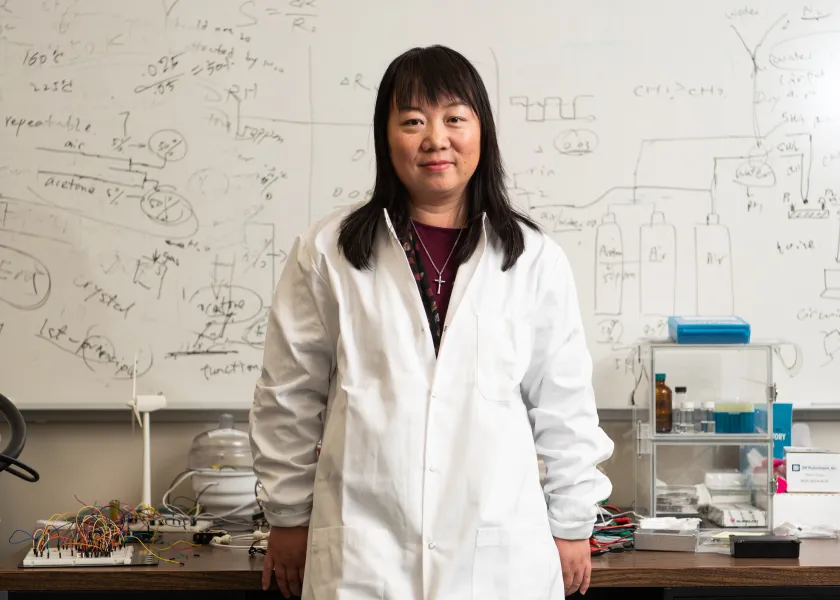
NDSU associate professor of electrical and computer engineering, Danling Wang, has been named one of nine emerging leaders nationwide by the American Institute for Medical and Biological Engineering.
Located in Washington D.C., AIMBE represents the “most accomplished individuals in the fields of medical and biological engineering.” Goals of AIMBE’s Emerging Leaders Program include increasing AIMBE’s engagement with exceptional professionals who are underrepresented in medical and biological engineering; recognizing MBE’s outstanding rising leaders; and serving as a pathway for leaders to AIMBE’s College of Fellows.
Emerging leaders receive direct mentoring from current AIMBE Fellows and can network and engage with all AIMBE Fellows at the organization’s Annual Event.
“Being named one of the nine AIMBE Emerging Leaders is an incredible honor. It means a lot because it reflects not just my individual work, but the dedication of my team, collaborators and mentors,” Wang said. “It reinforces that the problems we’re trying to solve — whether in health monitoring, sensing, or materials innovation — truly matter to the broader biomedical community.”
Wang has been at NDSU since 2016. She has a doctorate in physics from Peking University and a doctorate in electrical engineering from the University of Washington. She has received research funding from several sources, including NASA, the U. S. National Science Foundation and Sanford Health.
“We are immensely proud of Dr. Danling Wang for being recognized as one of only nine AIMBE Emerging Leaders nationwide,” said NDSU interim vice president for research and creative activity Heidi Grunwald. “This honor is a direct reflection of her world-class expertise in electrical engineering and her tireless dedication to solving complex biomedical challenges. We are incredibly excited to see her take on this leadership role, as her willingness to innovate and collaborate continues to elevate the profile of NDSU on a national stage.”
Her research lab at NDSU is called the Nano-Electronic Wearable Sensor, or NEWS, lab and focuses on researching the synthesis and functionalization of nanomaterials for sensing devices and fabricating sensor devices for disease detection.
Her work has led to two significant research projects: the development of new sensors for a breath analyzer to detect diabetes and a sensor device for cancer detection.
“Each time we breathe, organic compounds are released,” Wang said. Her research team designed the breath analyzer device to detect acetone, a volatile organic compound gas, emitted when a person breathes. NSF Track II provided funding towards this research.
Elevated acetone levels are common in people with diabetes, and this device offers a less invasive way to assess whether preventive steps or additional testing might be necessary.
“It won’t replace blood tests for diagnosing diabetes, but with it, we can distinguish between a healthy person and a high-risk person,” Wang said.
Wang added that there may be an opportunity to use the diabetes monitoring technology in diagnosing plant diseases in their early stages, since plants also emit gases.
"Working with Dr. Wang on breath sensor research has been an incredibly rewarding experience,” said Md Hasib Fakir, an NDSU doctoral student researching in Wang’s lab. “Her guidance helped me dive deep into the fundamentals of gas sensing mechanisms, from material design to device integration. She always pushes creative thinking and encourages doing work that can directly affect human life. This work isn’t just an academic exercise — it’s paving the way toward low-cost, highly sensitive sensors that could one day enable early disease detection through breath analysis, and being part of that mission has been both inspiring and motivating."
Monitoring diabetes is crucial in the United States. According to the CDC website, 38.4 million people, or 11.6% of the population, had diabetes in 2021.
Wang notes how diabetes wellness monitoring is important because it helps catch problems early and prevents serious complications.
“From a research perspective, continuous data on glucose-associated breath acetone level, daily activity, diet and lifestyle give us a clearer picture of how a patient’s daily habits affect their disease,” she said. “This allows more personalized care, better prediction of risks, and ultimately improves long-term health outcomes. It also generates valuable data for AI training to drive new tools and treatments to support diabetes patients.”
Wang’s team is also focusing on developing advanced scaffold sensor technologies to detect cancer-related biomarkers with improved accuracy. Specifically, the team is working to add sensing components into the scaffold tissue to better monitor the treatment of the cancer. This work is supported by an NSF Track I –Advanced Interface of Computation Engineering and Science award.
Wang is driven to develop these technologies given the many benefits to both doctors and patients.
“For doctors, this means faster, data-driven insights into their patient’s tumor activity, treatment response and potential risk without relying solely on infrequent imaging or lab tests,” she said. “For patients, it makes monitoring far less invasive and more continuous, enabling earlier intervention, more personalized treatment adjustments and greater peace of mind.”
Wang wants her research to move cancer monitoring from reactive to proactive, thus improving outcomes and quality of a patient’s life. “It motivates me to push even harder, to keep mentoring students, advancing impactful science, and contributing to technologies that can genuinely improve people’s lives,” she said.
Wang will be formally honored at AIMBE’s Annual Event held on April 11-13, 2026, in Washington, D.C.