NDSU chemistry professor receives NSF CAREER Award
Alexey Leontyev's project looks to advance green chemistry education.
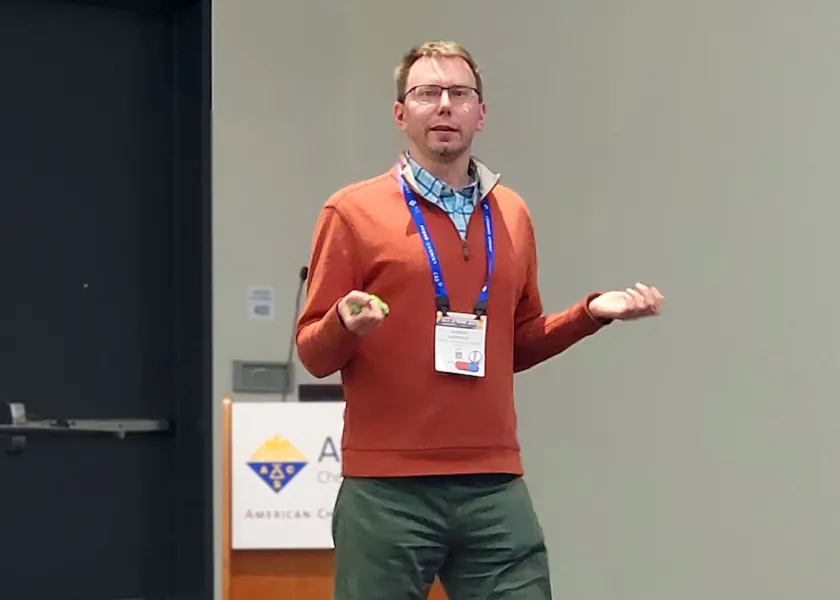
Alexey Leontyev, NDSU associate professor of chemistry and biochemistry, has received a U.S. National Science Foundation CAREER award of $868,229 for his project, “Standardized Polytomous Assessment for Community Explorations in Green Chemistry Education.”
The project's primary aim is to design, develop and validate a polytomously scored (where an individual receives partial credit if the candidate provides some correct answers), community-authored assessment tool for Green Chemistry Education. GCE focuses on teaching chemistry where the priority is protecting the environment, which means creating chemicals and processes that use fewer harmful materials and produce less pollution.
GC has become an essential focus in education as the American Chemical Society (ACS) requires GC instruction for program approval. Leontyev’s research aims to bring proven assessment techniques from Chemistry Education Research into the Green Chemistry Education (GCE) field and support a collaboration between those two areas. CER is focused on understanding and improving the teaching and learning of chemistry.
“Green chemistry gives students a rich, engaging platform to explore core chemical principles at a deeper level while actively practicing decision-making about how chemicals are designed and used,” Leontyev said. “It equips them with the skills to create safer, more efficient and sustainable processes – critical for addressing urgent environmental and health challenges. By linking chemistry concepts to real-world issues, it fosters systems thinking and ensures chemistry education remains relevant for building a sustainable future.”
Leontyev wants to ensure chemistry education remains relevant in building a sustainable future by fostering systems thinking through linking chemistry concepts to real-world issues. However, while there has been recent focus on including green chemistry in education to make chemical studies more relevant to modern practices, no reliable test tool exists to assess how much students are learning regarding GCE.
The main goal of Leontyev’s project is to develop and test high-quality tools to assess organic chemistry students’ understanding of important green chemistry concepts.
“This project will help chemistry instructors know whether their students truly understand green chemistry – which is a way of doing chemistry that’s safer for people and the planet,” he said. “Even as green chemistry becomes a required part of many courses, there’s no reliable way to measure what students actually learn. My team will create a new kind of test that doesn’t just mark answers right or wrong but also reveals partial understanding. Artificial intelligence will help analyze student answers and even assist in designing new questions.”
“Dr. Leontyev’s innovative work in developing tools to measure students’ grasp of Green Chemistry is a breakthrough in science education,” said Kimberly Wallin, NDSU dean and professor of the College of Arts and Sciences. “By connecting chemistry education to real-world sustainability practices, he’s not only elevating the student experience at NDSU but also shaping the future of chemical education nationwide. This kind of research and leadership moves the field forward.”
Leontyev will work with experts to create a diagnostic tool that uses a scoring system to track students' progress. Jane Wissinger, University of Minnesota Professor Emerita in the chemistry, serves on the advisory board for Leontyev’s program.
Wissinger notes that although the adoption of green chemistry education curricula has been increasing in higher education over the last two decades, the assessment tools to evaluate student learning are severely lacking.
“Professor Leontyev's pioneering work in developing green chemistry assessment instruments for college-level organic chemistry courses is addressing this need, she said. “His NSF CAREER award is a testament to his past success in this field and potential to apply state-of-the art educational research methodologies to create diagnostics tools that will be highly valued by instructors incorporating green and sustainable chemistry into their curriculum.”
This project will benefit the state of North Dakota in terms of the agricultural economy and also in furthering STEM (Science, Technology, Engineering and Mathematics) education in the state.
“Green Chemistry education can benefit North Dakotans by linking chemistry concepts to biomass utilization, a key part of the state’s agricultural economy. By emphasizing renewable feedstocks, we can make chemistry more relevant to rural students’ lived experiences, valuing their local knowledge,” Leontyev said. “This approach deepens learning, supports STEM engagement, and highlights chemistry’s role in sustainable agriculture and energy.”
Leontyev adds that this award isn’t just about the research itself – but about working to make chemistry education more innovative and influential.
“NSF CAREER awards, especially through the NSF IUSE program, are incredibly competitive, and knowing that a panel of experts and program officers at NSF reviewed my work and found it worthy of support is both deeply validating and humbling,” Leontyev said. “This award is a turning point for the field of green chemistry education. It allows me to build the kind of rigorous, community-driven assessment tools we have been missing — resources that can help instructors understand what students truly know, think, and feel about sustainability in chemistry. This isn’t just a research project; it’s an investment in the future of teaching, in making chemistry education more relevant, transformative and impactful.”
Leontyev’s research is supported by NSF award No. 2442826.