NDSU doctoral student receives CAS Future Leader award
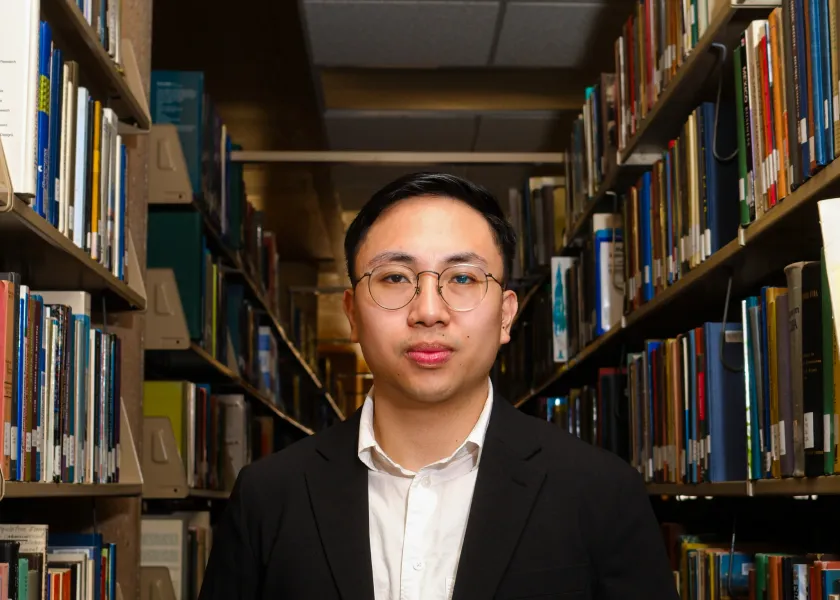
Marcel Roy Domalanta, a doctoral student in coatings and polymeric materials, recently received the CAS Future Leader award from the American Chemical Society.
The CAS Future Leaders program supports the growth of science leadership among early-career scientists through opportunities to learn leadership skills, engage in scientific discourse and connect with peers and innovators from around the world.
For Domalanta, the award is not only a reflection on his leadership, but a responsibility.
“Receiving the ACS CAS Future Leaders award feels both humbling and grounding,” Domalanta said. “It is not just recognition; it is a transfer of trust. To me, the award is not defined by what happens during the program, but by what happens after it. The real measure is whether the ideas, conversations and perspectives gained can move beyond the cohort and reach others. Knowledge, when kept, is static. When shared, it multiplies. I see this award as a responsibility to carry something forward: to pass on not only what I learn, but what it can become in someone else’s journey.”
Throughout the Future Leaders program Domalanta will receive exclusive leadership training from industry experts, engage in the American Chemical Society’s annual meeting and make meaningful connections with peers and innovators from around the world.
Domalanta’s time at NDSU has helped shape the researcher he is today. Domalanta credits the Department of Coatings and Polymeric Materials for teaching him how to ask precise scientific questions and build answers from data. He also credits the Center for Entrepreneurship and Family Business, especially the P2P program and Possibility Fellowship, for teaching him how to ask the questions “who is this for, and does it matter?”
“That intersection changed how I see research. It is no longer just about making something work, but about understanding whether it should exist, who it serves and how it can improve lives responsibly,” he said. “That balance between technical depth and human context is what I carry both inside and outside the classroom.”
At NDSU, Domalanta has been heavily involved in various research projects spanning fluoropolymer coatings, corrosion science, electrochemical characterization and battery modeling. While each research project has required a different way of thinking, Domalanta said each project has been meaningful to his scientific career. The strong research environment at NDSU has also helped contribute to Domalanta’s development as a researcher.
“Moving between them taught me adaptability and reinforced a simple idea: you never really start from zero; you start from what you already know and build forward,” he said. “The research environment here values that process. It allows room for failure, not as a setback, but as part of the method. That kind of environment is rare, and it shapes not just better researchers, but more resilient ones.”
His advice for fellow student researchers is to put in the work when feeling inspired, but also when you don’t.
“Motivation comes and goes, but progress depends on showing up anyway. You don’t have to be the best to do your best — you just have to continue. And while you pursue excellence, do not forget kindness. Research is demanding, and the people around you are carrying their own challenges. When you reach a position where you can help, do it. Be the mentor you once needed. Be the person you once wished was there. Impact is not only measured by what you discover, but by who you support along the way.”
Domalanta also advises researchers on campus to acknowledge and celebrate one another.
“As scientists, we often focus on advancing knowledge, pushing boundaries and solving problems. But none of that exists without people. There is no science without scientists,” Domalanta said. “So, while we work to move the field forward, we also have a responsibility to look after one another, our peers, our students and those who will come after us. Progress is not only about what we build, but about who we bring with us.”