NDSU President looks to new horizons in State of the University Address
Announcements included an Honors College and six new Distinguished Professors.
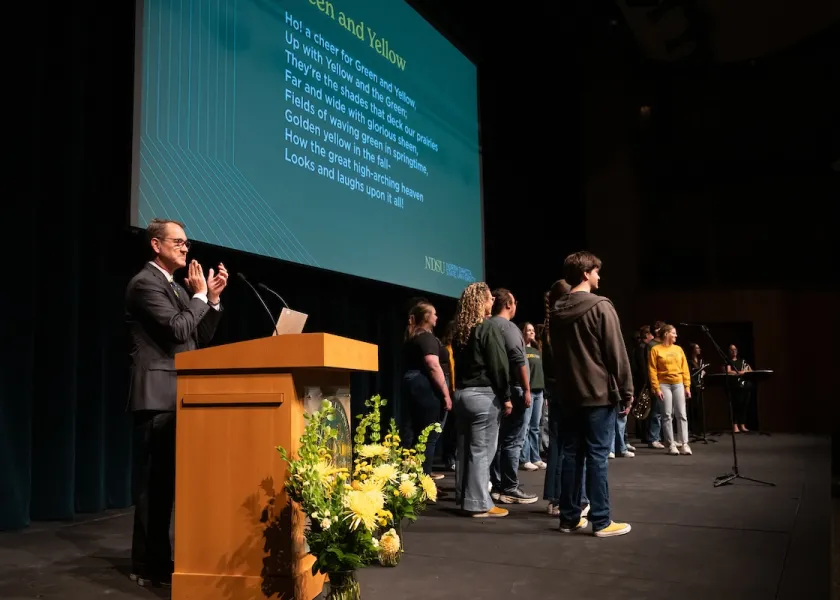
During his annual State of the University Address on Tuesday, Sept. 9, NDSU President David Cook outlined transformative opportunities that will shape the university’s future.
“This year feels different. There’s a sense of energy and optimism across campus,” Cook said. “I truly believe now is our moment. We’ve collectively done a lot of hard work these past few years, and it has positioned us to move forward with incredible success.”
One of the most significant announcements in his address was the launch of an Honors College centered on artificial intelligence.
“The Honors College invites the brightest minds, students who might otherwise look to the nation’s most elite institutions, to find their place here,” Cook said. “Guided by an abundance mindset, we believe excellence multiplies when it is shared. Here, opportunity sparks innovation, innovation fuels success, and success creates room for every student to rise. Together, we build a community where possibility knows no limits.”
Beginning in fall 2026, for each incoming class, 30 exceptional students will receive scholarships to join a new kind of academic community focused on the ethical, technical and societal dimensions of artificial intelligence. Guest lectures from institutions such as MIT will help shape a curriculum designed to challenge students to think deeply about the frameworks guiding technological progress. Learning opportunities through the Honors College will be available for all students.
Cook also announced expanded academic programming in engineering, health and agriculture, made possible by a significant investment from the North Dakota Legislature. New degrees and certificates will be introduced to meet workforce needs and drive regional innovation. These include programs in AI and machine learning, robotics and automation, materials science and engineering, energy engineering and nuclear engineering, healthcare administration, clinical trials management and regulatory affairs, along with major expansions in nursing in both Bismarck and Fargo.
“The New Horizons initiative builds on areas where NDSU already leads and where we’re ready to do even more,” Cook said. “These offerings reflect our commitment to preparing students for the future.”
Six faculty members were also named University Distinguished Professors, the highest academic honor awarded at NDSU:
- Dr. Tom DeSutter – College of Agriculture, Food Systems, and Natural Resources
- Dr. Yeong Rhee – College of Health and Human Sciences
- Dr. Michael Robinson – College of Arts and Sciences
- Dr. Chanchai Tangpong – College of Business
- Dr. Chad Ulven – College of Engineering
- Dr. Jagdish Singh – College of Health and Human Sciences
“They are leaders in their fields, not just here at NDSU, but across the nation and around the world,” Cook said. “Their work is shaping disciplines, mentoring future scholars and driving innovation. We are proud to have these scholars at NDSU.”
Cook highlighted several areas of progress over the past year, including an increase in enrollment. After investment and intentional work to strengthen NDSU’s academic and operational foundation, this fall saw a 3% increase in the first-year class, a 3% increase in new transfer students and a significant rise in new international undergraduate students. Retention is also improving, with a 3% increase over a three-year period.
“And we’re not just enrolling students, we’re graduating them,” Cook said. “NDSU continues to be the state’s leading producer of undergraduate degrees, with 2,001 students graduating in 2023–24 and 2,245 in 2024–25. That’s a powerful workforce driver for North Dakota and a clear reflection of our commitment to student success.”
Student achievements were also spotlighted, including doctoral students Pooyan and Benjamin Vahidi Pashaki, who earned global recognition for their AI startup, Elevate BioTech, which improves ACL surgery outcomes.
Faculty and staff contributions were recognized as well. Staff created the Transition and Access Program and is preparing to graduate its first cohort with a College to Career Certificate, supporting students with intellectual and developmental disabilities. Faculty developed a new certificate in Applied AI for All Careers, making artificial intelligence accessible across disciplines.
Cook noted the transformation of several campus buildings, including Pavek Hall, Seim Hall, University Village, Challey Hall, the Richard Offerdahl ’65 Engineering Complex, Bolley Agricultural Laboratory and the Memorial Union.
“These aren’t just buildings. They’re spaces that shape the future, designed to support the next generation of Bison,” Cook said.
Looking ahead, Cook announced the launch of a campus-wide strategic planning process to guide NDSU’s next chapter. The plan will shape priorities from 2026 to 2030, aligning efforts across academics, research, student experience, infrastructure and outreach.
“This is the moment that matters,” Cook said. “Because the work we’re doing now — the choices we make, the partnerships we build, the students we support — we’re defining the new horizons ahead for NDSU.”