NDSU professor receives prestigious publication grant
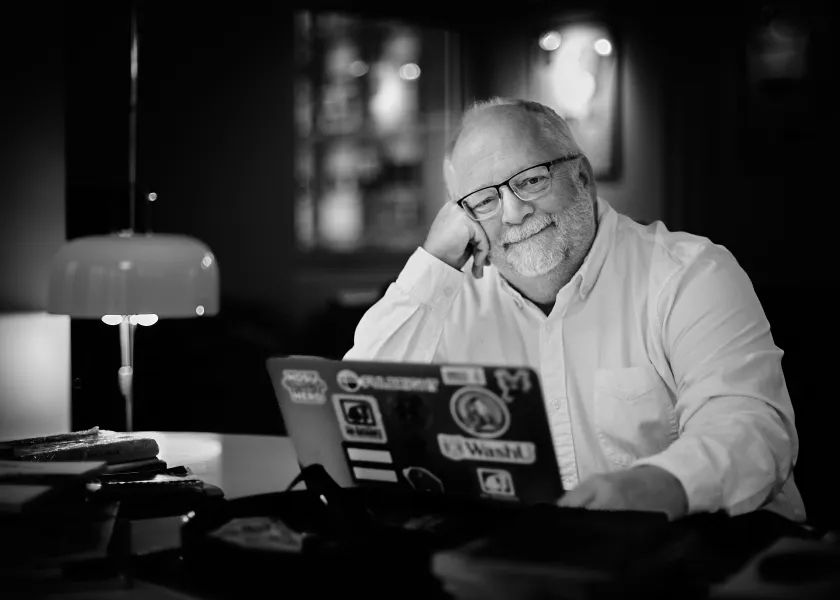
John Cox, NDSU professor of history, won a prestigious publication grant from the Serbian Ministry of Culture of the Republic for his translation of “The Children of Neverville,” a novel authored by Miloš K. Ilić.
This is the fourth publication grant Cox has received from the Serbian Ministry of Culture.
“Getting one of these awards in the annual competition means that the book has already been recognized as significant within Serbia; it's kind of an award for the book itself, a stamp of approval — not in the ideological sense but in the critical sense,” Cox said. “This recognition can then be used to increase the book's profile, or the author's, in English-speaking countries.”
Cox is no stranger to translating books, and The Children of Neverville is the 20th full-length book he has translated for publication.
“Professor Cox continues to be an outstanding researcher who not only broadens accessibility to foundational works, but shows that NDSU and its scholars are international assets,” said Dennis Cooley, Professor and Chair of the School of Humanities at NDSU.
Cox earned a Ph.D. in history and began writing more traditional history. He started translating primary sources and essays in the 1990s to utilize the several languages he studied in college. However, after receiving tenure and following the 9/11 attacks, Cox began to use literary works as the primary source of his studies in intellectual history. “I decided to make use of both my history skill set and my languages on the same projects, as much and as often as I could,” he said.
Cox has been a follower of Ilic’s work since 2014 and the two have become friends. Ilic has mainly written plays and poetry in the past, but when Cox saw that the Children of Neverville novel published, he jumped at the opportunity to translate.
“It is not a political or a historical work, but it is about social problems, including violence among young people,” Cox said. “The book's pace and conversations are masterful, because it almost reads like the movie it should become someday. The characters are sketched realistically, simply, memorably, and often, a bit endearingly. I wanted to translate it because it is very well written and addresses a number of contemporary themes relevant to all of us.”
The selection of which works to translate is a critical part for Cox, as it is a thorough and careful process.
“I don't translate any text that I do not love. Since I am going to make research or pedagogical use out of the translated works, I have every motivation to choose deliberately,” Cox said. “When I find a book that I'd like to ‘smuggle into English’ and make part of discussions in our part of the world, I read it very thoroughly — twice. Before I translate a word.”
Cox said it usually takes him a year to translate a book, and he doesn’t always start at the beginning of the novel because the products of an early phase of a big translation often need to be reworked later.
With teaching and academic duties at NDSU, much of the translating is done during the summer or during breaks. “I think translation works best, for me anyway, when I do it for 30 minutes or an hour or two a day. More than that, and it feels rushed to me,” Cox said.
These days, Cox primarily works with Serbian texts, though Serbian is closely related to Bosnian, Croatian, and Montenegrin. It is sometimes considered part of a pluricentric language known as BCMS, which refers to the initials of the four official state languages. In addition to translations from Bosnian, Croatian and Montenegrin, Cox has also worked on books from Hungarian, German and Slovene. The opportunity to study a wide range of languages in college and graduate school, coupled with time spent living in Europe for several years, has contributed to this diverse linguistic expertise.
“Dr. Cox’s training in both history and languages has allowed him to occupy a very special place in the arts and humanities,” NDSU interim vice president for research and creative activity Heidi Grunwald said. “Translation is not merely a linguistic bridge; it is a gateway to universal empathy. By bringing beautiful, creative works to English readers, he is not just sharing text; he is expanding NDSU’s global reach, enriching our lives and providing people around the globe the opportunity to glimpse life in other countries and eras. We are extremely proud of his work.”
Cox said that books are not only about self-fulfillment; they are also about sparking ideas for public discussion and interest.
“Translating novels is important because it puts unexpected works into circulation in spaces and places close to us,” Cox said. “Not everyone has the time or money to visit Serbia or Hungary, for instance. But we can explore through books, if we are willing to let them bring the world to us.”